





 Portuguese
  English
  Spanish
  5 min of reading
  1 comment


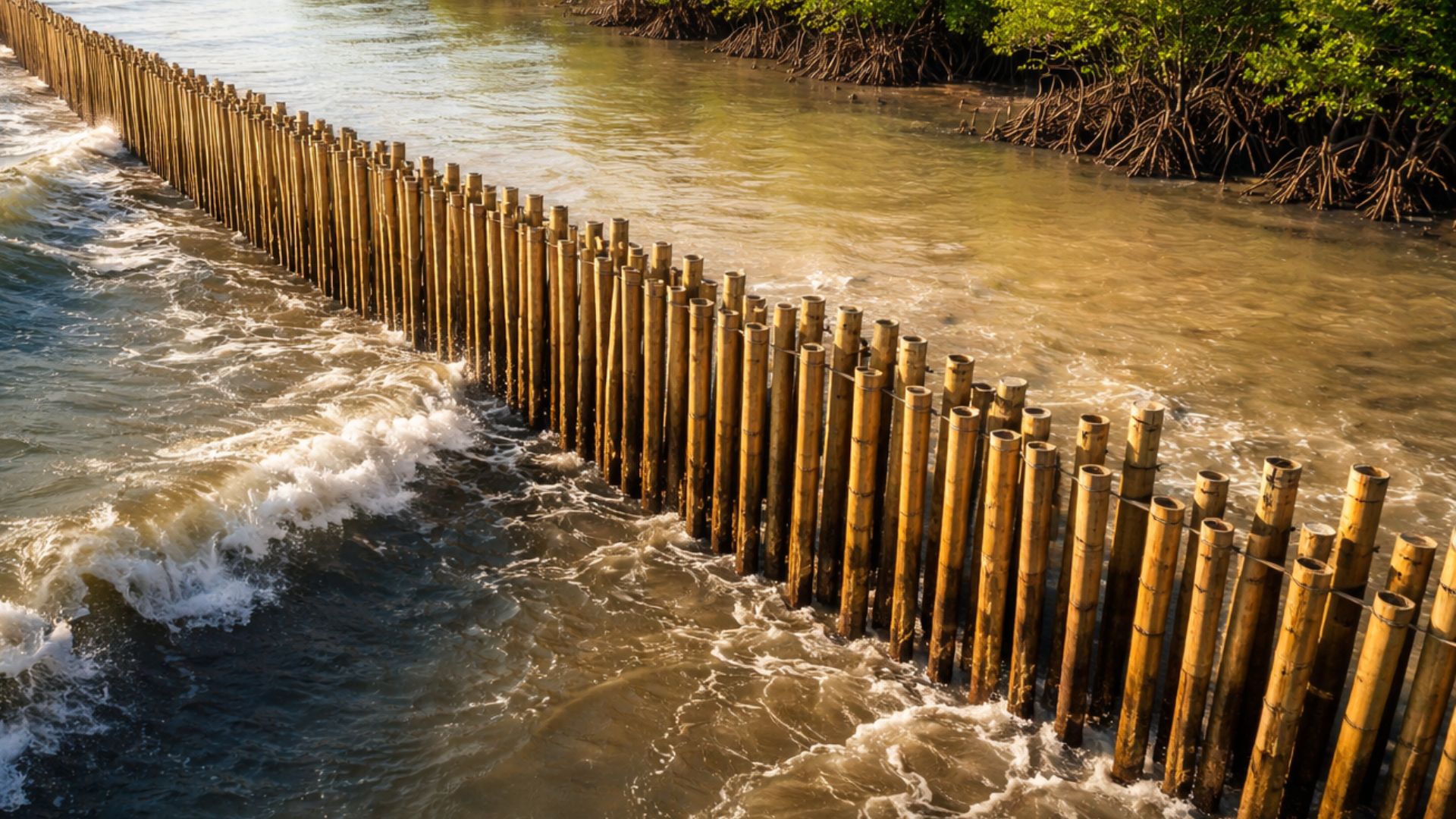


Simple Bamboo Structures in Shallow Water Help to Reduce Wave Force and Retain Sediments on the Indonesian Coast, Creating Conditions for the Mangrove to Regrow and Protect Communities. Project in Demak Combines Coastal Engineering and Ecological Restoration, with Documented Results.
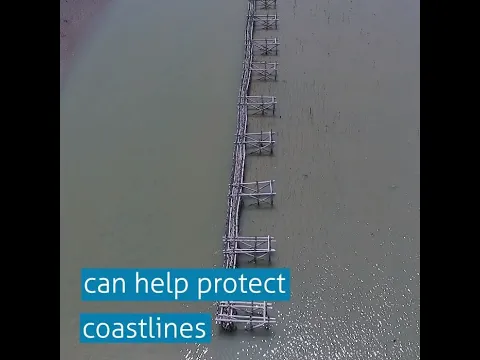
On the northern coast of Java, Indonesia, a stretch of shoreline that had been losing ground to the sea began to invest in a defense that appears improvised at first glance, but follows recognized principles of coastal engineering and ecological restoration: permeable structures made with bamboo and natural materials, assembled in shallow sections, to reduce wave energy and retain sediments.
The goal is simple and straightforward: stabilize the physical environment so that mangroves can reestablish themselves and, with them, restore a living barrier capable of protecting communities, productive areas, and coastal infrastructure.
Coastal Erosion in Demak and the Loss of Natural Protection
The case gained international attention in the Demak district of Central Java, where erosion and recurring flooding advanced over former aquaculture areas, roads, and homes.
-
Church from 1888 becomes a mansion of over 330 m² in Canada after a renovation of R$ 3.4 million and is eventually sold for nearly R$ 4.3 million.
-
How an innovative city combines high technology, well-being, and sustainability to become the largest reference in clean energy on the planet.
-
Couple buys 1846 church in ruins for R$ 660,000, invests R$ 3.2 million in renovations, transforms it into a millionaire mansion, and even preserved a historic cemetery with over 300 graves.

-
He started running at 66 years old, broke records at 82, and is now a subject of study for having a metabolic age comparable to that of a 20-year-old, in a case that is intriguing scientists and inspiring the world.


The region presents conditions common to many tropical coastlines: muddy, fine soil, tidal influences, seasonal winds, and a historically protected coastline by belts of mangrove.
When this natural protection is diminished, the system loses stability, and wave force encounters less resistance before reaching inland.
Building with Nature and Permeable Bamboo Dikes
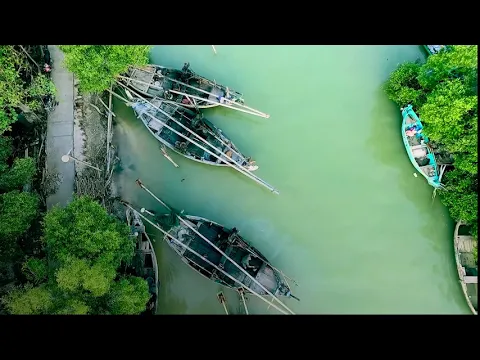

It was in this scenario that the so-called “Building with Nature” began to be applied as a practical response to coastal collapse.
Instead of relying solely on rigid containment structures, the proposal combines low-complexity intervention with natural processes already present on-site.
The logic is to create a zone of calmer waters, where suspended mud and sand particles can settle again, raising the bottom and reconstituting a favorable platform for mangrove seeds and seedlings to survive.
How Permeable Structures Work in Shallow Water
Permeable dikes do not function like a wall.
They are assembled like rows of bamboo stakes, often filled with branches, twigs, and plant materials, forming a “frayed” barrier.
Water continues to flow through, but loses speed and some of the energy it would carry to the coast.
In practice, this loss of energy reduces the waves’ ability to remobilize fine sediment.
With the slower and less turbulent flow, the mud settles, the soil level begins to rise behind the barrier, and the environment becomes more stable for mangrove regeneration.
Why the Mangrove Does Not Regrow Itself in Very Eroded Areas
Demak is an emblematic example because the erosion there does not have a single cause.
The region is described by institutions involved in the project as an area marked by land loss, coastal flooding, and associated environmental degradation, among other factors, such as land-use change, conversion of mangroves to aquaculture, and physical pressures that disrupt the balance between sediment deposition and removal.
In many coastal areas, the coastline has become more vulnerable precisely where there used to be a “belt” of mangrove capable of cushioning waves and keeping the soil consolidated by dense roots.
However, the restoration of mangroves is not automatic when the land is already eroded.

In environments where the bottom has become too low and wave energy remains high, planted seedlings may be uprooted, and seeds may not be established.
Therefore, bamboo structures serve as the first step of a process: creating a window of physical stability, enough time for the mangrove to fulfill its role as an “ecological engineer” and begin to keep sediment in place on its own.
Sediment Recovery and Mangrove Regeneration
The project described by partner organizations in Demak also includes actions beyond the waterline.
The publication by Wetlands International on the landscape-scale implementation points out that, along with the permeable structures for sediment retention and coastal stabilization, there was an effort to improve aquaculture practices, with the intention of reducing pressures affecting the coastline and increasing local economic viability.
This component is treated as part of the same problem: when the coast collapses, land loss directly affects nurseries, access routes, public services, and the income of families dependent on the coastline.
Throughout the documented implementation, mangrove regeneration has been encouraged along a broad stretch of coast.
Wetlands International records that the approach sought to favor natural regeneration over about 20 kilometers, with interventions and lessons learned between 2015 and 2021.
The strategy was supported by partnerships with research and engineering institutions, as well as agencies of the Indonesian government, specifically to adjust the design of the structures to local conditions of tide, waves, and sediment availability.
Coastal Engineering: Dissipate Energy Without “Rebound” of Waves
From a technical standpoint, the major advantage of permeable structures is that they dissipate energy without creating a strong “rebound” of waves, common in certain rigid barriers that reflect water.
In muddy coastlines, reflection can intensify turbulence and hinder sediment accumulation.
By allowing water to pass, the permeable dike seeks to reduce hydrodynamic stress without completely interrupting circulation, which helps maintain ecological processes and minimizes impacts on coastal fauna that use shallow areas for shelter and feeding.
Mangroves as a Living Barrier and Long-Term Protection
The return of the mangrove changes the level of protection.
The aerial and subterranean roots increase the roughness of the environment, slow currents, filter particles, and enhance sediment retention, transforming the “provisional defense” into a more durable natural system.
At the same time, mangroves are recognized for their role as nurseries for marine species and for storing large amounts of carbon in the soil, adding environmental relevance to a project initially motivated by coastal safety.
The experience in Demak also became a showcase for another reason: it was organized as a collaborative effort among environmental organizations, technical consortia, universities, and Indonesian ministries related to the sea and infrastructure.
Wetlands International describes this articulation as a central part of the project, including training and knowledge exchange actions aimed at expanding the adoption of the method in other vulnerable areas.
In a coastline where millions of people live from activities near the sea, the promise of a relatively lower-cost solution compatible with coastal ecosystems attracts the attention of local governments and researchers.
Still, the method is not presented as an instant “trick.”
The project’s own descriptions emphasize that it depends on specific conditions, such as sufficient sediment supply and design suited to local waves, in addition to maintenance of structures and management of human activities that continue to influence the coast.
The central idea, however, remains: when erosion is exacerbated by the loss of a natural barrier, rebuilding the conditions for that barrier to return can be more efficient than trying to replace nature with concrete.





Vcs usar sacos de areias pedras para fazer barreiras nas varzeas mangues aguas praias mar ou rios colocar tubos canos para dar aguas vazantes os excesos das aguas nas lagoas pantanos varzeas mangues pantanos rios lagoas lagos