





 Portuguese
  English
  Spanish
  5 min of reading
  0 comments



Discover How Infrastructure Technology Is Behind the Connections That Drive Your Routine and Propel Business in the Digital World.
We live in an era where everything seems to happen at the touch of a button. We order food, buy clothes, study remotely, and work from home with ease.
However, behind this modern reality, there exists an invisible foundation that makes it all possible: infrastructure technology.
It is so present in our lives that often it goes unnoticed.
-
Government enacts new law: paternity leave increases from 5 to 20 days with gradual increases until 2029, and Social Security pays the paternity salary; companies no longer bear the absence cost, estimated at R$ 5.4 billion.

-
End of the 1-hour lunch break in the CLT? Current labor law maintains the break, allows for negotiated reductions, and defines rules for working hours and home office in Brazil.

-
Employee Fired After Accumulating 114 Days of Medical Leave in One Year, Labor Court Upholds Company’s Decision

-
Employee Fired While Treating Depression Wins in Court and Vale Is Required to Rehire Him Following Decision Based on the CLT and INSS Benefits


Nevertheless, this set of systems, networks, equipment, and solutions underpins the functioning of the current world—both in personal spheres and in business.
The Emergence of Infrastructure Technology
To understand the impact of this technology, it is necessary to go back in time and observe how it all began.
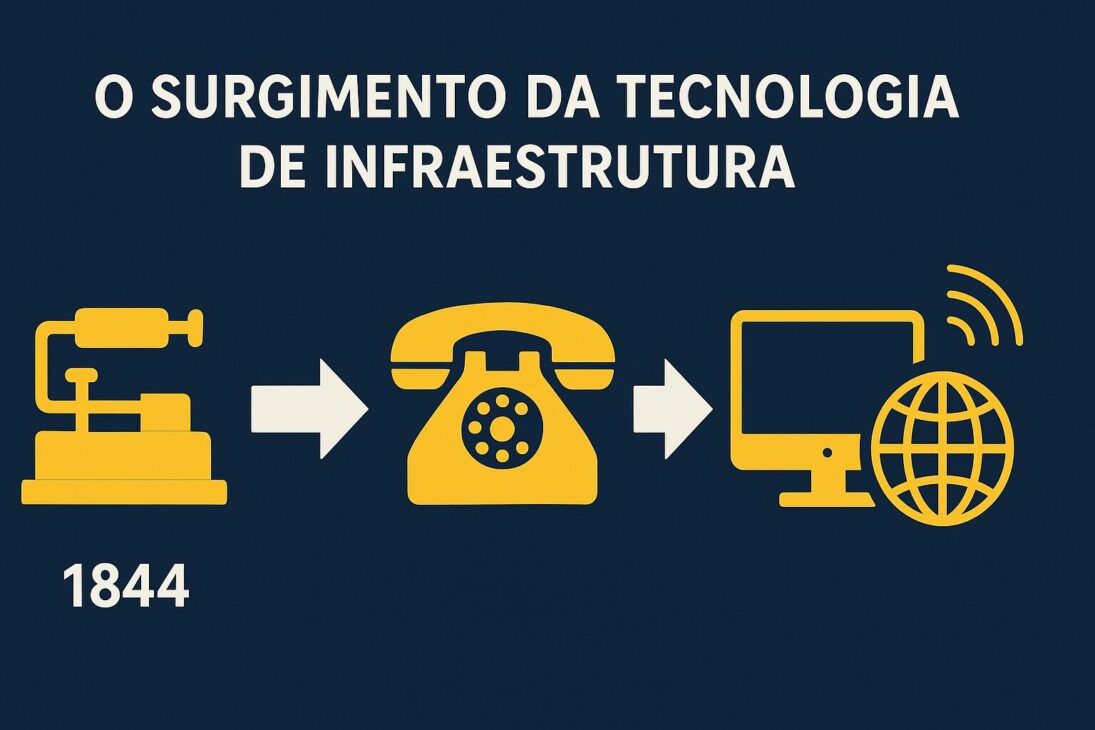
Technological infrastructure, as we know it today, is the result of decades of advancements, starting with the first attempts at long-distance communication, such as the telegraph in the 19th century.
In 1844, inventor Samuel Morse conducted the first successful test with the telegraph, allowing messages to be transmitted over distances.
This was a historical milestone that inaugurated the era of telecommunications and communication infrastructures.
According to the Museum of the History of Science in Oxford, the invention of the telegraph was one of the first steps towards the creation of communication networks, which would later give rise to the internet.
Over time, other fundamental innovations emerged: landline telephony, electrical transmission lines, communication satellites, the advent of computers, and later, the internet.
Each of these evolutions required the creation of new structures and systems to function.
According to the Massachusetts Institute of Technology (MIT) website, in the early 2000s, the internet became a global communication medium, with the popularity of broadband connection, transforming the way the world connected.
The Impact of the Internet and Computing in Recent Decades

In the 1990s, the popularization of personal computers and the expansion of communication networks gave rise to the digital revolution.
According to the U.S. government, in a report published by the National Telecommunications and Information Administration (NTIA) in 1999, the massive adoption of the internet made infrastructure technology an essential component for modern societies.
From the moment computers began to be connected in networks, especially with the popularization of the internet in the 1990s and 2000s, infrastructure technology gained even greater importance.
It became the basis for almost all human activities in society.
According to the report from the World Economic Forum (2020), all these elements work together to ensure that data circulates safely and efficiently.
In fact, this is not something restricted to large technology companies.
In reality, small businesses, public agencies, schools, hospitals, and even our homes are impacted by this universe.
In companies, for example, infrastructure technology enables management systems to function properly, customer data to be stored securely, online sales to occur without interruption, and teams to work collaboratively, even remotely.
The Constant Presence in Personal Life and Services

Moreover, infrastructure technology is deeply intertwined with our daily lives.
In the field of education, for instance, digital transformation has been driven by technological infrastructure.
Thus, distance learning platforms, virtual libraries, hybrid classrooms, and interactive resources require powerful servers, stable networks, and protection systems against cyber attacks.
This shows how education also relies on this technological foundation to offer access to knowledge in a more democratic and effective way.
According to the UNESCO website, in 2020, over 1.5 billion students worldwide were affected by the COVID-19 pandemic, with education being transferred to digital platforms at an unprecedented speed.
This change further highlighted the dependence on infrastructure technology.
Undoubtedly, the presence of an efficient technological infrastructure makes all of this possible, providing a more inclusive and accessible education.
Similarly, in people’s daily lives, infrastructure technology is present in simple actions.
Like sending a text message on your phone, watching a movie via streaming, paying a bill through your bank app, or using GPS.
All these tasks involve communication between various devices and servers, real-time data processing, and the use of technologies.
Such as cloud computing and mobile networks—which in turn depend on solid and well-planned infrastructure.
Digitalization and Growth of Global Infrastructure
It is important to highlight that this structure is not fixed or immutable. It constantly evolves to meet the needs of society.
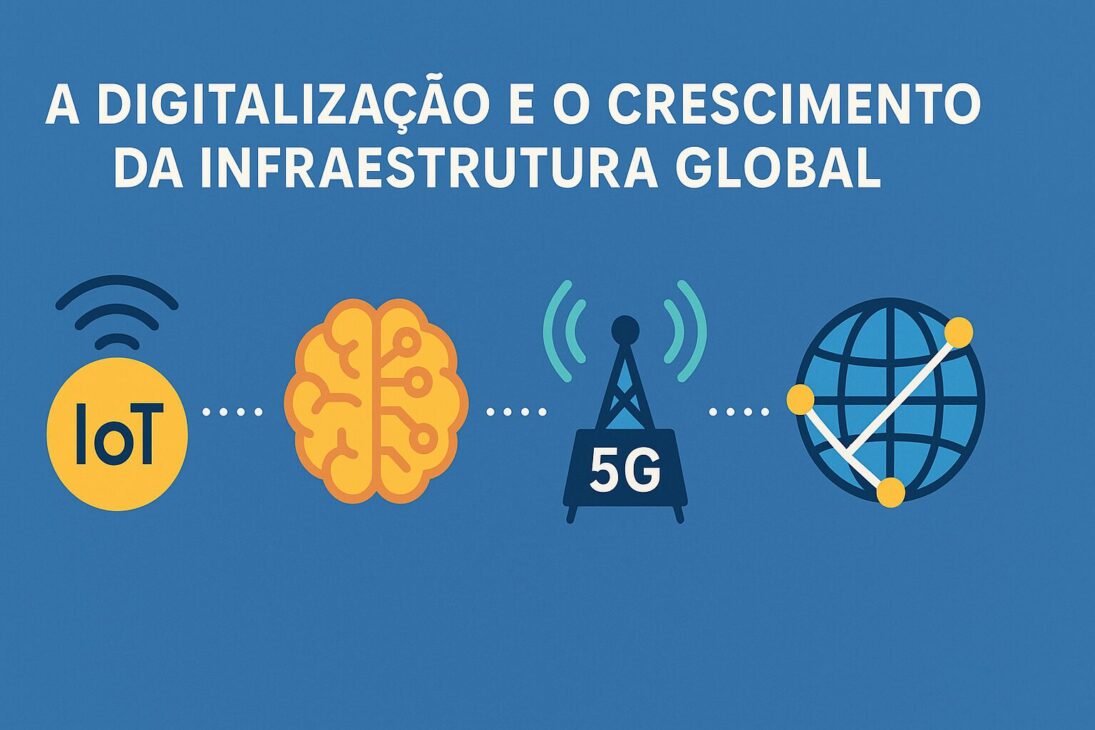
With the advent of the Internet of Things (IoT), artificial intelligence, and 5G, the demand for even more efficient, faster, and secure infrastructure is becoming increasingly greater.
According to the International Telecommunication Union (ITU), 5G began to be implemented in several countries in 2019, promising to significantly improve connection speed and data transmission capacity.
This means that new investments are necessary, both from the public and private sectors, to ensure that everyone can enjoy the benefits of digital transformation.
Today, many data centers already use renewable energy sources and intelligent cooling systems to reduce environmental impact.
Another important point is cybersecurity. Today, data protection is a priority, as information is increasingly valuable and vulnerable.
The protection of technological infrastructure against hacker attacks and data leaks requires a constant investment in new security technologies, such as encryption, firewalls, and intrusion detection systems.
When we look to the future, it is possible to foresee that technological infrastructure will be even more integrated into our daily lives.
Homes will be connected to smart systems, cars will communicate with traffic signals, cities will be based on real-time data, and new ways of interaction between humans and machines will emerge.
However, for all this to work efficiently, the foundation needs to be solid—and that foundation is precisely infrastructure technology.
The Importance of Recognizing What Sustains the Digital World
Therefore, understanding the importance of this topic is essential. This is not just about cables, servers, and equipment.
We are talking about an invisible pillar that supports the modern world, enabling opportunities for economic growth, improving the quality of life, and transforming the way we relate to knowledge, work, and people.
Whether you are an entrepreneur looking to optimize your processes or a student curious about the future of technology:
It is essential to recognize the vital role of technological infrastructure.
According to the Organisation for Economic Co-operation and Development (OECD):
Digital infrastructure has been one of the main factors contributing to growth and innovation in recent years.
It is behind everything—and the better structured it is, the more prepared society will be for the challenges and opportunities of the present and the future.









Seja o primeiro a reagir!