





 Portuguese
  English
  Spanish
  5 min of reading
  3 comments


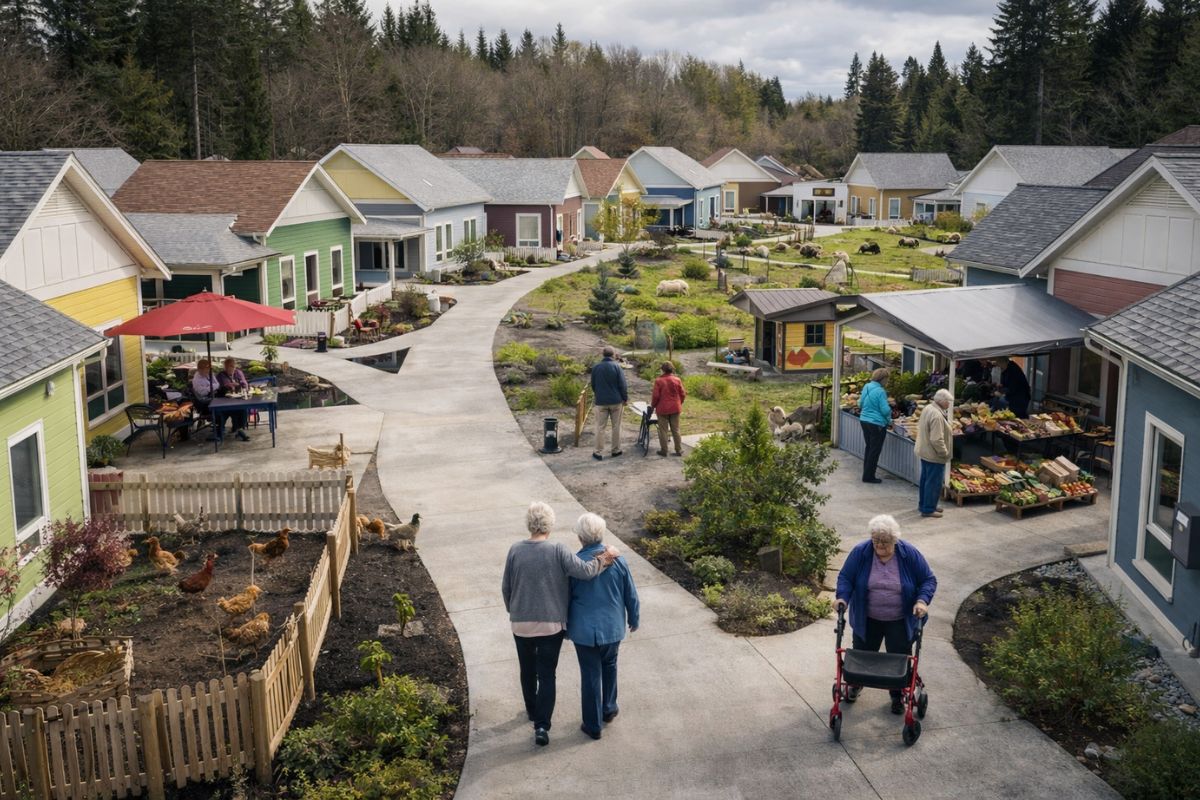


In Canada, The Village of Langley Proposes Freedom with Safety for People with Dementia, Bringing Together Housing, Commerce, Activities, and Trained Staff in a Controlled Space; Inspired by The Netherlands, The Initiative Highlights Quality of Life Gains, Access Limits, and An Urgent Debate on Public Funding for Future Care.
In Canada, the opening of the first planned village for people with dementia in Langley (British Columbia) has placed a sensitive question at the center of the debate: is it possible to provide continuous care without turning daily life into a hospital routine? Instead of closed hallways, the proposal combines homes, gathering spaces, commerce, and free movement within a protected perimeter.
The discussion has grown because the model attempts to balance two demands that, for decades, seemed incompatible: clinical safety and real autonomy. While expanding dignity and socialization, the experience unveils a crucial point for the future of care: who pays this bill and how to make the format accessible beyond isolated cases.
How It Works in Practice: The Canadian Village for Dementia

The structure in Langley was designed to resemble a common neighborhood. In an area of about five acres, residents live among colorful homes, activity areas, a farm, and a community center, with the freedom to enter and exit indoor environments at their own pace. The central logic is simple and powerful: the more familiar the space, the less the feeling of institutionalization.
-
Friends have been building a small “town” for 30 years to grow old together, with compact houses, a common area, nature surrounding it, and a collective life project designed for friendship, coexistence, and simplicity.

-
This small town in Germany created its own currency 24 years ago, today it circulates millions per year, is accepted in over 300 stores, and the German government allowed all of this to happen under one condition.

-
Curitiba is shrinking and is expected to lose 97,000 residents by 2050, while inland cities in Paraná such as Sarandi, Araucária, and Toledo are experiencing accelerated growth that is changing the entire state’s map.

-
Tourists were poisoned on Everest in a million-dollar fraud scheme involving helicopters that diverted over $19 million and shocked international authorities.



Another key principle is “freely circulating” with perimeter protection. Instead of visible blockages at every turn, safety is built into the design of the environment. This reduces the feeling of confinement and tends to alleviate episodes of agitation associated with the frustration of being unable to move. It is not about the absence of control; it is intelligent environmental control that is less invasive and more compatible with everyday life.

The staff is also part of the architectural and social concept. Professionals trained for cognitive decline operate without the traditional hospital aesthetic, reinforcing the idea of normality. The care stops being merely surveillance and becomes mediation of daily routines: guiding, accompanying, preventing risks, and sustaining bonds, without erasing the identity of those living there.
From Dutch Reference to Canadian Context
The direct inspiration comes from The Netherlands, where a village for people with dementia was opened in 2009 with the proposal to replace the institutional logic with a community living environment. The concept originated from a direct critique of the closed model: people with dementia remain people, with histories, preferences, and a need for social participation.
In this Dutch model, residents live in dozens of homes and benefit from neighborhood infrastructure, including a restaurant, market, and theater. The proposal combines housing, care, and communal living on a human scale. Socialization is not an extra activity; it is part of daily treatment.
There is also a significant difference in funding. In the Dutch case, the model receives public subsidy and operates at a cost comparable to traditional institutions. In Canada, the Langley project arises without direct government subsidy for the residents, completely changing the social reach of the initiative and broadening the discussion about public policy.
How Much It Costs, Who Can Access, and Where The Biggest Bottleneck Emerges

Today, the village of Langley accommodates about 75 residents. The monthly cost generally ranges between 8,000 and 10,000 Canadian dollars, varying according to the level of care needed. This positions the service at a high expenditure level for families and imposes a concrete barrier for a large portion of the population.

This financial point is not peripheral; it defines the real extent of possible transformation. Without a funding design, innovation becomes an exception. Even if the model shows quality of life gains, its scale remains limited when access depends almost exclusively on the ability to pay.
At the same time, the Canadian experience serves as a social policy laboratory: revealing what is feasible from a care perspective and what still requires public decision to become a system, not just a showcase. The debate shifts from “does the model work?” to “how to democratize what works?”.
Why Experts Speak of a Paradigm Shift in Care
The backdrop is demographic and urgent. More than 55 million people live with dementia worldwide, with projections for continuous growth in the coming decades. In Canada, the estimate cited for 2023 was nearly 700,000 people living with dementia, projected to approach 1.7 million by 2050. The pressure on long-term care has already begun.
Gerontology experts argue that the traditional long-term model was designed around a logic of intensive care centered on hospital structure: long hallways, aligned rooms, and large standardized common areas. This design responds to operational needs but does not always address the emotional and social realities of those experiencing cognitive decline.
The change proposed by villages and similar initiatives is to shift toward person-centered care, not building-centered care. This includes purposeful routines, supervised autonomy, opportunities for social interaction, and trained staff to interpret behavior, not just contain it. It is about replacing the control paradigm with the possible life paradigm.
What This Model Resolves Now and What Still Needs to Be Proven at Scale

There are clear signs of gains in dignity, belonging, and continuity of identity. When residents maintain access to common spaces and daily choices, the care experience tends to become less punitive and more humane.


Stories such as that of Alan, once an adventurer and later impacted by cognitive loss, show that the possible autonomy still matters, even when total autonomy no longer exists.
There is also symbolic and clinical value in simple activities: walking, participating in classes, visiting farm animals, moving around the neighborhood without the sensation of imprisonment. Small daily acts become therapeutic tools when integrated into an environment that reduces stress and preserves emotional bonds.
However, there are objective limits: high costs, limited availability, the need for trained professionals, and dependence on budget decisions. The advancement of the model will require consistent evaluation of results, regulatory adaptation, and, above all, a pact on funding. Without this, the future of care may change in discourse but not in the lives of the majority.
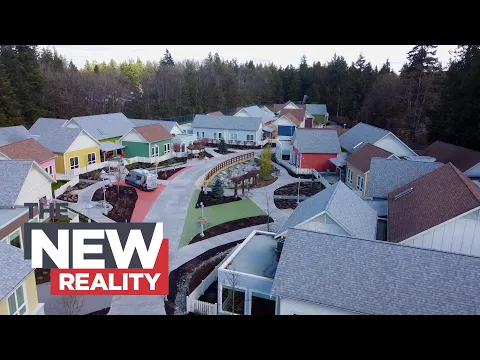

The Canadian experiment opens a difficult and inevitable question for families, managers, and professionals: if we already know that more human environments can improve the experience of those living with dementia, what is lacking to transform this exception into a scalable policy?
If this model were to come to your city, what change would you consider most urgent to make it truly work: public funding, team training, or adaptation of existing spaces? And, instead of a family facing a difficult decision, would you prioritize maximum traditional safety or monitored freedom with more social life?










Mtu Bom, isso deveria ser obrigatório em todos os países. Deixaria de haver tantos idosos nas mãos de pessoas erradas e mts abandonado.
Muito bonito e aprazível esse sistema de vila p pessoas idosas c demência.Seria bom se os órgãos públicos aqui no Brasil optassem modelos assim,TB p idosos sãos,q buscam paz e tranquilidade nos últimos anos de vida.Adorei isto.porem,pelo visto não e acessível p todos né?E preciso ter condições financeiras p isto.Mas poderiam fazer modelos de acordo c as condições de cada pessoa.O importante e ter acessibilidade a serviços dignos nos últimos anos de vida.
É maravilhoso!
Saber que existem mentes brilhantes, coração gigante, amores incondicionais.
Merecem uma vida digna!
Parabéns!