





 Portuguese
  English
  Spanish
  5 min of reading
  0 comments


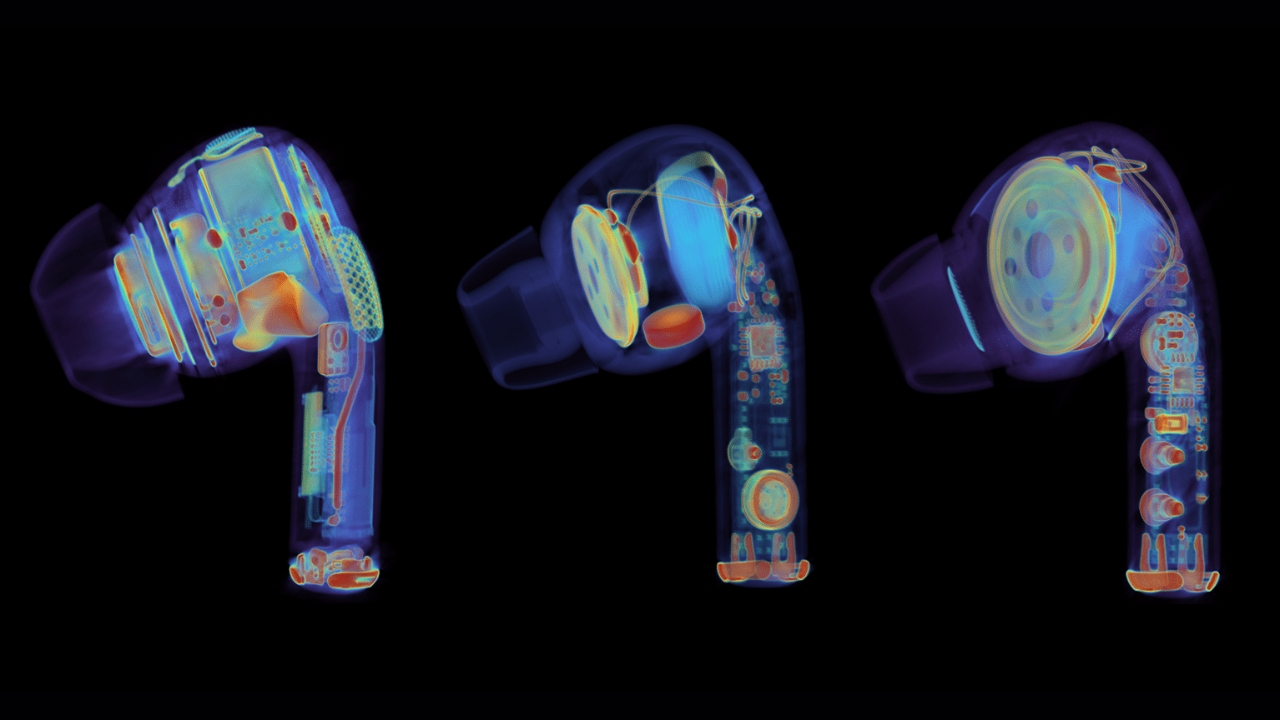
Industrial Tomography Revealed Shocking Differences Between Original and Fake AirPods. Counterfeits Hide Improvised Batteries, Loose Parts, Artificial Weight, and Poor Internal Engineering That Consumers Never See
The difference between an original AirPod Pro and a counterfeit rarely appears at first glance. White casing, magnetic case, a fit similar to Apple’s, and nearly identical weight. But behind this almost perfectly replicated appearance lies a radically different internal universe, impossible to see with the naked eye.
It was exactly this universe that the technology company Lumafield decided to explore by using industrial tomography to scan side by side a pair of genuine AirPods Pro and two counterfeit pairs. The result garnered international attention, not only for the clarity of the images but for what they reveal about Apple’s actual engineering and the shortcuts taken by the copies.
Industrial tomography works like a high-precision “3D X-ray.” The technique allows for visualization of everything hidden inside a product without needing to disassemble it and without damaging any components.
-
Scientists drilled nearly 8,000 meters into the ocean floor above the fault that caused the 2011 tsunami in Japan and discovered that a layer of clay 130 million years old was responsible for making the wave much worse than any model had predicted.

-
Thousands of years after causing the largest eruption of the Holocene, one of the world’s largest supervolcanoes is rebuilding itself beneath the sea south of Japan, receiving new magma and alarming scientists with its transformation.

-
China has activated a magnet 700,000 times more powerful than the Earth’s magnetic field that operates for over 200 consecutive hours while consuming little energy, and now the world wants to know what Beijing plans to do with this technology in 2026.

-
Mercado Livre has started selling medications in Brazil with delivery in up to 3 hours, and the project that launches in São Paulo may expand to the entire country, transforming the way millions of Brazilians buy medicines.


In the case of the AirPods, this meant observing the battery, microphones, circuits, logic board, antenna, and even the magnetic system that allows for the fit with the case. An analysis impossible for the average consumer, but revealing about the true gap between original and counterfeit.
Inside the Original AirPod: Miniaturization, Precision, and Silent Engineering
The scanned images from Lumafield show why an Apple product costs more and delivers more. Inside the original AirPods Pro, there is practically no empty space. Every millimeter is occupied by circuits, sensors, antennas, microphones, and a specially molded circular battery designed to fit into the rounded body of the earbud.
This custom battery, in a coin cell shape, is one of the first signs of high-level engineering. It allows for greater stability, lower internal vibration, and better weight distribution, which directly impacts comfort and durability of the device.
The internal circuit is also impressive. Rigid and flexible boards connect precisely, utilizing space efficiently and securely. Apple uses strategically distributed microphones, with each capsule protected by suitable materials to prevent interference and noise. Even the internal magnets, which ensure the famous “click” when placing the earbud in the case, are symmetrically positioned to balance weight and fit.
It’s an interior that resembles more of a medical device than an everyday audio accessory.

The Counterfeits: Improvised Batteries, Artificial Weight, and Loose Circuits
The scanning of the counterfeits reveals a very different scenario. Instead of a custom circular battery, what appears is a rectangular pouch battery, simply placed inside the internal space. These batteries, cheaper and easier to manufacture, are left loose, pressed only by the outer casing. In some analyzed models, it was possible to see leftover space and even improvised foam padding to prevent the battery from moving around.
Another striking difference is the number of microphones. While the original uses three independent microphones that work together for active noise cancellation, many counterfeits have only one poorly positioned microphone, lacking isolation and precision. As a result, noise cancellation is almost nonexistent, and sound quality falls far below the standard advertised on packaging.
The internal circuitry of the fakes also shows exposed wires, rough soldering, and loose parts. In some models, Lumafield identified the use of small pieces of metal inside the earbud. They are not electronic components: they are weights used solely to simulate the real weight of the original product. The goal is simple: to deceive the consumer’s perception when holding the earbud for the first time.

The Charging Case: Another Uncomfortable Revelation
The comparison between the original AirPods Pro case and the counterfeit cases is as revealing as that of the earbuds. The original shows two internal batteries, symmetrical magnets, a wireless charging coil, and well-protected circuits. The counterfeit case, on the other hand, usually contains a single battery and poorly fitted parts. In cheaper versions, the charging coil simply does not exist, and the magnetic compartment is improvised with magnets glued to plastic.
The presence of artificial weights in the cases also appears in counterfeit models. They are metal bars with no technical function, placed just to give the sensation of a robust and well-constructed product. It’s the engineering of illusion replacing real engineering.

Why This Matters to the Brazilian Consumer
The Brazilian market is flooded with counterfeit AirPods sold on e-commerce platforms, marketplaces, and even physical stores. In many cases, the products reach the consumer accompanied by high-quality packaging, fake seals, cloned serial numbers, and even manuals identical to Apple’s. For those lacking technical knowledge, identifying a fake becomes practically impossible without opening the product or using advanced equipment like those used by Lumafield.
But this internal difference matters. The pouch batteries used in counterfeits have lower durability and a higher risk of thermal wear. Exposed circuits increase the chance of premature failures. Noise cancellation practically does not exist. Sound quality is inferior. And the lifespan is short. For those who pay believing they are getting an original, the loss can be significant.
Industrial tomography makes clear what the eyes cannot see. What appears the same on the outside can be completely different on the inside.
The Advancement of Counterfeiting and the Technological Challenge
Lumafield’s study also exposes a concerning phenomenon. Counterfeiting is no longer artisanal. The copies are becoming increasingly sophisticated on the outside and increasingly dangerous on the inside. Reverse engineering companies replicate the external design with millimeter precision but cannot reproduce the real miniaturization of an Apple product. For those working in retail, technology, or specialized journalism, this difference needs to be communicated.
Apple does not comment on internal engineering methods, but the public’s reaction to Lumafield’s study shows the impact of technological transparency. In a market filled with seemingly perfect replicas, seeing the inside of the original product serves as a reminder that quality is not an accident. It is engineering.
If you have ever owned a fake AirPod, you know exactly what we are talking about.








-

2 pessoas reagiram a isso.