





 Portuguese
  English
  Spanish
  4 min of reading
  0 comments


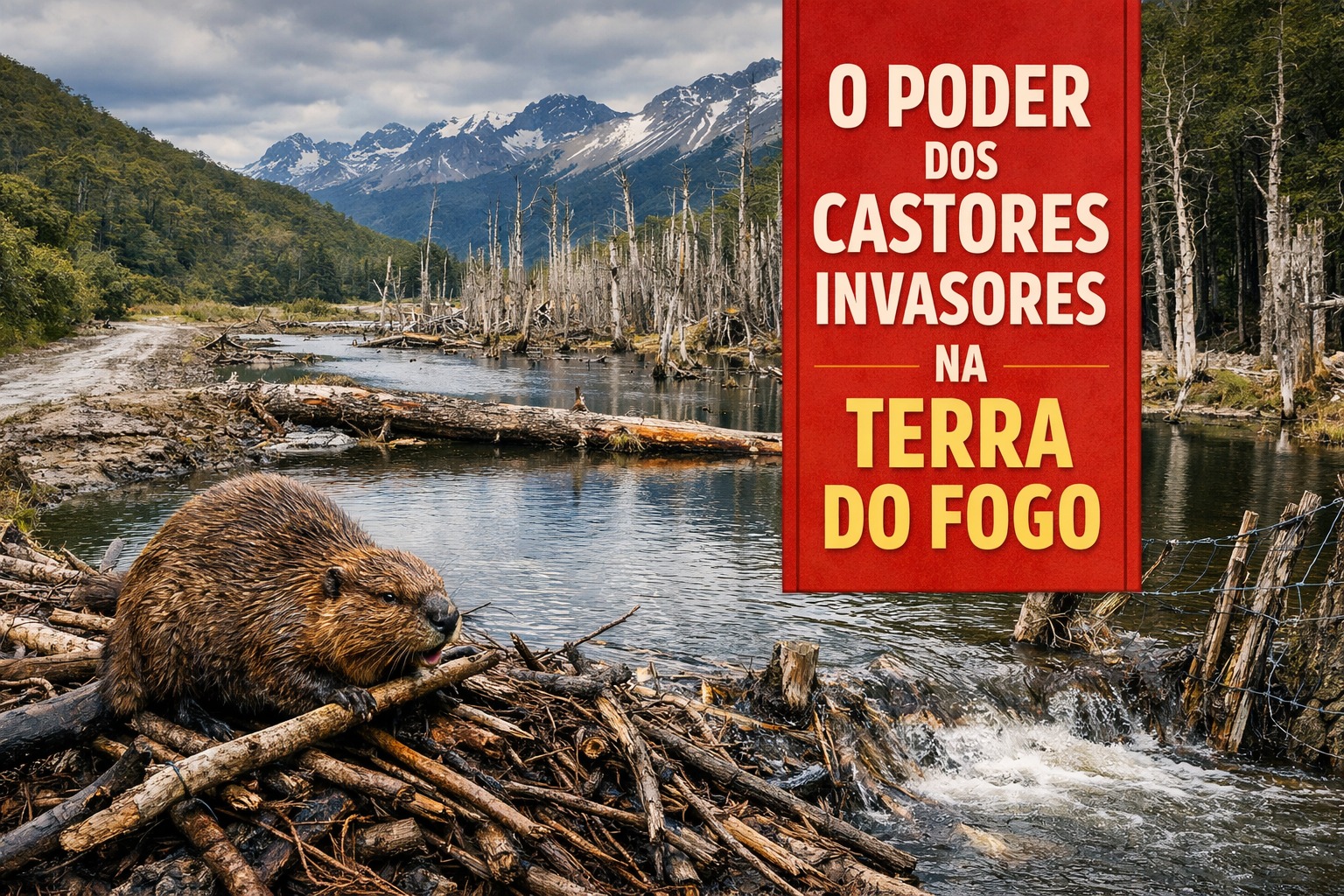
Introduced In 1946, The North American Beaver Spread Through Fireland, Causing Forest, Hydrological, And Economic Damage, Pressuring Argentina And Chile To Adopt Binational Eradication
The North American Beaver (Castor canadensis) became an invasive species in Fireland, in the southernmost part of Patagonia, after its introduction in 1946, causing environmental, economic, and forest damage, prompting binational actions between Argentina and Chile.
Since 1946, when 20 beavers were imported from Canada and released into Lake Cami, the population has spread across almost the entire island, with no effective control.
The initiative came from the Argentine government, which sought to establish a fur trade industry in the region, a strategy that proved unviable.
-
Scientists have captured something never seen in space: newly born stars are creating gigantic rings of light a thousand times larger than the distance between the Earth and the Sun, and this changes everything we knew about stellar birth.

-
Geologists find traces of a continent that disappeared 155 million years ago after separating from Australia and reveal that it did not sink, but broke into fragments scattered across Southeast Asia.
-
Samsung launches cordless vertical vacuum cleaner with up to 400W of suction and relies on AI to automatically recognize corners, carpets, and different surfaces.

-
The lost continent beneath Europe: separated from North Africa about 240 million years ago, comparable in size to Greenland, Greater Adria was crushed over 40 million years and left geological marks from the Alps to the Balkans.


With the economic failure of the original project, the animals remained free, multiplied rapidly, and began to profoundly alter the local ecosystems.


Uncontrolled Natural Expansion Of Beavers
The North American beavers found in Fireland an environment without natural predators capable of limiting their population growth.
In North America, bears and wolves play a fundamental role in controlling the species, a situation non-existent in the southernmost part of Patagonia.
An observer cited in discussions on the subject stated that anyone thinking of importing beavers should also import their natural predators.
According to a report by NPR in June 2011, about 200,000 beavers lived in the region at that time.
Another estimate mentioned in reports described a population exceeding 100,000 individuals, comparing the level of destruction to that of tractors passing through.
Direct Impacts On Forests And Rivers
The Tierra del Fuego National Park, in Argentine territory, is among the areas most threatened by the ongoing actions of invasive beavers.
The trees that have been protected for decades are being cut down, compromising natural landscapes that have been stable for thousands of years.
Beyond the island, the animals have already been recorded in the Brunswick Peninsula, in continental Chile, raising governmental concerns about future expansion.
According to the journal Nature, approximately 16 million hectares of native forest are under direct threat.
Unlike North American forests, many trees in South America do not regenerate after cutting, exacerbating environmental loss.
Dams, Floods, And Damages
The beavers build dams that flood extensive areas, drowning trees, riverside vegetation, and altering the natural course of rivers.
These structures create artificial freshwater lagoons, modifying the hydrological regime and accumulating sediments and organic matter.
The floods also affect roads, pastures, and agricultural areas, causing direct damage to infrastructure and local productive activities.
According to NPR, these damages have reached millions of dollars over the years, impacting human communities in the region.
Historical Alteration Of The Landscape
The ecologist Christopher Anderson, from the University of Magallanes, highlighted the magnitude of the changes caused by the invasive beavers.
For him, the modification of the forested area represents the greatest alteration at the landscape scale of the Holocene, a period of approximately 10,000 years.
This transformation affects entire habitats and triggers cascading effects on the sub-Antarctic ecosystem, which is considered fragile and poorly resilient.
Research indicates that local habitats have a low capacity for recovery after the damage caused by dams and deforestation.
Social And Economic Consequences
With the territorial expansion of beavers, human communities have started to face direct impacts on their daily lives and basic infrastructure.
Reports indicate flooding of roads, destruction of livestock fences, and damage to internet and cellphone poles.
It is estimated that only in Argentina these problems generate annual costs of US$ 66 million, an amount associated with constant maintenance and repairs.
These damages have reinforced the need for coordinated responses between the two countries that share the island.

Support For Eradication And Restoration
A survey conducted in 2017 with land managers and researchers in Fireland revealed significant support for the eradication of beavers.
Support for eliminating the species was stronger among managers, while researchers emphasized the restoration of the forest landscape.
Both groups agreed on the severity of the environmental problem and the need for structured and continuous actions.
Binational Policies And Cultural Challenges Regarding Beavers
Initially, authorities tried to encourage recreational hunting, revoking previously existing protection laws for the species.
The result was limited, as the pelts have low commercial value and financial incentives proved insufficient to mobilize hunters.
There is also a relevant cultural factor, as part of the local population views beavers as peaceful and friendly animals, not destructive invaders.
In 2008, Chile and Argentina approved Resolution 157/10, ending population control and determining the complete eradication of the species.
Studies by scientists from countries such as the United States and New Zealand indicated that eradication would be possible, but costly, estimated at 33 million dollars.
Methods And Operational Limits
Among the methods used are steel traps that kill the animal instantly, with rewards offered to participating individuals.
By 2011, the results were limited, leading authorities to announce plans involving professional hunters, dogs, helicopters, and boats.
These operations would advance on mobile fronts and would be accompanied by scientific studies to assess efficacy and collateral impacts.
In the Tierra del Fuego National Park, the priority in 2011 remained control, not eradication, for animal welfare reasons.
Despite the difficulties, scientific consensus indicates that the species’ permanence represents a continuous risk to the sub-Antarctic forest landscape, regional infrastructure, and the human population, keeping the issue as a binational environmental priority, even in the face of ongoing forest challenges.
With information from Wikipedia and other sources.





-

-

-

-

-

10 pessoas reagiram a isso.