





 Portuguese
  English
  Spanish
  5 min of reading
  0 comments


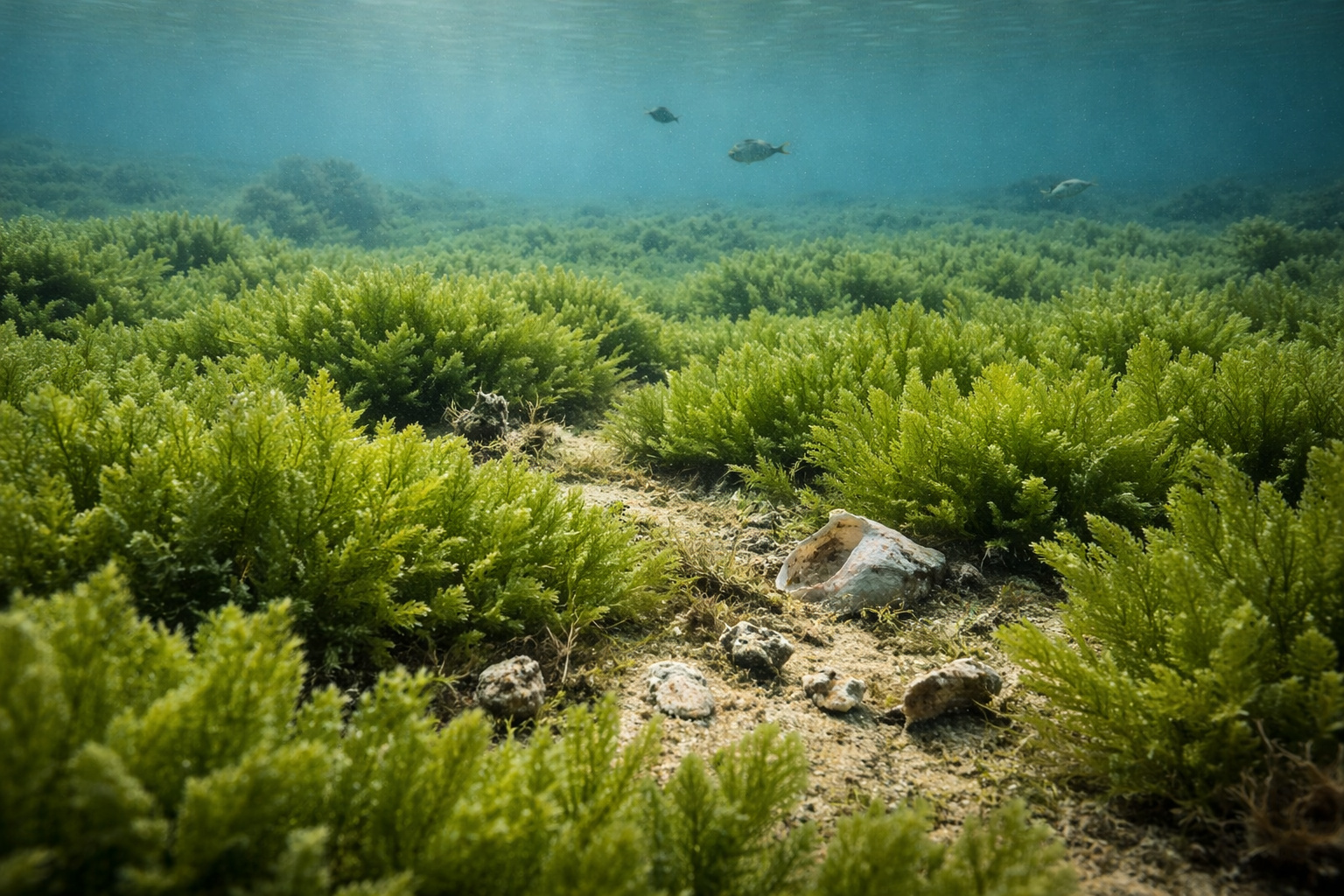
Invasive Alga Caulerpa Taxifolia Creates Toxic Rugs in the Mediterranean, Expels Native Fauna and Transforms Marine Ecosystems Without Natural Predators.
When talking about invasive species in the marine environment, the common imagination goes to predatory fish, giant crustaceans, or poisonous organisms. But the most emblematic case in the Mediterranean in recent decades comes from something much more discreet: a tropical green alga artificially selected to live in aquariums, which ended up escaping to the ocean and becoming one of the biggest ecological problems in the marine world. It is Caulerpa taxifolia, recorded by institutions such as IUCN, NOAA, and CSIC (Spain) as a highly invasive species, capable of forming extensive monospecific “rugs,” releasing toxins, suppressing native fauna, and altering the substrate of the seafloor.
Although the topic is rarely discussed outside scientific circles, the impact of this alga is profound. In just a few decades, it has conquered entire areas of the Mediterranean coast, replaced traditional algal beds and seagrass meadows, and dramatically altered the local ecology to the point that the IUCN classified it among the 100 worst invasive species in the world. The story of how this happened mixes biology, genetics, human error, lack of predators, and a rate of expansion that caught oceanographers by surprise.
Caulerpa Taxifolia and the Phenomenon of “Toxic Rugs”
The species belongs to the group of tropical green algae of the genus Caulerpa, known for having a single stalk and a creeping structure that resembles a carpet of branched leaves. In tropical waters, it coexists with various marine herbivores, such as reef fish and sea urchins, that regulate its density. In the Mediterranean, however, the story has been completely different.
-
Motorola launched the Signature with a gold seal from DxOMark, tying with the iPhone 17 Pro in camera performance, Snapdragon 8 Gen 5 that surpassed 3 million in benchmarks, and a zoom that impresses even at night.

-
Satellites reveal beneath the Sahara a giant river buried for thousands of kilometers: study shows that the largest hot desert on the planet was once traversed by a river system comparable to the largest on Earth.

-
Scientists have captured something never seen in space: newly born stars are creating gigantic rings of light a thousand times larger than the distance between the Earth and the Sun, and this changes everything we knew about stellar birth.

-
Geologists find traces of a continent that disappeared 155 million years ago after separating from Australia and reveal that it did not sink, but broke into fragments scattered across Southeast Asia.

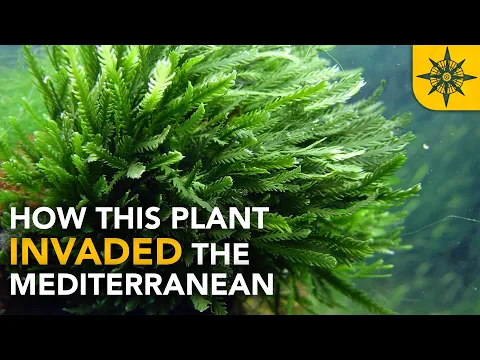

What surprises researchers is not only the invasion itself but the ecological model that it creates. Caulerpa taxifolia secretes toxic compounds—such as caulerpina and caulerpenina—that inhibit consumption by fish and invertebrates. This means that, unlike edible algae such as Posidonia oceanica (the dominant seagrass in the Mediterranean), Caulerpa builds a hostile environment for herbivores, reducing the ecological pressure that would limit its growth.
As a result, it forms continuous mats of dozens to hundreds of square meters, displacing native species that depended on a mosaic of habitats. It is a domino effect: where there was once a diversity of algae and seagrass meadows, there now exist homogeneous surfaces that reduce the structural complexity of the seabed, expel sensitive invertebrates, and decrease biodiversity.
How an Aquarium Alga Conquered the Mediterranean
The most cited episode in scientific literature dates back to the 1980s when a highly resistant strain of Caulerpa taxifolia cultivated in European aquariums escaped to the sea, likely from an oceanographic center in Monaco. This lineage had been selected to tolerate lower temperatures and intense artificial light—characteristics that do not exist in natural tropical lineages.
According to the Spanish CSIC and IUCN reports, this modified strain found in the Mediterranean a dangerous combination: relatively warm waters, few specialized herbivores, and an absence of efficient competitors. The result was a population explosion that became a classic case of marine biological invasion.
By the late 1980s, the Caulerpa patch was small. In less than 20 years, studies recorded its presence at various points along the Mediterranean coast, including France, Italy, Croatia, Spain, and Tunisia. The expansion was so rapid that it raised international debates about quarantine, aquarium water disposal, and environmental monitoring in ports and marinas.
Ecological and Economic Impacts Documented by IUCN, NOAA, and CSIC
Scientists divided the impacts into three main axes:
- Habitat Transformation
The uniform coverage reduces the substrate complexity, eliminating micro-habitats that served as shelter for invertebrates such as mollusks and crustaceans, and also affecting juvenile commercial fish. - Toxicity and Herbivore Exclusion
The presence of toxins reduces consumption by fish and echinoderms. In tropical regions, species like parrotfish and some sea urchins consume Caulerpa, but in the Mediterranean, few organisms have similar tolerance. - Competition with Marine Angiosperms
Posidonia oceanica meadows, considered key ecosystems in the Mediterranean, have retracted in invaded areas. These plants are essential for oxygenation, sediment stabilization, and reproduction of various species. The replacement of Posidonia by Caulerpa reduces the ecological value of the habitat and also affects the coastal fishing chain.
In addition to biological impacts, there is the economic aspect. Artisanal fishing and diving tourism are activities sensitive to changes in the underwater landscape. Invaded areas lose species variety and visual interest, while fishing suffers from the decrease in juveniles.
Control Attempts and Why They Failed
A marine invasive species in open waters is much more complex to contain than terrestrial plants. In the case of Caulerpa, methods cited by IUCN and NOAA included manual removal by divers, covering the substrate with opaque tarps, suction with underwater pumps, and experimental use of herbicides in isolated locations.
The results were deemed insufficient. Manual removal fragments the alga, and each fragment can start a new colony. Tarps work in small areas but are unfeasible in patches of hundreds of square meters.

This is why oceanographers argue that prevention is more effective than control. The debate has evolved into a legislative matter focused on the quarantine of marine species, port inspection, and aquarium certification—elements cited in documents from NOAA and the European Union.
What Makes This Case So Iconic in Invasive Biology
Although there are much more famous terrestrial invasive species, Caulerpa taxifolia has become a scientific icon for three reasons:
- It was not a natural accident, but the result of human selection.
- It affected one of the most studied seas in the world, facilitating monitoring.
- It altered a key and economically important ecosystem.
It serves as a reminder that biological invasions do not require large predators. Sometimes, a discreet plant or alga carrying toxins and physiological resistance can have deeper effects than spectacular animals.
And Now?
The Mediterranean serves as a living laboratory for researchers to document how invasive species respond to global warming, maritime transport, tourism, and aquarism. Scientists from CSIC and NOAA state that there are still many unanswered questions about the future of Caulerpa in the Atlantic, especially with rising water temperatures.
The case raises a troubling question: if a simple alga can alter the Mediterranean in just a few decades, what other silent species may be doing in even less monitored seas? Marine biology is still seeking answers.








-

-

-

-

-

16 pessoas reagiram a isso.