





 Portuguese
  English
  Spanish
  5 min of reading
  0 comments


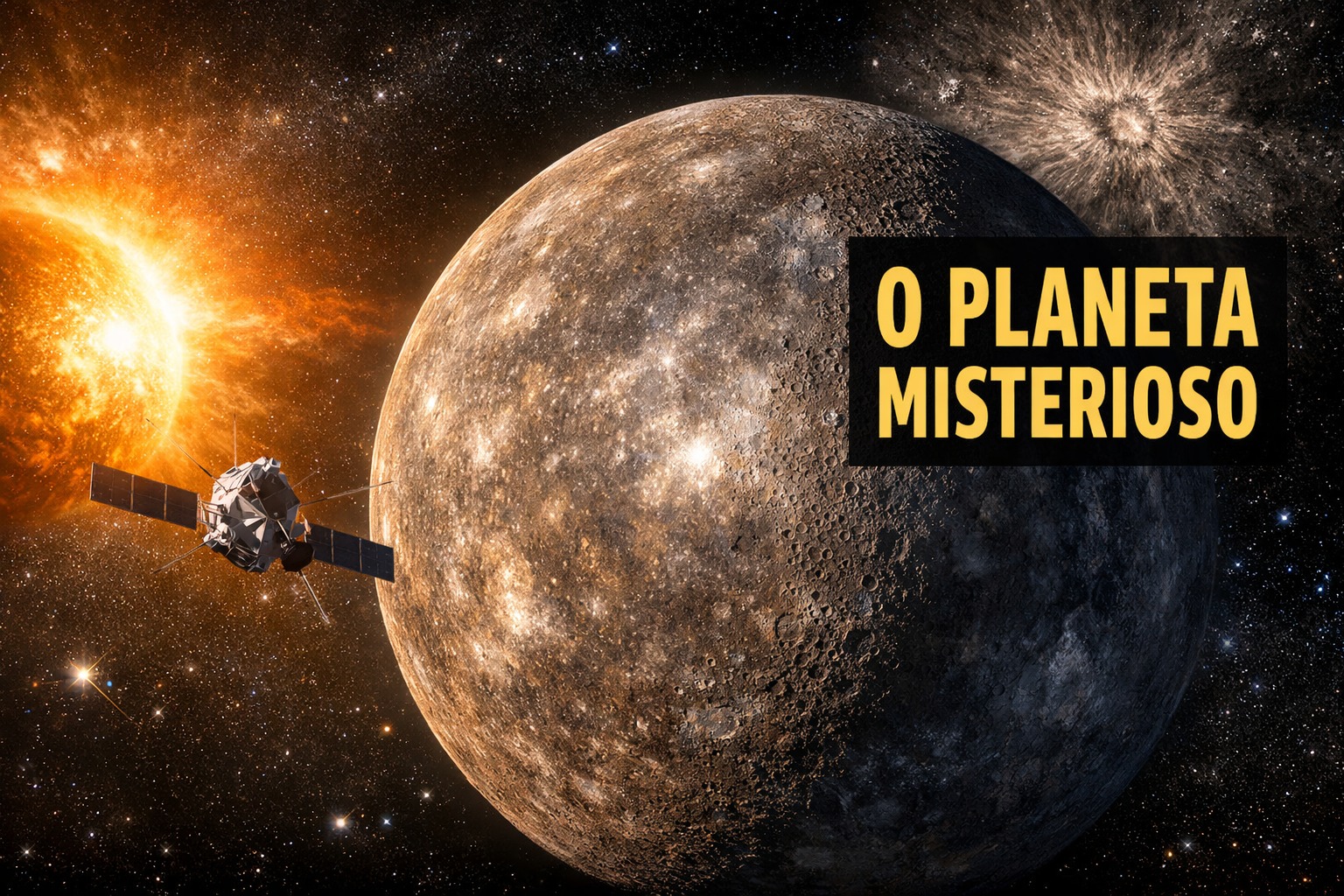
Small and Dense, Mercury Challenges Theories About Planetary Formation, Displays Extreme Temperatures and Unexpected Volatile Elements, Keeping Alive One of the Greatest Scientific Mysteries of the Solar System Currently Observed
Mercury is often remembered as a discreet planet, almost unnoticed compared to its more vibrant neighbors. The arid landscape, extremely thin atmosphere, and absence of any possibility of life seem to reinforce this image. However, a closer look reveals that the smallest planet in the Solar System has a story marked by extremes, contradictions, and unanswered questions.
Small in Size, Giant in Mystery
Even though it is tiny, with 20 times less mass than Earth, Mercury defies simple classifications. It is the second densest planet in the Solar System, a characteristic attributed to its enormous metallic core, which is responsible for concentrating most of its mass.
This unlikely combination of reduced dimensions and high density intrigues planetary scientists, who admit not fully understanding how the planet formed.
-
Motorola launched the Signature with a gold seal from DxOMark, tying with the iPhone 17 Pro in camera performance, Snapdragon 8 Gen 5 that surpassed 3 million in benchmarks, and a zoom that impresses even at night.

-
Satellites reveal beneath the Sahara a giant river buried for thousands of kilometers: study shows that the largest hot desert on the planet was once traversed by a river system comparable to the largest on Earth.

-
Scientists have captured something never seen in space: newly born stars are creating gigantic rings of light a thousand times larger than the distance between the Earth and the Sun, and this changes everything we knew about stellar birth.

-
Geologists find traces of a continent that disappeared 155 million years ago after separating from Australia and reveal that it did not sink, but broke into fragments scattered across Southeast Asia.

Sean Raymond, a planetary formation and dynamics specialist at the University of Bordeaux, sums up the dilemma succinctly.
According to him, there is something fundamental that still escapes theoretical models. The mystery surrounding Mercury’s origin remains one of the most persistent gaps in understanding the Solar System.
The Mission Seeking Answers
Launched in 2018, the BepiColombo mission, the result of a partnership between the European Space Agency (ESA) and the Japan Aerospace Exploration Agency (JAXA), is heading towards the planet.
After a delay caused by a problem with one of the thrusters, the spacecraft is expected to finally enter orbit in November 2026.
Among its main objectives is to clarify the origin and evolution of Mercury.
Saverio Cambioni from MIT emphasizes that studying Mercury goes beyond curiosity about a single celestial body.
To him, the planet can serve as a reference for understanding small, dense, iron-rich exoplanets observed around other stars.
First Clues of an Uncommon World
Indications that Mercury was different emerged as early as the 1970s, when NASA’s Mariner 10 spacecraft flew by the planet in 1974 and 1975. Gravitational measurements revealed a surprising interior.
While Earth, Venus, and Mars have cores equivalent to about half of their radii, Mercury’s core corresponds to almost 85% of the planetary radius. In contrast, the rocky mantle is extremely thin.
Nicola Tosi, a planetary scientist at the German Aerospace Center, notes that there is still no consensus on how Mercury acquired such an extreme configuration.
Decades later, the Messenger mission, which orbited the planet from 2011 to 2015, added to the scientific puzzle.
Extreme Temperatures and Unexpected Elements
Orbiting around the Sun just 60 million kilometers away, Mercury faces dramatic thermal variations. During the day, temperatures reach 430 °C; at night, they plummet to -180 °C.
In such a hostile environment, it would be expected that volatile elements would have disappeared billions of years ago.
Yet, Messenger detected potassium and thorium, as well as molecules like chlorine and even ice in shadowed polar craters.
These discoveries surprised researchers and reinforced the perception that Mercury is not an ordinary planet.
The presence of these materials challenges classical predictions and fuels new hypotheses about its formation.
Giant Impact or Exotic Formation?
Among the debated scenarios is the hypothesis of a colossal impact. Mercury might have been originally much larger, perhaps close to the size of Mars.
A collision that occurred in the first 10 million years could have removed a large part of its mantle, exposing the iron-rich core.
Alessandro Morbidelli from the Côte d’Azur Observatory claims this is one of the most accepted interpretations today. However, Cambioni highlights significant difficulties.
For so much material to be stripped away, the impact would require speeds exceeding 100 kilometers per second, something considered improbable.
Moreover, such a violent event should have eliminated the volatiles, whose existence still raises questions.
David Rothery from Open University adds another point of tension. A planet so close to the Sun should not exhibit an abundance of volatile substances.
This raises new questions: Did Mercury form farther out and migrate inward? Or did the materials that compose it come from distant regions?
Migration and Theoretical Alternatives
Another possibility suggests that Mercury was the impacting body itself, colliding with another planet before reaching its current orbit. There are also theories that dismiss gigantic impacts.
Anders Johansen from Lund University proposes that the planet formed in an extremely hot region, where eruptions from the primitive Sun evaporated light materials, favoring the concentration of iron.
Nevertheless, this explanation does not clarify why Mercury stopped growing.
Planetary migration models are also gaining traction. Matt Clement from Oxford University suggests that rocky planets might have formed closer to the Sun and migrated outward. In this scenario, Mercury would have lacked sufficient material to grow.
A Natural Laboratory Still Enigmatic
Observations of other stars reveal the existence of “super Mercurys,” dense and iron-rich worlds.
Cambioni estimates that these planets may represent between 10% and 20% of the planetary bodies in the galaxy. Still, their formation remains poorly understood.
BepiColombo is set to map the surface, measure gravity, and investigate the magnetic field. According to Tosi, this data may constrain hypotheses and offer a clearer picture of the planet’s composition.
The first flyby images already show craters, ancient lava flows, and remnants around 3.7 billion years old. Wrinkles in these regions indicate that Mercury has been slowly contracting as it cools.
While scientists dream of a landing and sample return, there is no such mission planned. Rothery states that a direct sample or even the identification of a meteorite originating from Mercury could profoundly transform current understanding.
For now, the planet remains a silent guardian of secrets, small in size but immense in mystery.
With information from BBC.







Seja o primeiro a reagir!