





 Portuguese
  English
  Spanish
  5 min of reading
  0 comments


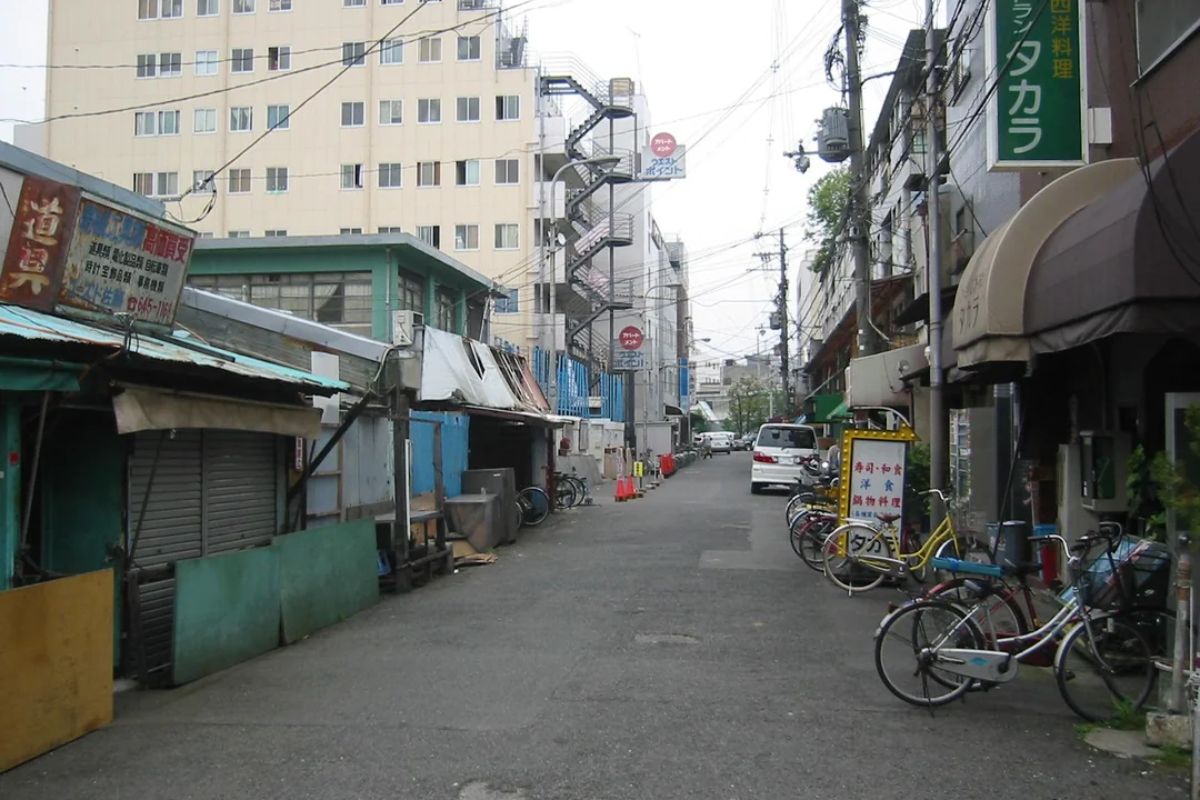
In The Largest Japanese Slum, Routine Mixes Timely Subway, Clean Sidewalks, And Constant Sense Of Safety With A Less Visible Social Crisis: Elderly Men, Precarious Work, Dependence On Alcohol And Gaming, As Well As Minimal Housing That Reveals An Urban Poverty Different From Brazilian Peripheries In Multiple Layers Of Daily Life.
The slum of Kamagasaki, in Osaka, dismantles a simplified image that urban poverty always appears with open sewage, destroyed streets, and a permanent presence of violence. What arises there, at first contact, is almost the opposite: functioning transportation, active commerce, urban cleanliness, and circulation without apparent tension.
But poverty does not disappear when infrastructure works. It changes its face. Instead of a landscape of physical collapse, the neighborhood reveals prolonged social wear: older men without family networks, unemployment, idleness, frequent alcohol consumption, and a routine marked by solitude.
Kamagasaki: Where The Japanese Slum Was Born And Why It Has Transformed

To understand this Japanese slum, it is necessary to go back to the post-war period. With the country destroyed, Japan underwent rapid reconstruction, with industrial expansion and intense demand for labor. Kamagasaki established itself as an arrival area for temporary workers, many hired for daily services in construction and low-stability operational activities.
-
Friends have been building a small “town” for 30 years to grow old together, with compact houses, a common area, nature surrounding it, and a collective life project designed for friendship, coexistence, and simplicity.

-
This small town in Germany created its own currency 24 years ago, today it circulates millions per year, is accepted in over 300 stores, and the German government allowed all of this to happen under one condition.

-
Curitiba is shrinking and is expected to lose 97,000 residents by 2050, while inland cities in Paraná such as Sarandi, Araucária, and Toledo are experiencing accelerated growth that is changing the entire state’s map.

-
Tourists were poisoned on Everest in a million-dollar fraud scheme involving helicopters that diverted over $19 million and shocked international authorities.


Over time, especially after the economic crisis of the 1990s, this machine lost strength. Contracts disappeared, work bonds became weaker, and part of the local population became trapped in a cycle of uncertain income.

The neighborhood did not turn into a “no-state” territory; it became a territory where the state arrives but does not solve everything. The difference is central to understanding why this slum seems organized on the surface but socially tense on the inside.
A Slum With Subway, Clean Sidewalks, And A Sense Of Order

Kamagasaki is just minutes away from central Osaka, with access by subway and train. The presence of this mobility system already separates this slum from the more common experience in many Brazilian peripheries, where transportation is often expensive, slow, and irregular. There, transportation connects, shortens time, and keeps the neighborhood integrated with the rest of the city.
The streets also attract attention: well-maintained pavement, signs of upkeep, and predictable urban routine. There are even teams in action, cleaning and organizing public roads. The scene breaks the automatic stereotype that urban poverty must come accompanied by physical disorder. In Kamagasaki, the contrast appears precisely because material order and social vulnerability coexist without negating each other.
Who Occupies The Social Landscape: Elderly Men, Little Presence Of Families, And Rare Childhood In The Streets

Walking through the slum, the demographic composition catches the eye. The predominant presence is of men, especially elderly men, with little circulation of children and families.
This distribution is not a visual detail: it indicates an aging territory, with low community renewal and lower density of collective domestic life in public spaces.
This aspect also explains part of the local atmosphere. There is no same type of social noise associated with neighborhoods with strong youth presence, schools, games, and family coexistence in the streets.
The silence of Kamagasaki speaks as much as its buildings. In many places, what is seen is a routine of permanence: people sitting, observing movement, smoking, drinking, waiting for time to pass.
Alcohol, Gaming, And Idleness: The Silent Crisis That Structures The Slum From Within
If crime does not appear as a central mark of the Japanese slum observed, other factors occupy that space: alcoholism, gaming addiction, and isolation.
The concentration of establishments related to pachinko and the availability of drinks in meeting areas show that recreational consumption works, for many, as an escape valve from a life without strong bonds and without a stable occupational outlook.
Instead of fear of robbery organizing the routine, what is perceived is another type of insecurity: social insecurity, slow and continuous.
It is not an immediate impact violence; it is a daily erosion of belonging and perspective. When work fails, when family distances itself, and when age advances, the slum transforms into a space of emotional survival, not just economic.
How Much It Costs To Live In The Osaka Slum And What Prices Reveal About Survival
The values observed in daily life help measure this scenario. Rent is advertised around 40,000 yen for small units, fast food prices are affordable, and basic items have values that require tight budgeting at the end of the month.
It is not extreme misery in visual form, but it is also not comfort: it is a timed budget, with little margin for any unforeseen events.
A simple meal, drinks sold in vending machines, and basic purchases reveal the local logic: practicality, standardization, and low unit cost to keep the day afloat.
The slum here does not seem like a “void of consumption”; it is a consumption of constraint. Little is spent at a time, basic items are repeated, and life is pushed forward in small installments of survival.
Slum In Japan And Slum In Brazil: Real Differences, Without Romanticization And Without Caricature
Comparing Kamagasaki with Brazilian communities requires caution. In Brazil, the slum often appears linked to self-construction, historical deficit of public services, and security conflicts that traverse the territory.
In Osaka, at least in this neighborhood, the material picture is different: present infrastructure, sense of security, and integration through transport.
This does not mean a better scenario in all aspects. It means a different scenario. The crisis in Kamagasaki is less visible to those who only look at the street and more evident to those who observe the social structure: aging, isolation, labor precariousness, and chemical dependence.
A slum can be clean, connected, and functional and still carry deep suffering. This is the point that challenges easy comparisons the most.
What This Slum Reveals About Urban Poverty In The 21st Century
Kamagasaki forces a reconsideration of what is understood as poverty in large cities. The equation no longer fits solely within sanitation, paving, and police presence. These elements matter, but do not encapsulate the problem.
When social bonds break and work no longer sustains a life trajectory, a less noisy and more persistent poverty emerges.
The largest slum in Japan, in this sense, serves as a global alert: infrastructure without social care produces efficient cities and tired people.
The neighborhood does not confirm the imaginary of the “dangerous slum,” but confirms perhaps something harder to face: the marginalization that advances silently within apparently normal streets.
From this reality, it is worth opening a direct debate: in your city, have you seen neighborhoods with good infrastructure, but with elderly people, unemployment, and alcohol occupying the space of coexistence? What weighs more in defining a slum today: the physical condition of the place or the quality of life of those who live in it? I want to read concrete examples from your neighborhood or region.










Seja o primeiro a reagir!