





 Portuguese
  English
  Spanish
  6 min of reading
  0 comments


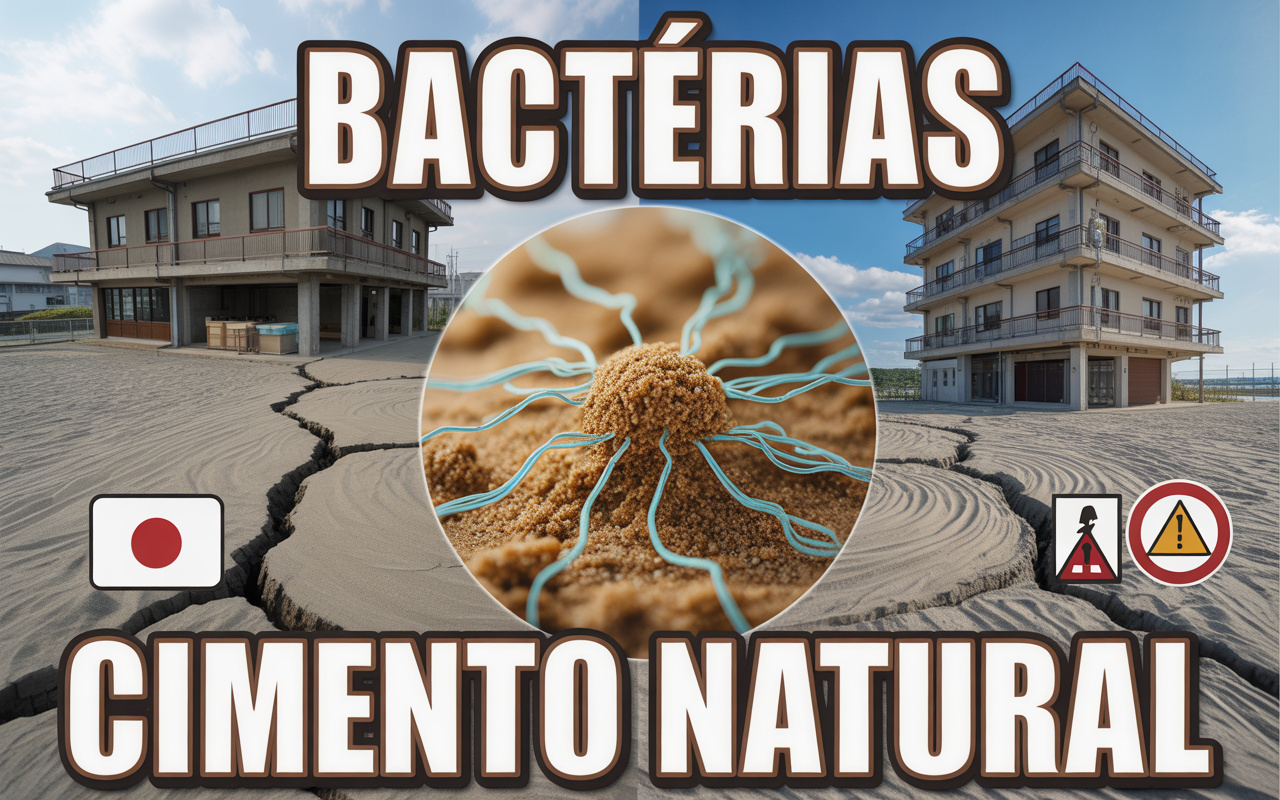
Japanese Technology Uses Bacteria to Solidify Sandy Soils and Prevent Liquefaction During Earthquakes, with Recent Advances from NIED and Universities, Based on the MICP Technique Studied Internationally Since 2011 and Reviewed.
In April 2023, the Japan Meteorological Agency (NIED), along with teams from Tohoku University, Kobe University, and the National Institute of Advanced Industrial Science and Technology, gained attention again in Japanese newspapers and scientific journals after publishing new advances in field tests of a technology considered revolutionary for seismic regions: the use of bacteria to solidify sandy subsoil and prevent it from turning into a kind of liquid sludge during earthquakes. In addition to coverage in technical newspapers in Japan, the technology had already been discussed in international publications such as the Journal of Geotechnical and Geoenvironmental Engineering and Geomicrobiology Journal, which have been discussing the scientific basis of the technique, called MICP – Microbially Induced Calcite Precipitation, since 2011.
When Soil Behaves Like Liquid and Biotechnology Emerges as an Alternative
The motivation did not come from nowhere. Japan deals with earthquakes daily and has a history of disasters associated with a phenomenon little known outside engineering: soil liquefaction. During the Tōhoku earthquake in 2011 and the major seismic event in Niigata in 1964, entire neighborhoods sank a few centimeters, pipes emerged from the ground as if they were “floating,” streets twisted, and hundreds of houses ended up crooked. All this was not due to structural collapse of the buildings, but because the water-saturated sandy soil lost strength and literally began to behave like a fluid.
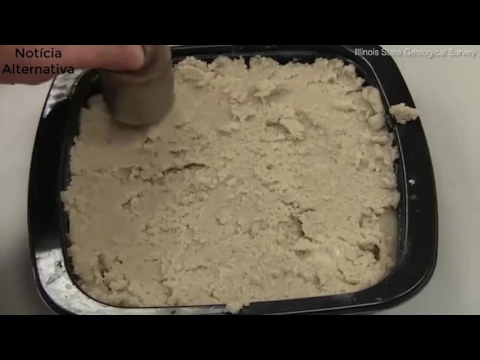

Traditional solutions to mitigate this effect involve deep compaction, cement injection into the subsoil, or vertical drainage systems. All are expensive, slow, and require large equipment. This is exactly where Japan stands out: using natural bacteria to turn unstable sand into something more like cohesive sandstone, without digging wide trenches, injecting cement, or displacing residents.
-
Motorola launched the Signature with a gold seal from DxOMark, tying with the iPhone 17 Pro in camera performance, Snapdragon 8 Gen 5 that surpassed 3 million in benchmarks, and a zoom that impresses even at night.

-
Satellites reveal beneath the Sahara a giant river buried for thousands of kilometers: study shows that the largest hot desert on the planet was once traversed by a river system comparable to the largest on Earth.

-
Scientists have captured something never seen in space: newly born stars are creating gigantic rings of light a thousand times larger than the distance between the Earth and the Sun, and this changes everything we knew about stellar birth.

-
Geologists find traces of a continent that disappeared 155 million years ago after separating from Australia and reveal that it did not sink, but broke into fragments scattered across Southeast Asia.

What the Japanese Are Really Doing Technically
The technique called MICP involves introducing microorganisms into the soil that are capable of inducing calcite precipitation (calcium carbonate), the same material that forms shells and corals. The bacteria use urea as a substrate and, by metabolizing it, create chemical conditions that cause calcium to bond with sand, filling pores and creating a kind of “biological cement.” This process hardens the soil over days or weeks, depending on temperature and local composition.
Japanese researchers have conducted not only laboratory experiments but also field tests using real sections of sandy soil. In 2020, an experiment conducted in coastal areas of Chiba and on research grounds of Kobe University measured soil strength before and after the application of the technique. According to reports released by NIED, the application resulted in a significant increase in penetration resistance and a reduction in deformation during tests simulating seismic load. Simply put, the soil ceased to “flow” so easily under vibration.
In addition to shear resistance, parameters such as elasticity and permeability were also evaluated. One of the most important points demonstrated was that calcite forms not only on the surface but at depths of 1 to 10 meters, which is essential to prevent liquefaction in coastal neighborhoods and sedimentary plains, such as those in Greater Tokyo.
Where the Technology Is Being Tested and Why It Matters
Contrary to what many people imagine, liquefaction does not occur only during gigantic earthquakes. Moderate events, combined with water-saturated sandy soils and proximity to the sea, are enough to cause expensive damage to urban infrastructures. This is why cities like Chiba, Tsukuba, Niigata, and Kobe are considered “natural laboratories” by engineers.
In Niigata, for example, the 1964 earthquake is still used in geotechnical courses around the world as the most educational case of modern urban liquefaction. In that episode, buildings did not collapse due to structural failure, but instead tipped over with the entire foundations inclined. This iconic image shaped decades of research in Japan.
When the Japanese demonstrate that it is possible to solidify sandy soils with bacteria without displacing residents and without interrupting urban infrastructure, it completely changes the prevention landscape. It means that industrial areas close to the sea, port sections, airport runways, buried pipelines, entire neighborhoods on landfill sites, and fuel depots can be stabilized with discreet interventions and without cement.
There is also an important environmental advantage: compared to traditional methods like cement injection, MICP emits much less CO₂, does not require trucks carrying tons of material, and can be stopped and resumed easily.
The Biological Background That Few People Know
Many people find it curious that the solution to such a mechanical problem comes specifically from microbiology. However, bacteria that precipitate calcite exist naturally in caves, seabeds, and coral reefs. They have been used in engineering for decades to repair microcracks in concrete, in a field called “self-regenerating concrete.”
The major difference in Japan is the application in a geotechnical context, which involves completely different pressures and scales. In the laboratory, forming calcite between sand particles is one thing; doing this in cubic meters of real soil, with variations in pH, temperature, salinity, and compaction, is another.
The Japanese tests occur with selected bacterial species deemed safe, naturally present in the environment, and capable of operating under variable conditions. A crucial point observed by researchers is the control of the ureolysis rate, which regulates how much calcite is produced and prevents the soil from becoming too rigid or obstructed to hinder natural drainage.
Advantages and Challenges of the Technique Compared to Traditional Methods
The big advantage is the absence of heavy machinery and cement. A street does not need to be completely closed off for the soil beneath it to be reinforced. The technique can be applied via injection from the surface or through narrow wells, while traffic and pedestrians continue to circulate. This changes the economic logic of urban seismic engineering.

On the other hand, the challenges are not trivial. One of them is the chemical durability of calcium carbonate over decades. Another is the cost on a large scale since it is necessary to produce urea and ensure the adequate supply of calcium. There is also the work of regulatory standardization, as anything involving microbiology and the environment requires health regulations.
Japanese researchers insist that it is not about “throwing bacteria into the ground,” but about a controlled, calculated, and monitored process, with penetration tests, piezometry, and flow modeling. This difference is essential to understand why the stages are still in pre-commercial phase in many places.
Global Impact and What It Could Represent for the Future of Civil Engineering
If the technique consolidates, Japan may rewrite urban seismic engineering for the 21st century. Countries like Chile, New Zealand, Indonesia, Turkey, Greece, and parts of the USA face the same problem. Coastal sedimentary cities like Los Angeles, San Francisco, Vancouver, and Santiago have soils prone to liquefaction, especially after heavy rains or aquifer flooding.
The idea of using biotechnology to replace high-emission and high-cost methods attracts international attention not only for its efficiency but also for its symbolism: geotechnical engineering that mimics natural processes. If Japan is managing to “glue sand” with bacteria, the boundary between biology and infrastructure is likely to disappear in the coming years.








Seja o primeiro a reagir!