





 Portuguese
  English
  Spanish
  5 min of reading
  0 comments


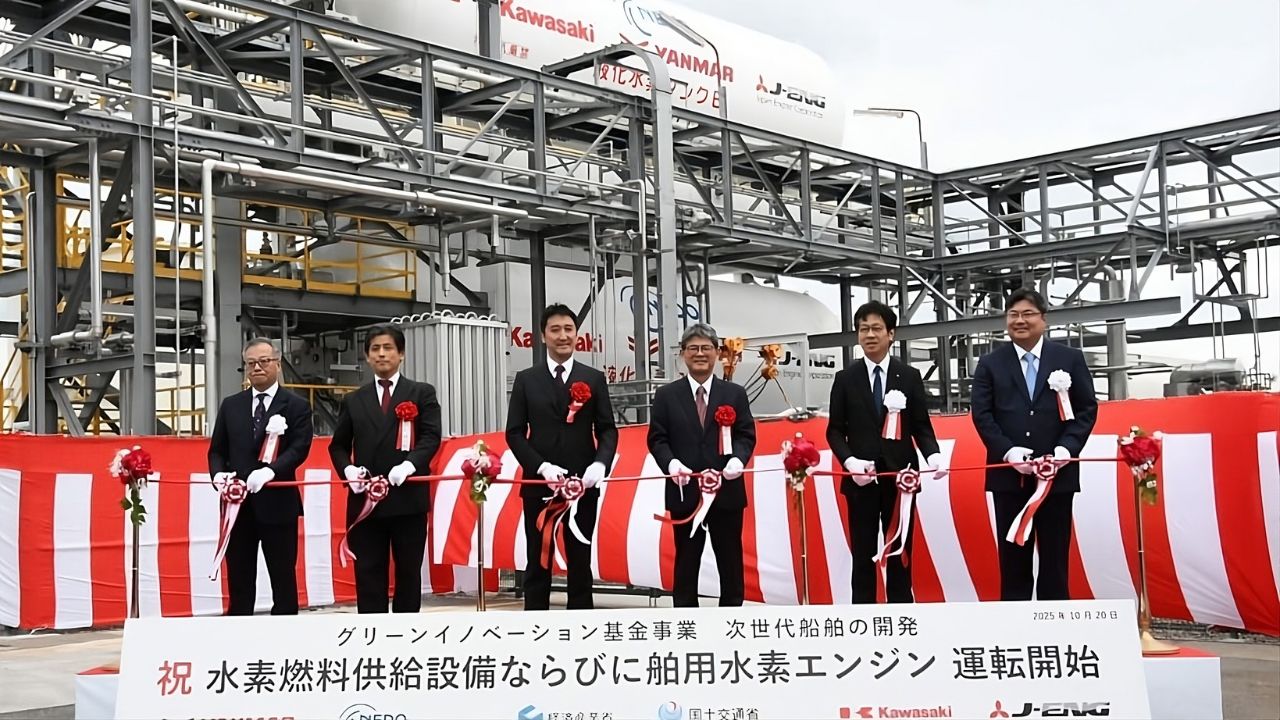
Japan Takes A Decisive Step Towards Decarbonization By Testing The First Hydrogen-Powered Marine Engine On Land. The Technology Promises To Revolutionize Naval Transport And Accelerate The Energy Transition
According to the ESG News portal and official statement from Japan Engine Corporation, Japan has achieved a historic milestone in the search for global decarbonization: the world’s first test of a hydrogen-powered marine engine on land.
The operation, conducted by a consortium formed by Kawasaki Heavy Industries, Yanmar Power Solutions, and Japan Engine Corporation, validated the stable operation of hydrogen-powered marine engines in a terrestrial environment — something unprecedented worldwide.
Initial Results Of The Test In Japan
The project aims to accelerate the transition of the naval transport sector to cleaner energy sources, aligning with Japan’s goal of achieving carbon neutrality by 2050.
-
Revolution in public transport: Goiânia puts into circulation the first articulated buses powered by biomethane in Brazil and promises to drastically reduce pollution on the Anhanguera Corridor.

-
Sesc-BA bets on renewable energy with the support of EDP and drives the energy transition with a direct impact on cost reduction and the sustainability of its operations in Bahia.

-
Technology giant breaks global sustainability records: How Amazon’s leadership in renewable energy procurement transformed the global energy market in the past year.

-
Alert in the electric sector: Atlas Renewable Energy confirms billion-dollar investment and Brazil risks losing a share of the new investment in Latin America to neighboring countries.


During the demonstration, the consortium used a liquid hydrogen fueling system developed by Kawasaki Heavy Industries, capable of supplying fuel at different pressures for multiple types of engines.
The test was conducted at the Japan Engine Corporation facilities, where four-stroke marine engines operated stably and safely using only hydrogen, proving the technical feasibility of the system.
In addition, the project uses a dual-fuel configuration, meaning the engine can switch between hydrogen and marine diesel. This solution is strategic, as it allows the adoption of the new fuel without compromising the operational reliability of ships, which is essential for safety in ocean transport.
According to data from the report released by the consortium, the operation was completed without failures, confirming that the hydrogen-powered marine engine on land is ready for the next step: usage in real vessels.
Why Hydrogen Is Crucial For Maritime Decarbonization?
Maritime transport is responsible for about 3% of global greenhouse gas (GHG) emissions, according to the International Maritime Organization (IMO).
This percentage may seem small, but it represents approximately 1 billion tons of CO₂ per year, emitted by over 50 thousand vessels crossing the oceans, transporting 80% of global trade.
With growing pressure from the IMO to zero emissions by 2050, the sector is seeking alternatives to diesel and bunker fuel — highly polluting fuels. In this context, hydrogen emerges as one of the most promising solutions, mainly because it does not emit carbon dioxide during combustion and offers high energy density when compressed or liquefied.
The success of the Japanese test proves that the technology is mature enough to enter the phase of practical application, serving as a model for other countries that wish to decarbonize their commercial fleets.
The Strategic Role Of The Government Of Japan In Innovation
The project is part of initiatives supported by the Green Innovation Fund, managed by the New Energy And Industrial Technology Development Organization (NEDO) and supervised by the Ministry Of Economy, Trade And Industry Of Japan (METI).
This fund has approximately ¥2 trillion (US$ 13 billion) allocated for decarbonization technologies and energy transition — including fuel cells, green ammonia, and hydrogen engines.
Japan, historically dependent on energy imports, sees hydrogen as a long-term strategic solution to ensure energy security and industrial leadership.
The focus on applied research, such as this hydrogen marine engine test on land, reinforces the country’s commitment to a sustainable and competitive future, especially in the naval sector, where it is already recognized for its advanced engineering.
Technical Challenges And Next Steps Of Japan’s Project
Despite the success, the path to commercial adoption is still long. The main technical challenges involve the safe storage of liquid hydrogen, the fueling infrastructure at ports, and the retrofitting of existing vessels to operate with the new fuel.
Marine engines require thermal control and high pressures to maintain efficiency. Additionally, handling hydrogen requires cryogenic materials and complex ventilation and safety systems. Even so, the Japanese consortium plans to conduct the first onboard test in the coming years, equipping a test ship with the dual-fuel engine tested on land.
This will be the true turning point for hydrogen-powered naval transport, as it will demonstrate the technology’s performance under real operating conditions — temperature, vibration, load, and salt spray — factors crucial for international certification.
Global Impacts For Naval Transport And The Maritime Industry
The development of the hydrogen marine engine on land in Japan goes far beyond technological innovation: it represents a structural change in the naval transport sector.
If implemented on a large scale, hydrogen could replace fossil fuels and drastically reduce carbon emissions, contributing to meeting global climate goals.
In addition to the environmental impact, there are also economic and logistical gains:
- Hydrogen-powered ships will have lower costs with carbon taxes.
- Companies will be able to obtain green certifications, attracting more investors.
- The technology will stimulate the creation of new jobs and sustainable production chains.
Companies in Europe and North America are closely monitoring Japan’s advances, studying technical cooperations and bilateral agreements to accelerate the spread of maritime hydrogen.
The Hydrogen Marine Engine On Land As A Symbol Of The New Maritime Era
The test conducted symbolizes a new era in naval engineering. Japan has shown the world that hydrogen can be the fuel of the future for the oceans.
More than a technological achievement, it is a clear signal that the energy transition is accelerating — and that maritime transport will need to adapt quickly.
With international pressure to reduce emissions, the competitiveness among nations will also depend on the ability to innovate sustainably. Countries that invest now in hydrogen marine engines on land will be a step ahead in the race for carbon neutrality.
In a sector historically driven by heavy diesel, the revolution of hydrogen is not just desirable — it is inevitable. And Japan once again takes on the role of pioneer.








Seja o primeiro a reagir!