





 Portuguese
  English
  Spanish
  4 min of reading
  0 comments


How Japanese Agricultural Reconstruction Combines Modern Engineering and Traditional Techniques to Face Ever More Severe Climate Disasters
In recent years, heavy rains and extreme weather events have caused significant damage in rural areas of Japan. Nevertheless, even in the face of landslides, crop losses, and damages amounting to billions of yen, the country follows a clear principle: to rebuild quickly, with technical precision and a focus on preventing new disasters. This commitment translates into detailed construction projects, rigorous building methods, and the combined use of modern technologies with millennia-old soil containment techniques.
The information was released by Japanese channels specialized in civil works and agricultural recovery, which documented step by step the processes adopted in different regions affected by record rains that occurred in August, when the total damages reached 1.6 billion yen. From these records, it is possible to understand how Japan transforms devastated areas into productive, safe, and future-ready lands.
Containment and Drainage Engineering: The Foundation to Prevent New Collapses

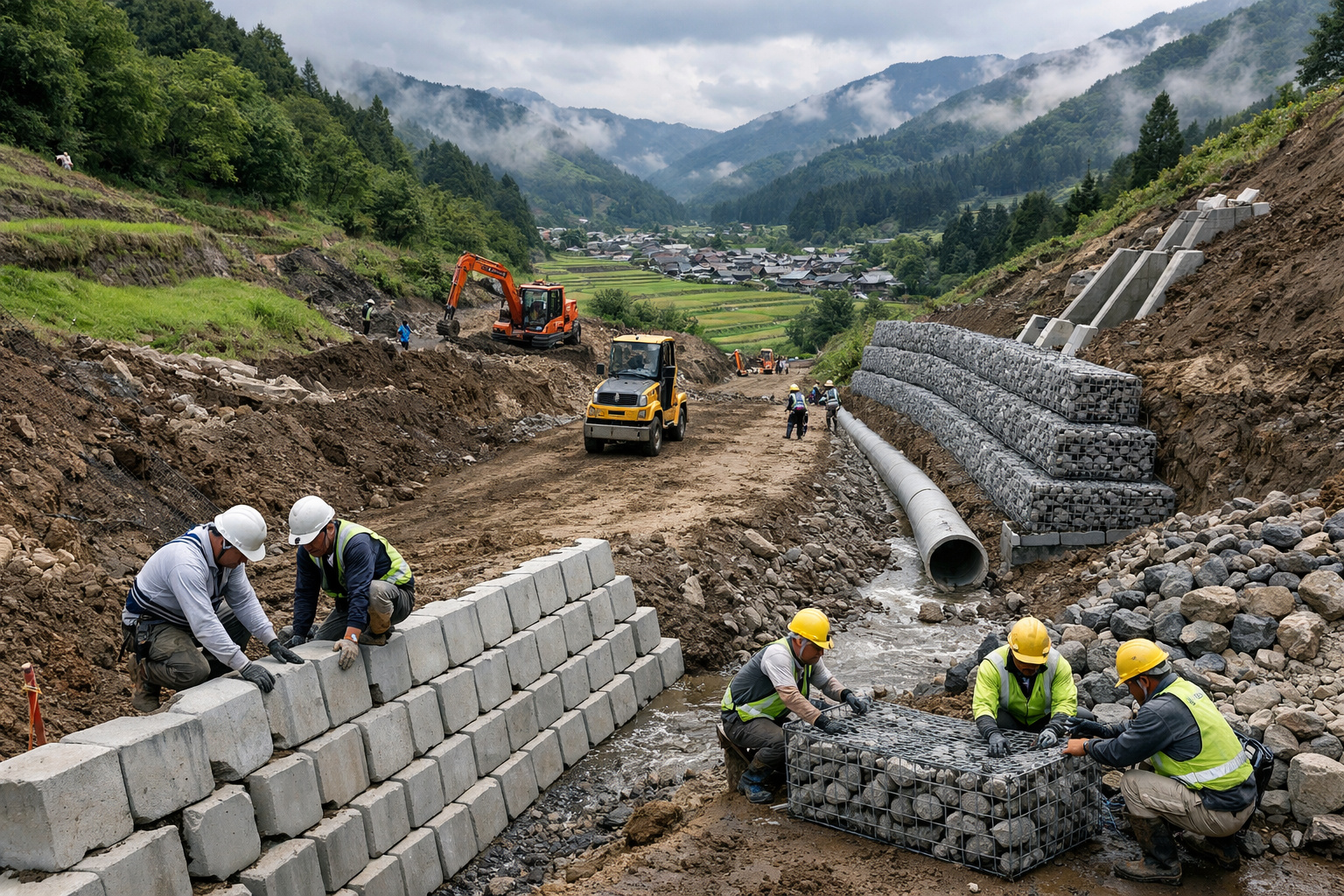
Initially, the technical teams face a critical challenge: saturated and unstable soil, responsible for large-scale landslides. To address this problem, the process begins with the construction of the foundation, where crushed stone is applied, an essential step to stabilize the ground and improve drainage. Next, the soil undergoes compaction with rollers, eliminating unevenness and creating a flat and durable base.
-
Friends have been building a small “town” for 30 years to grow old together, with compact houses, a common area, nature surrounding it, and a collective life project designed for friendship, coexistence, and simplicity.

-
This small town in Germany created its own currency 24 years ago, today it circulates millions per year, is accepted in over 300 stores, and the German government allowed all of this to happen under one condition.

-
Curitiba is shrinking and is expected to lose 97,000 residents by 2050, while inland cities in Paraná such as Sarandi, Araucária, and Toledo are experiencing accelerated growth that is changing the entire state’s map.

-
Tourists were poisoned on Everest in a million-dollar fraud scheme involving helicopters that diverted over $19 million and shocked international authorities.


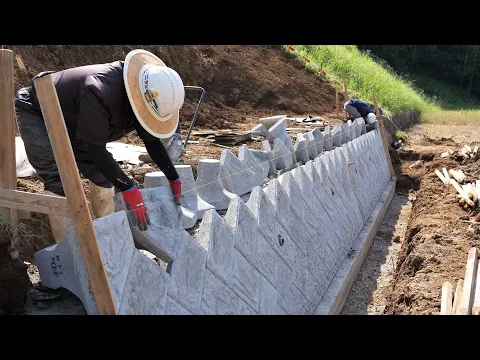
Shortly thereafter, formwork is assembled, which will serve for the pouring of the foundation concrete. With the concrete cast and cured, the structural base is ready to receive the so-called “machi blocks”, specially designed blocks for erosion control and agricultural slope containment. These blocks require millimeter adjustments, made with the aid of reference lines, ensuring perfect alignment and proper fit.
After installation, stone is placed at the back of the blocks to ensure efficient drainage, while concrete is injected inside, significantly increasing structural stability. This process repeats layer by layer, forming a solid barrier against soil displacement. In some models, the blocks have specific holes for drainage pipes, allowing water buildup behind the structure to drain away, drastically reducing the risk of new slides.
Millennia-Old Techniques Still in Use: Futon Baskets and Permeable Gabions

In addition to modern solutions, Japan keeps alive a technique with more than two thousand years of history: futon baskets, structures resembling baskets filled with stones. Despite their simple appearance, this method continues to be widely used due to its low cost, extreme durability, and high efficiency in drainage.
In this system, the baskets are assembled on-site, positioned carefully, and secured with stakes to prevent movement. They are then filled manually with broke stones, stacked strategically to ensure balance, strength, and water passage. The stability does not depend on the basket itself, but on the precise arrangement of the stones, which creates a structure resistant to soil pressure and flash floods.
After filling, the baskets are closed and secured with spiral wires, forming successive layers until the required height is reached. The collapsed ground is then backfilled in 30-centimeter layers, each one rigorously compacted to prevent future sinking. Finally, the slopes are reshaped, recreating agricultural embankments and dikes, known as “ridges,” which are fundamental for water control in cultivation areas, especially rice paddies.
Vegetative Protection, Soil Improvement, and Prevention of New Disasters

Once the structural part is complete, biological protection of the soil comes into play. For this, vegetative mats with seeds are applied, secured with special nails, which help prevent surface erosion while the vegetation grows. Over time, the roots act as a natural reinforcement of the slope, further increasing soil stability.
In areas where the original soil was washed away by the rains, soil improvement with lime occurs, a process known as soil enhancement, which increases its mechanical resistance. This material is then reused in backfilling, reducing costs and speeding up the recovery of agricultural areas. Meanwhile, damaged or suspended drainage channels are reinforced with concrete, restoring their function and preventing future overflow.
Another widely employed method is the use of permeable gabions, metal cages filled with stones that allow water to pass while retaining the soil. These gabions are stacked up to six layers, forming true draining walls. To further strengthen the system, anti-suction materials with high drainage capacity are installed between the soil and the gabions, preventing the buildup of hydraulic pressure.
At the end of the process, the areas previously devastated by heavy rains are completely restored, with stable slopes, fertile soils, and efficient drainage systems. In this way, the risk of new collapses is significantly reduced, allowing farmers to resume their activities with safety, predictability, and peace of mind.
After seeing how Japan combines interlocking blocks, drainage, layered compaction, and vegetative protection to rebuild slopes and restore safety to farmers, the question remains: what really makes a structure “withstand” the next storm — the most modern technique, the discipline in executing each step, or the preventive planning that prevents tragedy from repeating?
Source: MK Project









-

-

2 pessoas reagiram a isso.