





 Portuguese
  English
  Spanish
  7 min of reading
  0 comments


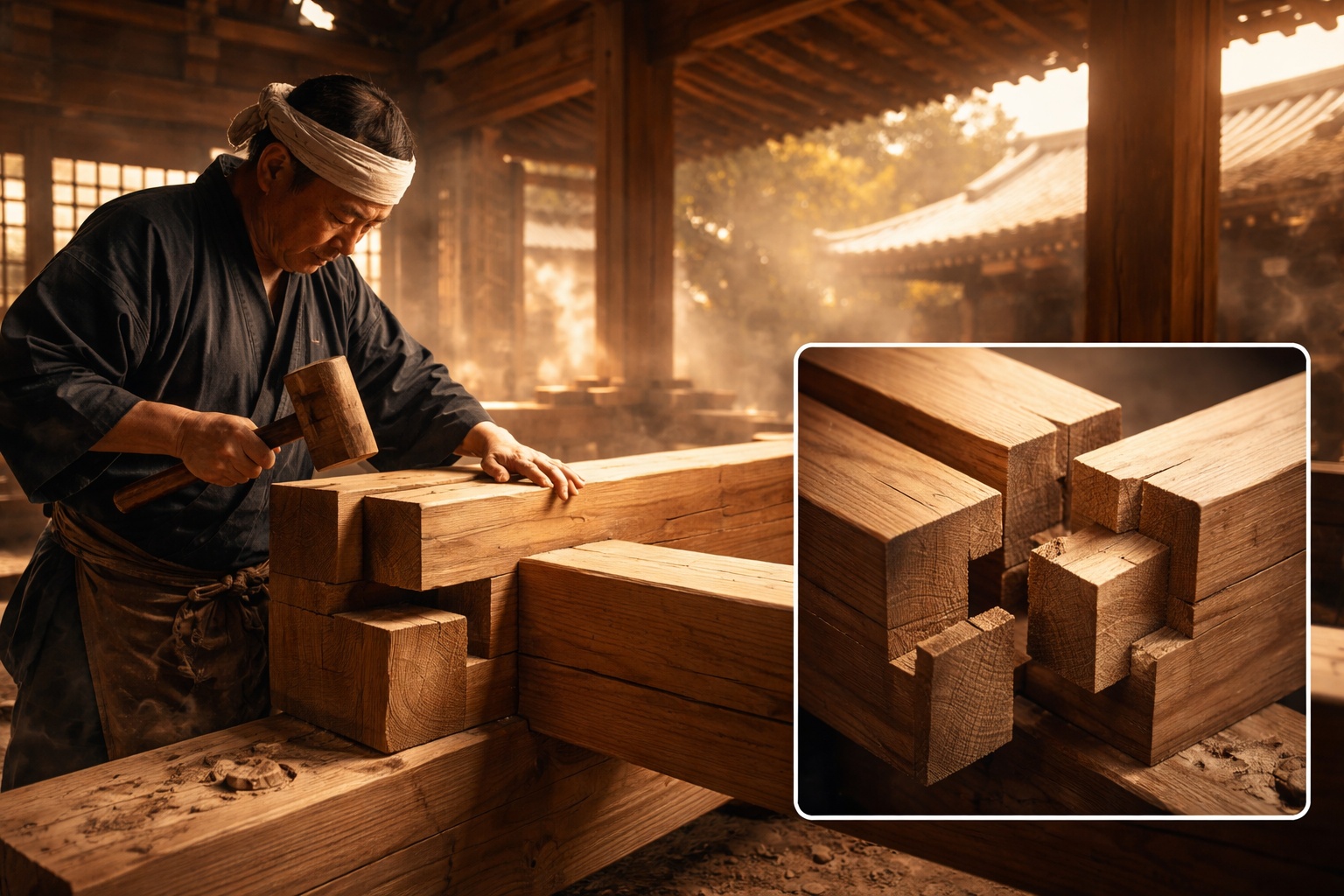
Traditional Japanese Carpentry Uses Millimeter Joinery and Pure Geometry to Erect Temples and Houses Without Nails or Screws, Proving That Solid Wood Can Ensure Durability and High-Level Structural Engineering for Centuries.
The traditional Japanese carpentry known as tsugite carries a secret that has survived more than twelve centuries without losing relevance. While modern construction relies on metal connectors, chemical adhesives, and industrial screws, Japanese artisans erect temples, houses, and bridges using only solid wood and pure geometry. The result is not only impressive for its clean aesthetics but also for the realization that millimeter cuts and calculated joints can hold entire structures with absolute firmness and durability that exceeds generations.
This method reignites discussions about sustainability, artisanal precision, and valuing carpentry as high-level engineering in today’s market. In the end, what stands out is not just the absence of visible hardware but the proof that tradition and structural performance can coexist in a single construction system that completely dispenses with any form of makeshift solutions.
Male-Female Joints Replace Metal with Geometric Precision
The Japanese joint system known as tsugite operates through complementary cuts where one piece features a projection (male) and the other has a cavity (female) sized for locking by physical pressure. The carpenters carve these interfaces with manual chisels following millimeter markings that ensure a snug fit.
-
The lack of welders, electricians, and operators becomes a structural threat in 2025, with the construction industry and manufacturing already suffering from delays, cost pressures, and labor shortages in Brazil.
-
Brazil and Paraguay are just 46 meters away from a historic union on the bioceanic bridge that promises to revolutionize trade between the Atlantic and the Pacific.

-
With 55 km over the sea, a cost of US$ 20 billion, and enough steel to build 60 Eiffel Towers, China’s largest project has connected Hong Kong, Zhuhai, and Macau in a colossal bridge that defies the logic of engineering.

-
A trick with joint compound transforms a Styrofoam ceiling into a plaster-like ceiling: leveled panels, wires and mesh at the joints, sand, paint, and change the environment while spending little today.

Each joint is designed for columns and beams to support each other, eliminating weak points that compromise stability.

The geometry of the joints varies according to the structural function. Octagonal joints distribute vertical loads in master pillars, while square shapes accommodate lateral forces in braces. Additional pieces act as wedges compressing opposite joints and creating locks that resist seismic movements without reliance on external connectors.
This tradition began to develop over 1,200 years ago during the Nara period (710-794) when the first temples using connection methods such as kanawa-tsugi emerged.
Buildings were made with local woods, and the use of these joints allowed for the creation of durable structures that still stand today without the need for nails or metal screws.
Absence of Glue Allows Complete Disassembly and Total Recycling
The tsugite joints do not even require chemical adhesives because mechanical locking generates sufficient resistance through the geometry of the cuts.
This means that any structure assembled by this method can be completely disassembled, repaired, or recycled without destroying the original components. The wood does not suffer permanent damage during the separation of the pieces, maintaining its structural properties intact.
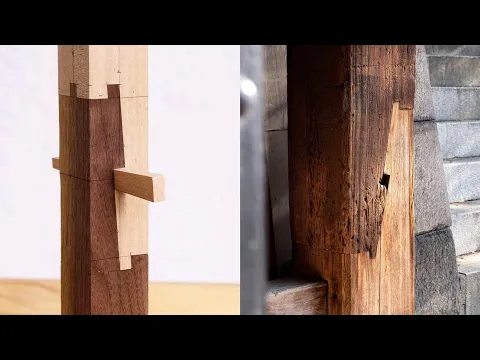

This feature creates practical advantages in contexts where mobility matters. Entire buildings can be moved to new locations after careful disassembly, something impossible in conventional constructions that rely on reinforced concrete or irreversible chemical fixations.
Defective pieces can be individually replaced without compromising the entire structure, reducing waste and maintenance costs over decades.
From an environmental perspective, the absence of glue eliminates the mixing of materials that complicates sorting and recycling.
Pure wood can be reused, composted, or transformed into biomass without chemical contaminants. This cycle completely closes when compared to modern systems that generate difficult-to-dispose waste.
Flexible Structures Accompany Ground Movements Without Breaking
The great structural differential of the Japanese joints lies in their ability to absorb dynamic forces without fractures.
Unlike rigid joints that concentrate stresses at fixed points, male-female interfaces allow controlled micro-movements that gradually dissipate energy. This explains why century-old temples in Japan withstand intense earthquakes while modern constructions collapse.
Gently sloping internal corners help dissipate forces in case of tremors, reducing stress concentration in the structure. Stacked braces in a triangular shape significantly increase structural resistance and reduce torsion in the ensemble.

The rigorous alignment of beams and columns with traditional marking methods ensures symmetry, perfect fit, and efficient distribution of vertical and horizontal loads.
Controlled flexibility also benefits durability in climates with pronounced thermal variations. Wood expands and contracts as moisture and temperature change throughout the seasons, but well-designed joints accommodate these dimensional changes without generating cracks or misalignments that compromise integrity over the years.
Knowledge Preserved as Family Secret in Millenary Guilds
The techniques of Japanese joinery are guarded as a closed heritage within families of carpenters and traditional guilds that have operated for centuries.
This knowledge does not circulate freely in public manuals or open courses but is passed from master to apprentice through years of hands-on training. Oral transmission and manual demonstration ensure that critical details are not lost in written translations or educational simplifications.
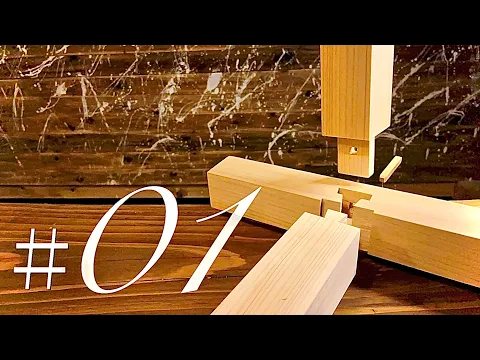
This family secret practice has been contested recently by initiatives seeking to democratize ancestral knowledge. One example is the Twitter account @TheJoinery_jp, which catalogs different types of joints through animated gifs created with Autodesk Fusion 360, making visible the complexity of cuts that previously remained restricted to closed circles of specialized craftsmen.
Despite digital openness, complete learning still requires difficult and time-consuming training that results in relatively high prices for handmade wooden items.
Few carpenters master all variations of joints needed to build complex buildings, which keeps the technique as a rare specialty even in the face of contemporary outreach efforts.
Tsugite Program Automates Joint Design for CNC Milling Machines
The University of Tokyo developed a free application called Tsugite that greatly simplifies the work of designing wooden joints and connects directly with digital fabrication equipment.
Through a simple 3D interface, even users with little or no prior experience in woodworking or 3D design can create projects for functional joints in minutes by following on-screen instructions.
The program uses voxels (three-dimensional cubes) that can be moved to the ends of the components to be joined, with the algorithm automatically adjusting the corresponding voxels to ensure a perfect fit.
Different colors inform the user about the properties of the joints such as the ease of sliding between pieces or potential structural weaknesses that need to be corrected.
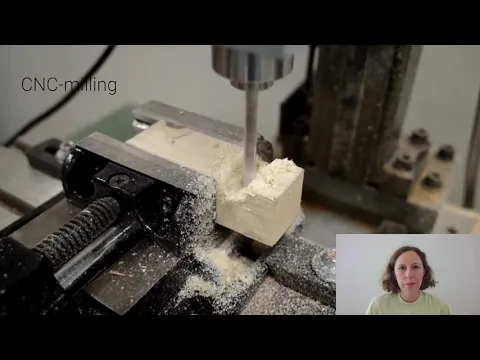
What makes Tsugite unique is that it factors the manufacturing process directly for the CNC equipment being used.
This means that milling machines with different physical limitations such as degrees of freedom, tool size, and movement range only receive designs that they are capable of producing, eliminating impractical designs even before production begins.
Reduction of Material Mixing Facilitates Recycling and Responsible Disposal
The use of joints to connect wooden pieces instead of metal fastenings drastically reduces the mixing of materials in the final product. This is crucial for sorting and recycling because pure wood can follow specific destinations without the need for manual separation of embedded metal components. Nails, screws, and galvanized sheets need to be removed before correct disposal, generating additional work and processing costs.
This material purity adds sustainability benefits to wood as a construction resource. Buildings erected with pure joints can be disassembled and reassembled elsewhere without destroying the components, something unthinkable in conventional structures fixed with concrete or metal welds. Defective pieces can be individually replaced while keeping the rest of the building intact.
The flexibility of reuse and repair extends the lifespan of constructions far beyond what modern systems allow.
While reinforced concrete buildings have a projected durability of 50 to 100 years, Japanese temples built over a thousand years ago remain functional after successive maintenances that only replace damaged elements without compromising the overall structure.
Centenarian Temples Prove Superior Durability to Modern Constructions
Buildings hundreds of years old erected without the use of a single nail still stand in Japan, resisting earthquakes, typhoons, and extreme climate variations. These historic buildings serve as practical laboratories demonstrating the effectiveness of traditional joints under real stress conditions over centuries, something no laboratory test can replicate accurately.
The maintenance of these ancient structures follows the same principles as the original construction. When a beam rots or cracks, carpenters remove it and install a replacement using the same joints that secured the original piece. There is no need for partial demolitions or structural reinforcements because the joint system accommodates exchanges without loss of overall stability.
This longevity contrasts sharply with the planned obsolescence of contemporary buildings that rely on composite materials and chemical fastenings. Reinforced concrete develops internal corrosion of reinforcements that compromises strength after decades of exposure to moisture.
Structural adhesives degrade under UV radiation and thermal variations, losing load-bearing capacity. Well-executed wooden joints do not suffer these limitations when the wood is properly treated.
Modern Application Faces Challenges of Scale and Speed of Construction
Despite all the technical and environmental advantages, traditional Japanese carpentry faces significant barriers to mass adoption in contemporary construction.
The time required to manually cut each joint makes large-scale projects economically unviable compared to industrialized systems that prioritize speed above all. A single joint can require hours of artisanal work, while metal connectors are installed in minutes.
The scarcity of skilled labor exacerbates the problem. Few carpenters master the dozens of joint variations needed to construct complex buildings, and training new artisans takes years of practical learning that few are willing to invest.
This creates a supply bottleneck that keeps costs high and restricts application to special projects with generous budgets.
CNC milling machines programmed with software like Tsugite can speed up the production of complex joints but still face limitations in large pieces or highly elaborate geometries. The integration between digital design and automated manufacturing is evolving; however, it has not yet reached the efficiency needed to compete with conventional methods in large-scale commercial construction.










-

-

-

-

5 pessoas reagiram a isso.