





 Portuguese
  English
  Spanish
  3 min of reading
  0 comments


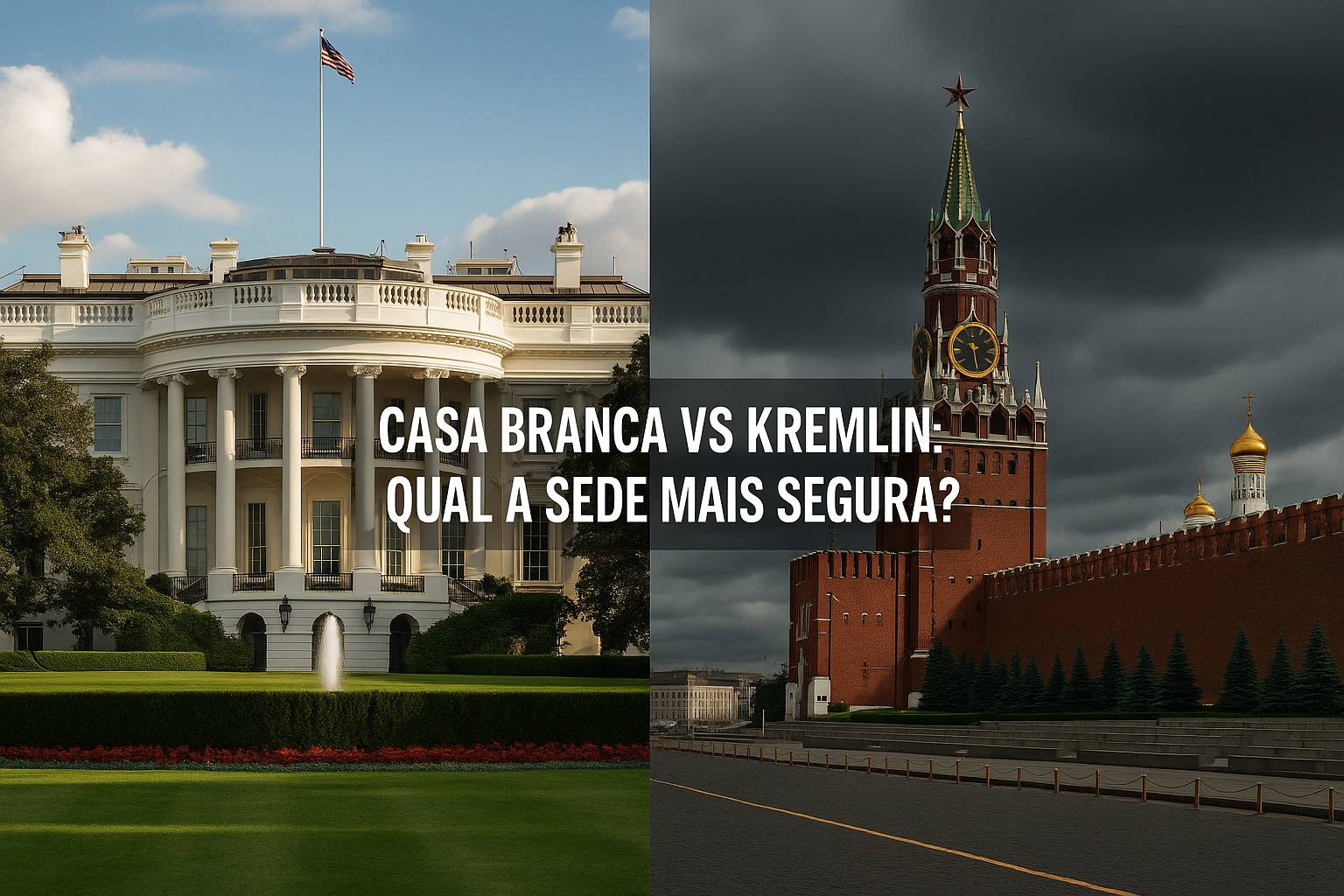
Between Secrecy And Transparency, The White House And The Kremlin Reveal Opposing Protection Strategies. While The U.S. Prioritizes Public Auditing, Russia Bets On Centralized Surveillance And Air Defense Installed At Strategic Points In Moscow
At first glance, comparing the security of the White House — a symbol of power in the United States — with that of the Kremlin and Russian government buildings seems almost like a political fiction. However, by examining public data, protection agencies, and institutional structures, we can draw a realistic, albeit incomplete, comparison.
The Security Of The White House: Transparency And Multiple Layers
The protection of the White House is the responsibility of the U.S. Secret Service, a federal agency under the Department of Homeland Security.
This mission includes protecting the president, the vice president, their residences, and significant national events.
-
He started running at 66 years old, broke records at 82, and is now a subject of study for having a metabolic age comparable to that of a 20-year-old, in a case that is intriguing scientists and inspiring the world.

-
Oldest tree on the planet reappears after 130 years of searches: Wattieza, 385 million years old, was 10 meters tall and had no leaves or seeds; Gilboa fossils in New York solved the mystery in 2007.

-
A 48-square-meter house assembled in hours with 4,000 bricks made of recycled plastic that does not absorb moisture, has natural thermal insulation, and costs less than 90,000 reais in a complete kit.

-
Luciano Hang revealed that Havan’s air fleet has already accumulated more than 20,000 landings, 10,000 flight hours, and 6 million kilometers traveled, and he says that without the planes, the company would never have grown so quickly.


Within the complex, the Uniformed Division is responsible for the physical security of the site. This division maintains patrols, fixed posts, and oversight, and coordinates actions with specialized agents.
Additionally, the building houses the Situation Room — a subterranean command and secure communication center. There, the government can make strategic decisions during national and international crises.
The perimeter is highly monitored. There are barriers, security scanners, cameras, and access control with multiple layers.
Still, the White House is not immune to incidents. There have been attempted break-ins, including by individuals who managed to enter the grounds.
The high degree of visibility also brings risks. Adversaries can study routes, exploit vulnerabilities, or attempt drone attacks.
On the other hand, American transparency allows for failures to be investigated and discussed publicly, which reinforces trust in the system.
There is no official data confirming the presence of missiles or cannons installed directly at the White House, however, the Washington, D.C. area is part of the national air defense system of the U.S.
This network includes radars, interceptors, and mobile batteries capable of responding to aerial threats within seconds.
Russian Security: Secrecy And Centralized Power
In Russia, the protection of the Kremlin and the president is the responsibility of the Federal Guard Service (FSO), an elite agency with broad powers.
Its personnel and budget are classified, but it is estimated to have tens of thousands of agents.
The FSO houses the Presidential Security Service (SBP), which manages the direct security of the president and his residences.
It also includes the Kremlin Regiment, responsible for defending the walls, ceremonial guards, and physical control of the area.
Another essential body is the Commandant’s Office of the Moscow Kremlin, which inspects visitors and maintains surveillance inside and outside the complex.
For secure communications, there is also Spetssvyaz — a service specialized in cryptography and data protection for the government.
The Russian system is strongly centralized. The FSO has the power to conduct searches without warrants and to oversee other security agencies. This ensures rigid and highly controlled protection.
Opacity is also a strategic advantage. Failures or attacks rarely reach the public, reinforcing the image of invulnerability and efficiency of the Kremlin.
Comparative: Security Or Transparency?
In terms of control and secrecy, Russia has the advantage. Concentrated power and internal surveillance give the Kremlin a level of protection that is difficult to match.
The White House, on the other hand, relies on transparency, inter-agency cooperation, and the constant upgrading of its technologies. When failures occur, they are corrected based on audits and public reports.
Therefore, if the criterion is control and secrecy, the Kremlin appears to be more secure. But if we consider efficiency, coordination, and public accountability, the White House maintains a solid, modern, and auditable structure.
In both cases, security is a direct result of how each country views power and access to information.








-

2 pessoas reagiram a isso.