





 Portuguese
  English
  Spanish
  4 min of reading
  0 comments


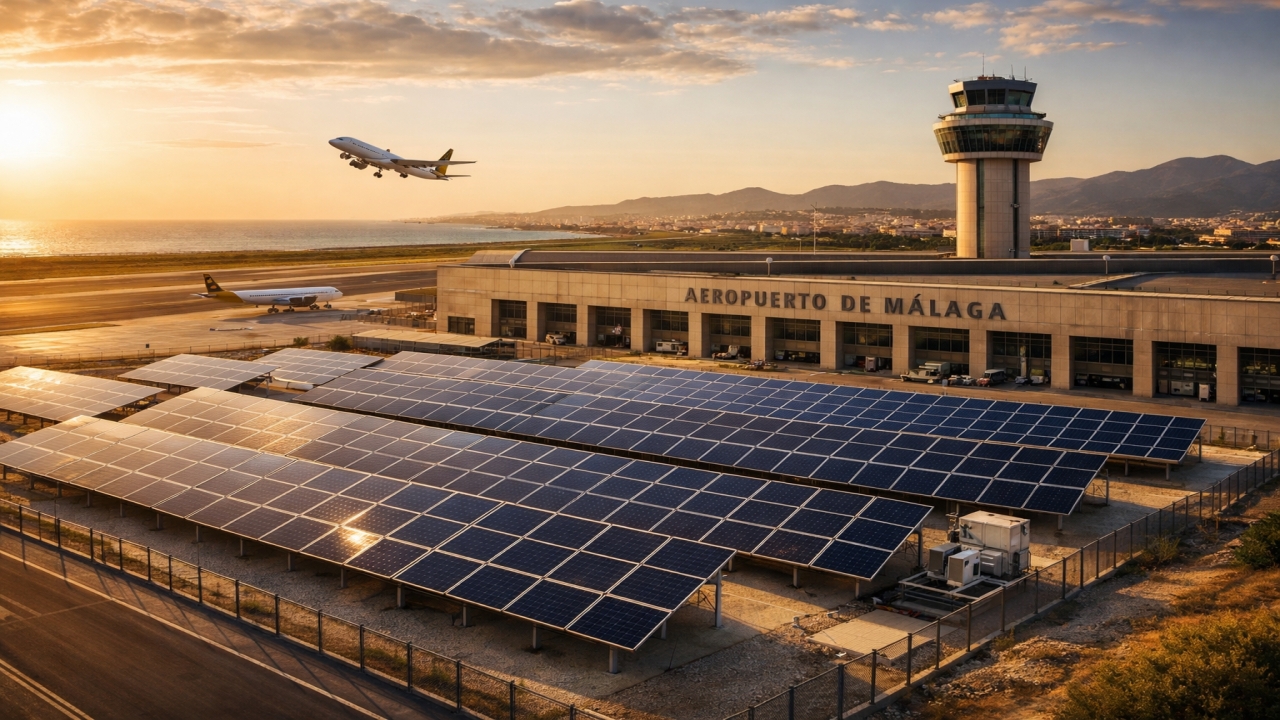
Spanish Airport Saw The Sun Become A Threat To Pilots: Self-Consumption Photovoltaic Installations Transform Málaga Airport After Years Of Risk For Landings And Takeoffs
Self-consumption photovoltaic installations at Málaga Costa del Sol Airport have ceased to be a risk to aviation and have become a safe energy solution as private companies adopted rigorous technical studies, adjusted the position of the solar panels, and proved that glare does not compromise landings and takeoffs at one of the most monitored spaces in Spain.
For decades, airports avoided solar energy due to fears of visual glare. In Málaga, in the south of Spain, this issue was tackled with science, planning, and real data. The result has become a reference for other European airports.
Why Airports Have Always Seen Solar Energy As A Security Problem
The main fear was never energy generation. The risk was in the reflection. Poorly positioned solar panels can reflect sunlight directly into pilots’ eyes during approach or obstruct the visibility of the control tower.
-
Friends have been building a small “town” for 30 years to grow old together, with compact houses, a common area, nature surrounding it, and a collective life project designed for friendship, coexistence, and simplicity.

-
This small town in Germany created its own currency 24 years ago, today it circulates millions per year, is accepted in over 300 stores, and the German government allowed all of this to happen under one condition.

-
Curitiba is shrinking and is expected to lose 97,000 residents by 2050, while inland cities in Paraná such as Sarandi, Araucária, and Toledo are experiencing accelerated growth that is changing the entire state’s map.

-
Tourists were poisoned on Everest in a million-dollar fraud scheme involving helicopters that diverted over $19 million and shocked international authorities.


That is why airports have always been sensitive areas. Any new structure must comply with strict air safety rules. In Spain, these regulations are enforced by Aena, the country’s airport operator.
For a long time, the solution was simple. Do not install panels. The sun was seen as an enemy on runways and areas near aircraft.
How Málaga Broke This Stalemate And Became An Unprecedented Case In Spain

Málaga Costa del Sol Airport became the first in the country to receive self-consumption photovoltaic installations made by private companies within its operational perimeter.
The rental companies Europcar and Goldcar led the project. The execution was carried out by the engineering company Ubora Solar, based in the city itself. The difference was that the initiative did not come from the airport operator, but from the companies located there.
The main source that revealed the details of the project was the newspaper La Opinión de Málaga.
The Technical Study That Showed That Glare Did Not Put Flights At Risk
The challenge was neither financial nor structural. It was visual. Ubora Solar conducted comprehensive glare studies, following standards from the Federal Aviation Administration of the United States and the European Union Aviation Safety Agency.
These studies analyzed actual flight paths, sunlight timings throughout the year, and the position of the control tower. The inclination and orientation of the panels were calculated precisely.
The data showed that the luminance generated was well below the European limit of 20,000 candelas per square meter, according to official EASA parameters. Moreover, any reflections coincided with the sun on the horizon itself.
This effect is called solar masking. The glare exists but is invisible to the human eye because it blends with the natural sunlight. This eliminates operational risk.
More technical information on glare limits is available on the official website of the European Union Aviation Safety Agency.
Why The Málaga Model Could Spread To Other Airports
In countries like the United States, Germany, and the Netherlands, airports with solar energy have been operating for years. The difference is that, in Spain, such projects have always depended on Aena itself.
Málaga created a precedent. It showed that private companies can invest in self-consumption photovoltaic installations within airports, as long as they meet rigorous technical criteria.
This paves the way for reducing energy costs, cutting carbon emissions, and accelerating the energy transition in areas considered untouchable until recently.
According to data from the International Energy Agency, distributed solar generation grows faster when consumption occurs on-site.
When The Sun Stopped Being A Threat And Became An Ally
For years, landing at an airport surrounded by solar panels seemed like a nightmare for pilots. In Málaga, it became proof that technology and science can resolve long-standing fears.
The airport does not receive millions of passengers each year. Now, it also serves as a laboratory for a new energy model in critical areas.
Without compromising safety, Málaga showed that the biggest obstacle to solar energy is not the sun. It is the lack of study.
If you are interested in innovation, clean energy, and urban solutions that seem impossible, keep exploring our content and discover how technology is changing places previously thought unimaginable.










-

Uma pessoa reagiu a isso.