





 Portuguese
  English
  Spanish
  7 min of reading
  1 comment




Meet The Animals That Clear Land Mines, Install Fiber Optic Cables, And Detect Cancer Better Than The Most Advanced Technology On The Planet
While humanity rapidly advances in the development of robots and artificial intelligence, there are tasks that no machine has yet been able to perform with the same efficiency as some animals. Giant African rats that clear land mines, ferrets that install fiber optic cables, and dogs that sniff out cancer before any medical exam—these are real stories that show that, in certain situations, nature still outperforms technology.
One of the most impressive examples comes from the Belgian NGO APOPO, which trains giant African rats to find land mines in conflict zones.
According to data from the International Campaign to Ban Landmines, nearly 6,300 people were killed or injured by land mines in 2024, with 90% of them being civilians and nearly half being children. It is an urgent problem, and these animals are on the front lines of the solution.
-
He started running at 66 years old, broke records at 82, and is now a subject of study for having a metabolic age comparable to that of a 20-year-old, in a case that is intriguing scientists and inspiring the world.

-
Oldest tree on the planet reappears after 130 years of searches: Wattieza, 385 million years old, was 10 meters tall and had no leaves or seeds; Gilboa fossils in New York solved the mystery in 2007.

-
A 48-square-meter house assembled in hours with 4,000 bricks made of recycled plastic that does not absorb moisture, has natural thermal insulation, and costs less than 90,000 reais in a complete kit.

-
Luciano Hang revealed that Havan’s air fleet has already accumulated more than 20,000 landings, 10,000 flight hours, and 6 million kilometers traveled, and he says that without the planes, the company would never have grown so quickly.


It’s not just about rats, though. Ferrets in England are contracted for engineering tasks that no human can perform, and dogs trained by organizations like Medical Detection Dogs in the UK have already proven that their sense of smell can save lives in a way that science is still trying to understand.
The HeroRATs, Rats That Save Lives In Minefields

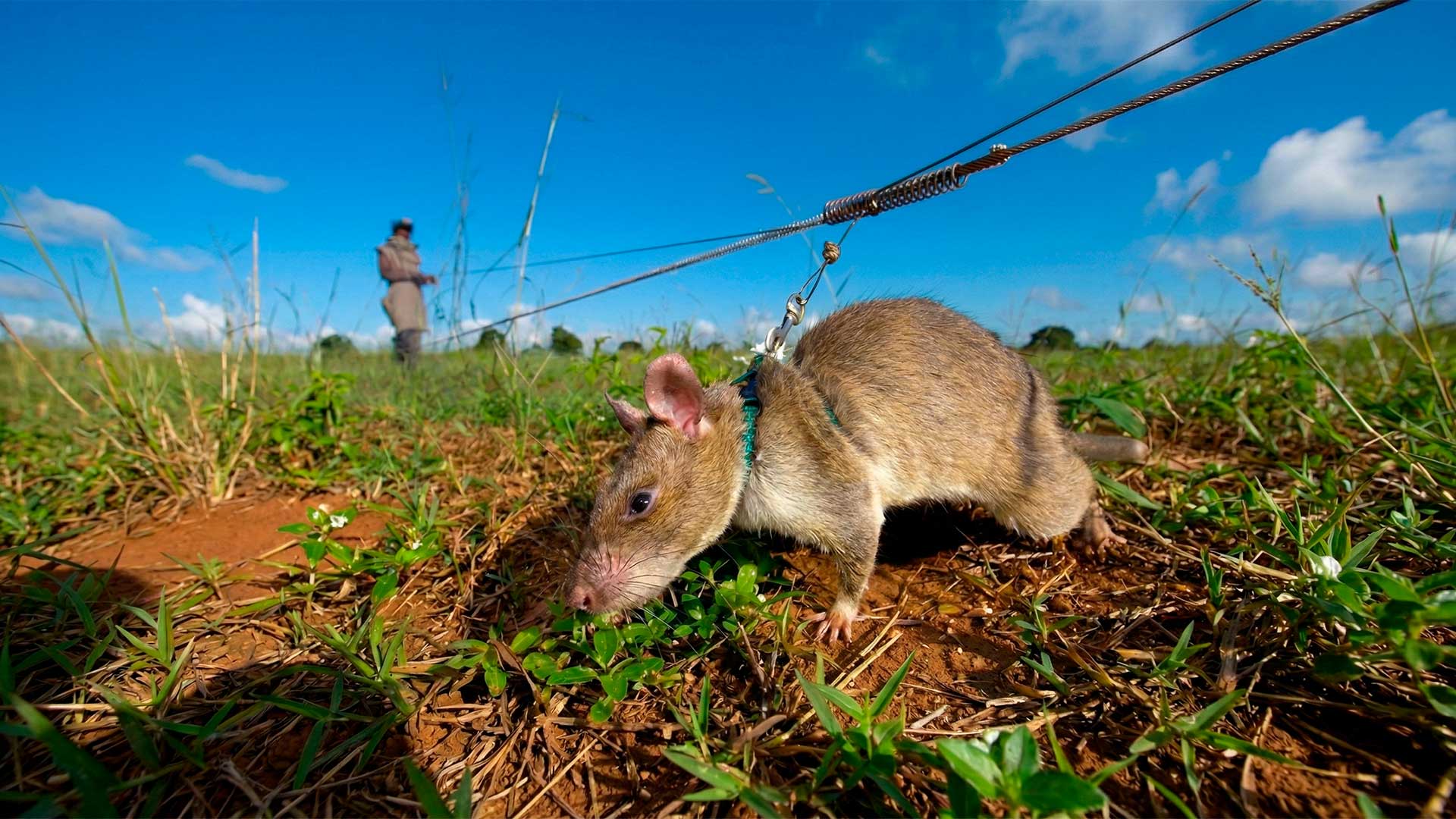
The NGO APOPO, based in Belgium and operating since 1997, uses a species of rat known as the giant African rat (Cricetomys gambianus) to carry out humanitarian demining work. These animals, nicknamed HeroRATs, are approximately the size of a small cat and have cheek pouches similar to those of a hamster, where they like to store food.
The efficiency of these rats is difficult to grasp at first glance. According to information from APOPO, a single rat can scour an area the size of a tennis court in about 20 to 30 minutes, a job that would take a technician with a metal detector between one and four days to complete.
The reason they are so efficient is biological. Giant African rats are light enough to walk over a pressure-sensitive mine without triggering it, but big enough to cover large areas quickly.
When they smell substances like TNT, they scratch the surface of the ground—this is the signal for handlers to mark the spot and then safely remove the mine.
A crucial advantage over metal detectors is that these animals ignore metal debris scattered across the ground, focusing only on the smell of explosives. This makes the work much more precise in areas with a lot of debris.
An Impressive Track Record And A World Record
The most famous of the HeroRATs was Magawa, a rat that worked in Cambodia for five years and found 71 land mines and 38 items of unexploded ordnance. In 2020, he received a gold medal from the British veterinary charity People’s Dispensary for Sick Animals, becoming the first rat in history to receive this award.
More recently, another HeroRAT named Ronin broke Magawa’s record and entered the Guinness World Records.
According to APOPO, since his deployment in the province of Preah Vihear, Cambodia, in August 2021, Ronin has detected 109 land mines and 15 items of unexploded ordnance. At just five years old, he can still work for two more years.
In total, according to data from APOPO, the HeroRATs have already cleared more than 120 million square meters of former minefields in countries like Angola, Azerbaijan, and Cambodia. To get a sense of the scale of this work, this area is larger than the city of Paris.
Ferrets: The “Engineers” No One Expected
If the rats are already impressive, the ferrets offer an even more unexpected surprise. In the Derbyshire region of England, the National Ferret Training School operates, run by zoologist James McKay, who is internationally recognized as an authority on ferrets and their uses in industry and agriculture.
The company keeps more than 50 ferrets of various sizes and uses them to install fiber optic cables, locate blockages in underground drains, and even pull electrical cables through spaces that no machine can reach.
The ferrets are equipped with a transmitter and a thin wire attached to their collar. As they move through the tubes, the wire trails behind and is later used to pull the actual cable through the path the ferret created.
The use of ferrets for this type of work is not exactly new. According to information from the National Ferret Training School, these animals were domesticated about 2,500 years ago, originally to hunt rabbits that humans could not reach. The Roman Legion took them along during their campaigns for exactly this reason.
From Drains To A Particle Accelerator
One of the most curious stories about ferrets working involves particle physics. In 1971, scientists from what was then called the United States National Accelerator Laboratory—later renamed Fermilab, in honor of physicist Enrico Fermi—faced a serious problem while constructing a particle accelerator.
Microscopic metal fragments were blocking the vacuum tubes of the equipment, which were approximately the diameter of a tennis ball. As no machine could clean these tubes, a British engineer named Robert Sheldon suggested using a ferret. For just $35, the laboratory purchased a small female ferret named Felicia, who was trained to navigate sections of 300 feet of the tubes with a wire attached to her collar.
According to records from Fermilab, Felicia completed about a dozen successful runs and saved the laboratory thousands of dollars. She became a small celebrity at the time, even appearing in Time magazine. After her retirement, engineer Hans Kautzky developed a mechanical device he called a “magnetic ferret” to continue the work.
Dogs That Scent Diseases: The Most Powerful Nose On The Planet
While the rats and ferrets impress with what they do in the physical environment, the dogs offer a capacity that seems almost supernatural: detecting diseases by smell. Dr. Claire Guest, co-founder and scientific director of Medical Detection Dogs, an organization based in Milton Keynes, England, is one of the leading authorities on the subject.
According to Dr. Guest, dogs have approximately 300 million olfactory receptors, while humans have only 5 million.
Moreover, the structure of a dog’s nose allows them to inhale and exhale simultaneously, maximizing the detection of odor molecules. This means they can identify extremely subtle odors and follow scents for hours.
These dogs have already been trained to detect cancer, epilepsy, malaria, Parkinson’s, and even COVID-19. Medical Detection Dogs has trained and deployed nearly 200 assistance dogs that work daily to save the lives of their owners. In cancer screening tests, the organization’s dogs demonstrated a reliability rate of 93%, a figure higher than many conventional tests used by the British health system.
Medical Assistance Dogs That Change Lives
In addition to detecting diseases in samples, Medical Detection Dogs also trains medical assistance dogs that live and work with a single human. These dogs are trained to alert their owners when a medical emergency is about to happen.
One of the most remarkable cases is that of Lauren, who suffers from postural orthostatic tachycardia syndrome and a functional neurological disorder. Her assistance dog, Mabel, learned to signal when Lauren is about to faint or have a seizure by putting her head in her lap or preventing her from getting up.
Lauren was diagnosed at 16, and before having Mabel, she could not dress, wash, or feed herself. According to her, the dog dramatically changed her life, allowing her to go out and move independently. When asked if she would trade Mabel for a robot, her answer was immediate: she wouldn’t trade her for anything in the world, because in addition to alerting her, there is an emotional connection that no machine can replicate.
Why Nature Still Beats Technology?
What connects all these animals—rats, ferrets, and dogs—is the capability that evolution has bestowed upon them over millions of years: acute sense of smell, bodies adapted to confined spaces, intelligence, and the ability to learn through positive reinforcement. Technology has advanced tremendously, but it has still not managed to reliably and cost-effectively replicate these characteristics.
According to data from APOPO, the operational cost of keeping a rat for demining is significantly lower than the investment required to use robots or advanced sensors. This allows humanitarian organizations to clear much larger areas with the resources available. In engineering and health fields, the situation is similar: ferrets and dogs offer practical, economical, and reliable solutions that technology has yet to surpass.
In an era where automation seems poised to replace everything, these animals remind us of a simple but powerful fact: nature still has much to teach us.
Do you think technology will one day replace these animals in their roles? Should HeroRATs be considered official heroes by the countries they help free? Leave your comment below and join this discussion.









Isso é magnífico saber que os animais superam a tecnologia.