





 Portuguese
  English
  Spanish
  4 min of reading
  15 comments


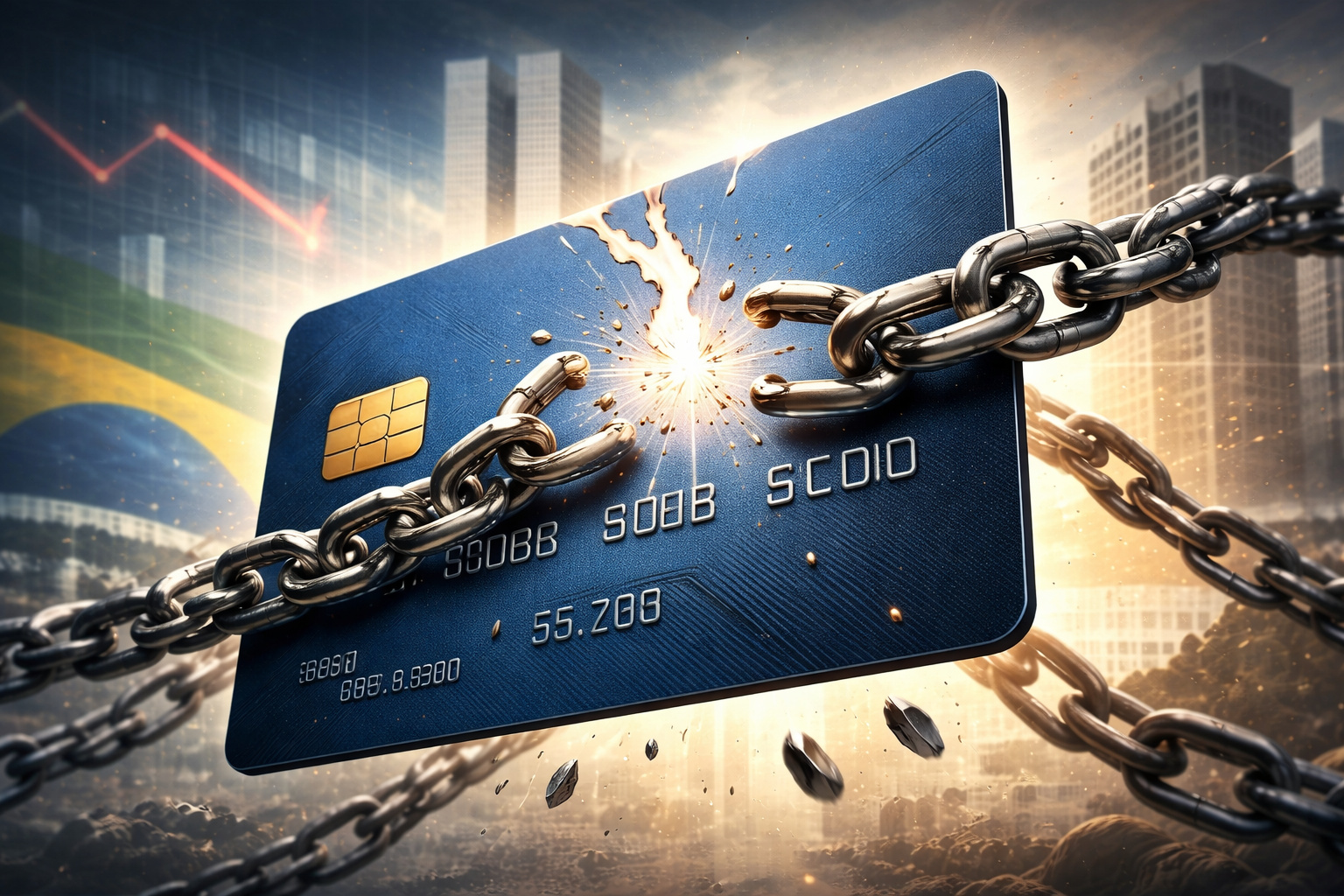


Law No. 14,690/2023 Limits Credit Card Interest Rates, Halts Debt Growth, Mandates Renegotiation, and Changes Rules for Revolving Credit in Brazil.
For years, credit cards have been one of the main drivers of over-indebtedness in Brazil. It was enough to miss a payment to enter the revolving credit and watch the debt grow almost infinitely, driven by interest rates that reached over 400% per year. This scenario began to change concretely with the Law No. 14,690/2023, enacted to permanently alter the rules of credit cards in the country.
The new law establishes objective limits for interest and fees, imposes unprecedented obligations on banks, and changes the logic of revolving credit, directly affecting customers of Nubank, Caixa Econômica Federal, Banco do Brasil, Itaú, Bradesco, and Santander. For the first time, the growth of credit card debt now has a clear legal brake.
What Law No. 14,690/2023 Changes in Revolving Credit for Credit Cards
The central point of Law No. 14,690/2023 is the end of the so-called “snowball” effect of credit card debt. The legislation states that the total amount charged to the consumer — including interest, fines, and charges — cannot exceed the original amount of the debt.
-
The noise law will no longer be in effect at 10 PM starting in June with a new rule valid during the 2026 World Cup.

-
The Chamber opens a debate on driver’s licenses at 16 years old as part of a reform that includes around 270 proposals to change the Brazilian Traffic Code and may redesign rules for licensing, enforcement, and circulation in the country.

-
The new Civil Code could revolutionize marriages in Brazil with “express divorce” and changes that could exclude spouses from inheritance.
-
Banco do Brasil sues famous influencer for million-dollar debt and intensifies debate on delinquency, risks of seizure, and direct impact on Gkay’s credibility.



In practice, this means that a bill of R$ 1,000 cannot generate a charge exceeding R$ 2,000, regardless of the delay time. Before the law, there was no legal limit to this growth, which turned small debts into unpayable commitments.
With the new rule, revolving credit ceases to be a mechanism of financial entrapment and now has a mandatory legal ceiling.
Law No. 14,690/2023 Mandates Banks to Renegotiate Credit Card Debts
Another decisive advancement brought by Law No. 14,690/2023 is the obligation of renegotiation. Financial institutions can no longer keep consumers indefinitely in the revolving credit. After a short period, the bank is required to offer an alternative installment plan for the debt, with clearer and more predictable rules.
This change profoundly alters the relationship between banks and customers. Previously, renegotiation was optional, often costly and not very advantageous. Now, the law creates a legal duty to present solutions that allow for debt settlement without uncontrolled growth.
For consumers, this means more bargaining power and a legal basis to demand fair conditions.
How Law No. 14,690/2023 Impacts Those Already Indebted
For those already with credit card debts, Law No. 14,690/2023 represents a turning point. Consumers now know exactly how much their debt can grow and gain legal backing to question abusive charges.
Consumer rights experts point out that the law strengthens the client’s position in extrajudicial negotiations, in consumer protection agencies, and even in court. If the bank breaches the legal limit or refuses to renegotiate, the consumer now has clear grounds for contesting.
Moreover, the predictability brought by the law makes financial planning easier and reduces the risk of exclusion from the credit system due to prolonged default.
Effects of Law No. 14,690/2023 on Banks and the Financial System
From the perspective of the financial system, Law No. 14,690/2023 forces a structural change in the credit card business model.
Profit based solely on high-interest rates tends to diminish, paving the way for more balanced credit granting practices.
Economists believe that the measure brings Brazil closer to international standards, where limits on revolving credit have existed for years. In the medium term, the expectation is for a reduction in structural delinquency, less litigation, and greater stability in the consumer market.
Banks and fintechs are now pressured to invest in financial education, more rigorous risk analysis, and less aggressive products.
Relation of Law No. 14,690/2023 with the Fight Against Over-Indebtedness
Law No. 14,690/2023 integrates into a larger set of public policies aimed at combating over-indebtedness in Brazil, such as the Over-Indebtedness Law and debt renegotiation programs. The goal is to tackle not just the symptom but the machinery that produces chronic debts in the country.
By imposing clear limits and mandating renegotiation, the state acknowledges that the market has been unable to self-regulate on this issue and that consumer protection requires direct intervention.
What Changes in Practice for Customers of Nubank, Itaú, Caixa, and BB
In practice, Law No. 14,690/2023 guarantees concrete rights: maximum charge limit, obligation to renegotiate, predictability of debt, and protection against historical abuses of revolving credit. The credit card ceases to be an instrument of absolute risk and now operates within clearer rules.
This is not an automatic debt forgiveness, but a legal brake that redefines the balance between banks and consumers.
Law No. 14,690/2023 does not solve all credit problems in Brazil, but marks a historic turning point by placing limits where there was previously total freedom to charge.
And you, reader: will this new law be sufficient to change banks’ behavior, or will the market find new ways to circumvent the rules?










Sim nao resolve todos os problemas pq dobrar o valor da dívida tb é um absuso. Mas ter um breque ja ajuda um pouco. Pq cobrar o qto eles querem e como querem cobrar. As pessoas se afunda de uma vez. Isso nao era nem pre ser regra . Pq nada no Brasil sobe 100% alem das dívidas. Salários subiu.do 4% ao ano e cartão cobrando qtos eles querem e agora 100% ainda continua uma desigualdade sem igual. Ainda acho que
50% ja é um aumento consideravel alto , sendo que só político consegue dobrar salários com o aumento que se dão.alem de ter ajuda de moradia . Paletó. Combustível. E o pobre tem que se desdobrar pra conseguir respirar.
Está de parabéns quem criou a lei.
Essa lei deveria valer também para os juros dos empréstimos também.