





 Portuguese
  English
  Spanish
  5 min of reading
  0 comments


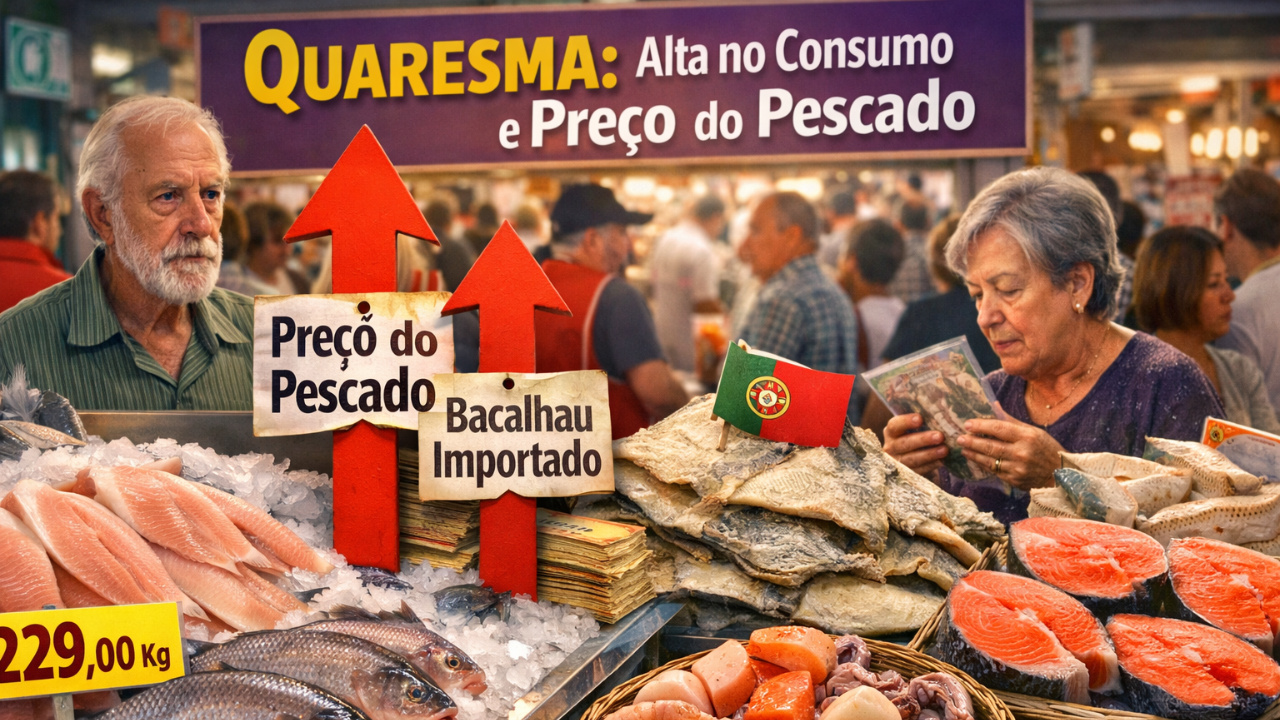
Lent Drives Fish Consumption, Pressures Seafood Prices, and Increases Imported Cod Prices in the DF. Local Production Tries to Meet Demand.
The Lent already has direct reflections on the pockets and plates of Brasília residents. What is happening is an increase in the price of seafood and in fish consumption, especially tilapia and imported cod.
Those who feel this impact are merchants and consumers in the Federal District, especially between Carnival and Holy Week, a period when nearly half of the population — 49.74%, according to IPEDF — identifies as Catholic.
As a consequence of the religious tradition of avoiding red meat, demand grows, stocks turn over more quickly, and prices rise.
-
The government requests the Federal Revenue Service for a new system to automate the income tax declaration, reducing errors, time, and bureaucracy for millions of Brazilians.

-
Pix in installments, international Pix, and contactless payment without internet: the Central Bank revealed the new features coming to the tool that is already used by almost every adult in Brazil.

-
Mercado Livre has just started selling medications with delivery in up to three hours to your door, and this move could completely change the way Brazilians buy medicines on a daily basis.

-
In Dubai, rising tensions from the war in the Middle East are causing super-rich individuals to leave the Gulf and direct their fortunes to a new financial refuge in Asia.


In addition, costs for feed, transportation, and logistics also pressure the market.
Fish Consumption Grows by Up to 60% During Lent
In fishmongers in the DF, activity has already changed.
At the Guará Fair, sales can increase by 60% during Lent and Holy Week compared to the rest of the year.
According to manager Leandro Braga, the most sought-after products include bass, yellow croaker, salmon, tilapia, and the traditional imported cod, as well as shrimp, squid, and octopus for paella.
Tilapia, primarily produced in the DF, tends to be the most affordable option, while cod, coming from Norway and Portugal, tops the list of the most expensive.
The expectation is that the price of seafood will rise by between 10% and 15% by Good Friday. To meet demand, the fishmonger hired 15 temporary employees.
“During these days, we open the store at 4 a.m. due to the movement.
The entire Fair gets非常 crowded, making it even difficult to move,” said Leandro.
Imported Cod Could See Price Increase of Up to 60%
The impact on wallets is mainly felt in imported cod.
In supermarkets in the DF, the price per kilo can be double that of tilapia, and further adjustments are expected.
“Our expectation is that during this Lent period, there will be an increase in seafood sales of between 18% and 25% in supermarkets.
In the case of cod, the forecast is for a price increase of up to 60%. To avoid passing this cost on to consumers abruptly, we will try to negotiate this burden between importers and merchants,” says Givanildo de Aguiar, spokesperson for the Brasília Supermarkets Association (Asbra).
In addition to high demand, exchange rate fluctuations directly influence the final price since the product depends on the dollar.
Therefore, any fluctuation in the currency affects the price of seafood on the shelves.
Consumers Maintain Tradition Despite Seafood Prices
Even with high prices, many consumers do not give up the tradition. Retiree Miguel Maluf, aged 75, sums up the feeling of those facing the counters.
“Very expensive,” he emphasized. “I observe Lent every year, avoiding red meat. But I try to vary my options, including white meats and eggs. Today, I will buy tambaqui. I really like cod, but I only buy about 300g and during Holy Week because it’s an absurd price.”
Retiree Vânia Vieira, aged 76, also maintains the custom, although she acknowledges that prices are “higher than last year.”
Regarding the main dish, she admits uncertainty: “I have been looking at the price of cod. It’s so expensive. But I don’t want to let it go by without celebrating. It’s a tradition.”
Local Production Gains Strength With Increased Fish Consumption
If on one hand the price of seafood is concerning, on the other hand, local production is experiencing a moment of expansion. Tilapia represents over 90% of the volume produced in the DF, followed by tambaqui, pacu, and pintado.
According to Adalmyr Borges from Emater-DF, growth is significant.
“Production in the DF has been growing a lot. To give you an idea, we went from 2,163 tons in 2024 to 2,637 tons in 2025, an increase of 22%.
This increase is well above that observed in other productive chains here,” he assured.
So, between Carnival and Holy Week, 40% of all annual seafood sales in the DF occurs.
This planning allows the fattening cycle of the fish, which lasts six to eight months, to be completed just in time for Lent, the period of highest fish consumption.
Still, the local market needs to rely on neighboring states to meet demand.
Why Do Seafood Prices Rise During Lent?
The increase in the price of seafood occurs due to three main factors:
Increased consumption for religious reasons;
Higher production costs, such as feed and transportation;
Dependence on the dollar in the case of imported cod.
Moreover, experts point out that higher-income consumers tend to maintain their consumption even with high prices, while lower-income families switch to chicken or eggs.
Tips to Save on Fish Purchases During Lent
Given the rise in seafood prices, consumers need to be more attentive. Here are some important guidelines:
Monitor the weighing of fresh fish.
Check if the product is well refrigerated or covered with adequate ice.
Avoid overcrowded frozen counters, which hinder cold air circulation.
Do not allow ice to be weighed together with the fish.
Check the origin of the cod and avoid pieces with reddish stains or dark spots.
Be cautious of prices significantly below the market rate.
If irregularities are identified, consumers can contact Procon at 151 or via email 151@procon.df.gov.br.
Lent Strengthens Tradition and Moves the Economy
Despite the adjustments, Lent remains one of the most important periods for the sector.
The increase in fish consumption strengthens local production, stimulates markets and supermarkets, and keeps a cultural and religious tradition alive.
Meanwhile, consumers balance faith, budget, and price research to maintain the traditional menu of Holy Week — even in the face of rising imported cod prices and the rest of the market.
Read more at: Understand the Price Increase of Seafood During This Time of Year









-

Uma pessoa reagiu a isso.