





 Portuguese
  English
  Spanish
 5 min of reading
  0 comments


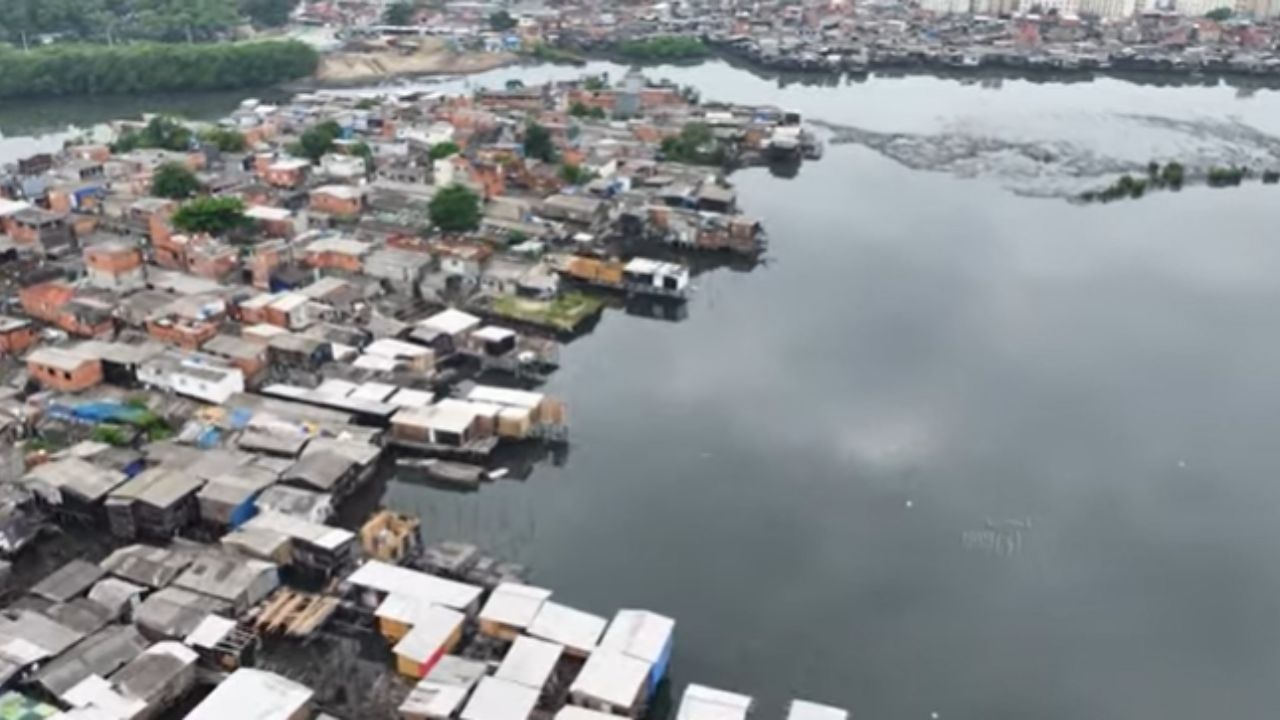
Community of Over 20,000 People Lives Under Constant Threat of Flooding in a City That, According to the UN, Could Be Partially Engulfed by the Sea by 2050.
Located at an average altitude of only two meters above sea level, the city of Santos in São Paulo embodies a reality of extremes. On one side, one of the most important ports in Latin America; on the other, the largest slum built on stilts in Brazil, the Dique da Vila Gilda. A study by the Institute for Applied Economic Research (IPEA), detailed in the magazine Planning and Public Policies (PPP), confirms the magnitude of the settlement and the complex socio-environmental challenges faced by its thousands of residents, who live in a state of permanent vulnerability.
The danger is not abstract. It materializes with each heavy rain that coincides with high tide, a devastating phenomenon that paralyzes the city. The threat, however, goes beyond periodic flooding. A report from the United Nations (UN), reported by the portal Nautica.com.br, places Santos on global alert: the city is one of the Brazilian urban areas with the highest risk of being permanently flooded by rising sea levels in the coming decades, making the struggle for survival a race against time.
Life in Dique da Vila Gilda: Between Adaptation and Risk
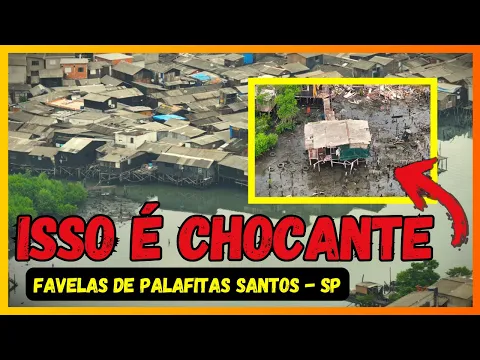
The Dique da Vila Gilda is the human epicenter of the climate crisis in Santos. According to data analyzed by IPEA, over 20,000 people live in wooden houses raised on stilts driven into the bed of the Rio dos Bugres. This community, identified by the institute as the largest slum built on stilts in Brazil, originated from an informal occupation in a sensitive mangrove area, which has now become a socio-environmental trap for its inhabitants.
-
This small town in Germany created its own currency 24 years ago, today it circulates millions per year, is accepted in over 300 stores, and the German government allowed all of this to happen under one condition.

-
Curitiba is shrinking and is expected to lose 97,000 residents by 2050, while inland cities in Paraná such as Sarandi, Araucária, and Toledo are experiencing accelerated growth that is changing the entire state’s map.

-
Tourists were poisoned on Everest in a million-dollar fraud scheme involving helicopters that diverted over $19 million and shocked international authorities.

-
Hidden beneath the dense forest of the Sierra Nevada, Betoma emerges in a neighbor of Brazil as the greatest archaeological discovery of the century, revealing a colossal ancestral city covering over 18 km², with 8,334 stone structures and the potential to rewrite the history of South American civilizations.


Daily life is marked by extreme precariousness. The absence of basic sanitation is almost total, with sewage and trash being discarded directly beneath the homes. In addition to the sanitation crisis, residents face the constant danger of fires, which spread rapidly through the wood, and the structural collapse of decaying stilts. The very solution of building on water, a form of adaptation to occupy marginalized land, has trapped tens of thousands of people in a cycle of health risks and imminent physical danger.
Why Does Santos Flood? The “Compound Event”

The flooding that plagues Santos rarely has a single cause. As explained by the head of the Municipal Civil Defense in a report to Jornal A Tribuna, the problem is almost always a “compound event”, where multiple factors converge to a catastrophic outcome. The combination of torrential rains with the high tide cycle creates a backwater effect: the elevated seawater prevents the rainwater from draining through the drainage channels, causing the city to flood from the inside out.
The situation is exacerbated by the fragility of the infrastructure. The same Jornal A Tribuna details how storm surges deposit huge volumes of sand in the channels, a process known as siltation, which drastically reduces their flow capacity. In one cited case, it was necessary to remove 960 tons of sand from a single channel to restore its functionality. This vicious cycle, storm surge that clogs the channels followed by heavy rain, paralyzes entire neighborhoods, causes losses in commerce, and damages residences and vehicles.
The Threat of the Future: A City Engulfed by the Sea
While the city battles the flooding of today, an existential threat looms. The UN report, quoted by Nautica.com.br, is categorical in naming Santos among the cities that could be “engulfed” by the sea by 2050. Scientific projections indicate that sea level rise could permanently submerge significant parts of the city, creating a scenario of tens of thousands of climate refugees.
This long-term perspective calls into question the sustainability of life throughout the coastal plain. The vulnerability that today affects the largest slum built on stilts in Brazil most acutely is likely to spread to other areas of the city. The fight against flooding, therefore, reveals itself not only as a matter of engineering and drainage but a battle for the very future existence of the municipality as we know it.
Billions in Works: Is It Possible to Win the Battle Against Water?
In response to the crisis, the City Hall of Santos has implemented an ambitious macro-drainage plan, with investments exceeding hundreds of millions of reals. The strategy combines what is called “gray infrastructure”, with the construction of 13 pumping stations and 14 sluice systems to actively control water flow, alongside “green infrastructure”, which seeks nature-based solutions to increase soil permeability.
Projects like the pumping station in the Northwest Zone, capable of draining the volume of six thousand-liter water tanks per second, demonstrate the monumental scale of the effort. In parallel, initiatives like the “Green Roundabout,” which replaces asphalt with permeable soil and vegetation, function as urban “sponges” to soak up rain. However, the big question remains: are these works, designed for today’s challenges, enough to hold back a continuously rising ocean?
Santos is racing against time. On one hand, it is massively investing in engineering to protect its citizens. On the other, it faces climate projections that threaten to permanently redraw its map. The resilience and suffering of the residents of the largest slum built on stilts in Brazil serve as a powerful symbol and an urgent warning: adaptation is no longer a choice, but a condition for survival.
Do you live in Santos or another coastal city? How do you perceive the advancement of the sea and the risks of flooding in your daily life? We want to hear about your real experiences in the comments.








-

-

2 pessoas reagiram a isso.