





 Portuguese
  English
  Spanish
  4 min of reading
  15 comments


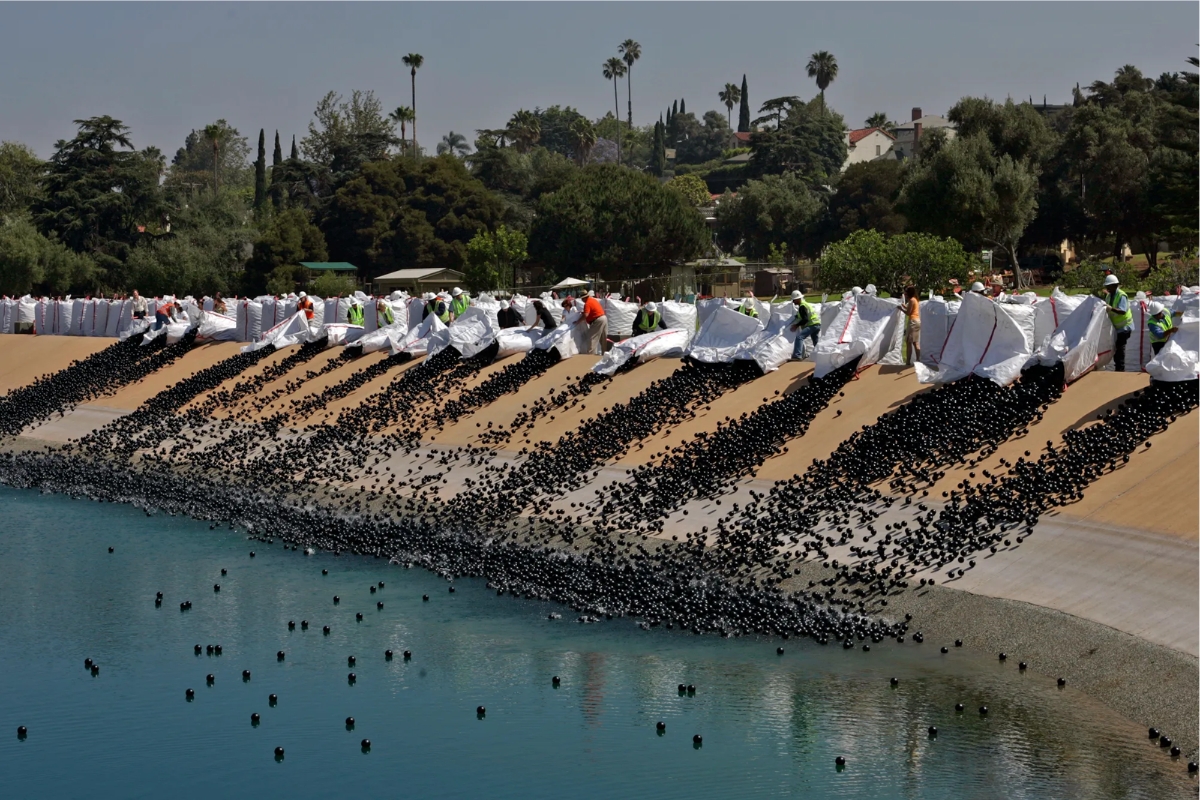


The Covering with Shade Balls Helped to Reduce Evaporation, Lower Bromate, and Limit Algae, Changing the Way the City Protects Treated Water
Los Angeles adopted an unusual solution to protect its water by covering open reservoirs with shade balls, small plastic spheres that float on the surface.
The strategy began in 2009 and gained scale between 2014 and 2015, when 96 million black balls were released into the city’s largest reservoir, the Los Angeles Reservoir.
The impact was direct both on water conservation due to evaporation and on quality, with a reduction in the formation of bromate, a substance associated with cancer risk when present at high levels in drinking water.
-
What if the Sun disappeared suddenly? Simulation shows Earth in darkness within minutes, extreme cold, and rapid collapse of life on the planet.
-
A 2,400-year-old iron foundry has been discovered in Senegal with 100 tons of slag, 35 furnace bases, and signs of nearly eight centuries of continuous metallurgical activity.
-
Four humans are flying towards the Moon inside the Orion capsule launched by the SLS rocket, and on April 6, Artemis II will disappear behind the far side of the Moon without communication with Earth for nearly an hour.
-
Worlds covered by water, atmospheres filled with hydrogen, and the possibility of life beyond Earth: ocean planets are rewriting the map of cosmic search and forcing scientists to rethink where to look.

Los Angeles Transformed Reservoirs into a Sea of Black Balls to Protect Water
In 2009, the city placed balls in the Ivanhoe Reservoir and saved 290 million gallons of water in a single year by reducing evaporation.
The result led to an expansion of the project between 2014 and 2015, when 96 million spheres covered the Los Angeles Reservoir, entirely shielding the surface from sunlight.
In addition to water conservation, the covering began to prevent chemical reactions that elevated bromate along the path between treatment and consumption.
What Are Shade Balls and How Do These Spheres Float Without Sinking

Shade balls are spheres made of high-density polyethylene, the same material used in common plastic packaging.
The black color comes from carbon black pigment, which protects the plastic against ultraviolet radiation from the sun.
Each ball has a 10-centimeter diameter, slightly larger than a baseball.
They are not completely hollow. Part of the interior is filled with water, which prevents the wind from blowing them away and ensures they remain floating on the surface of the reservoir.
Bromate in Drinking Water Raised Alarm and Required an Urgent Solution
In the early 2000s, the Los Angeles Department of Water and Power identified elevated levels of bromate in the water.
Bromate is a substance considered carcinogenic when present in high concentrations in the supply.
It forms from the reaction between bromide, a normally harmless compound, and ozone, under favorable conditions.
For this reason, treatment systems need to keep the level below 0.01 milligrams per liter, a limit considered safe for human consumption.
Understand How Sunlight, Chlorine, and Ozone Elevated Bromate in Reservoirs

The problem became evident when a beverage company detected bromate levels nearly three times above the safe limit.
The treatment plant showed normal indices, indicating that the increase occurred after treatment.
Analysis revealed an open reservoir between the plant and the consumption point.
In these environments, sunlight promotes the presence of ozone, while the chlorine used to control algae acts as a catalyst for the reaction that generates bromate.
Covers, Tarps, and Other Expensive Ideas Were Discarded Before the Final Decision
One of the first proposals evaluated was to install floating covers over the reservoirs.
The estimated cost exceeded 300 million dollars, and it made access and maintenance difficult.
Another alternative involved large tarps suspended over the water.
Although effective, they required complex and unfeasible structures for large reservoirs, which led to the idea being discarded.
The Simple Solution That Turned an Unlikely Idea into Public Policy

The final proposal was presented by retired biologist Brian White.
The inspiration came from spheres used to prevent birds from landing on lakes and pools.
Tests showed that fully covering the water surface effectively blocked light.
In controlled experiments, shade balls quickly reduced bromate, confirming the feasibility of the solution.
After the Installation of the Balls, Evaporation Decreased and Bromate Plummeted
The implementation began in 2009, with 400,000 balls in the Ivanhoe Reservoir.
Light stopped reaching the water and bromate levels fell significantly.
As an added benefit, there was a savings of 290 million gallons of water in one year.
In 2015, the project was expanded to 96 million balls in the Los Angeles Reservoir, covering 708 acres and keeping between 12 and 15 meters of water below the surface.
The Choice of Black Color Was Decisive in Reducing Heat, Evaporation, and Wear


Despite the appearance, the black color helped block radiation before it reached the water.
The carbon black pigment absorbs sunlight and reduces the transfer of energy to the water.
As the balls are partially filled with water, the internal air acts as thermal insulation.
This reduced evaporation by about 80 to 90 percent and increased the durability of the material exposed to the sun.
Light Blocking Also Reduced Algae and Decreased Chemical Use
Sunlight is essential for algae growth in open reservoirs.
Without enough light, photosynthesis is interrupted, and algae stop proliferating.
With fewer algae, the system requires less chlorine in water treatment.
This reduces operational costs and avoids undesirable visual changes during periods of intense heat.
Other Countries Follow the Model, but Experts Point Out Limitations
The strategy drew attention from other countries facing significant evaporation losses.
Turkey evaluated the use of balls after a six-year water crisis, seeking to reduce losses and keep animals away from the water.
Spain conducted smaller-scale tests, while Jordan and Morocco also adopted similar solutions.
Critics point to the volume of water used in production. 2.9 million cubic meters were needed to produce 96 million balls, while by March 2017, after 19 months, the savings were 1.7 million cubic meters, with a return estimate of two and a half years.
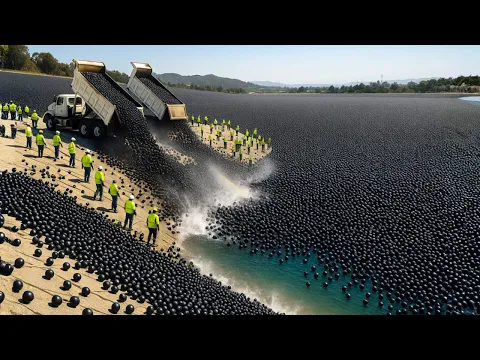
Los Angeles demonstrated that shade balls can reduce evaporation, limit algae, and contain the formation of bromate simultaneously.
The city combined water protection, operational savings, and health safety by turning its reservoirs into a simple, large-scale solution, using 96 million floating spheres as a permanent barrier against the sun.






Que coisa chata esse site de vocês todos poluído de propaganda não dá nem pra ler as notícias direito
Fica evidente a dificuldade do brasileiro em interpretação de texto pelo teor dos comentários. Nos resta gargalhar.
Desculpe aí os sabichões de plantão , mas eu também tenho dúvidas sobre o uso dessas esferas. Elas também não contribuem para contaminar a água? Sei que a maioria dos canos que fazem o “transporte” de água até a nossas caixas/ nossas casas, são do mesmo material, e que apesar de estar em baixo da terra absorvem o calor, porém, não estão diretamente expostos ao sol, assim como as esferas. Se alguém souber esclarecer essa dúvida, agradeceria.
Vou mandar pro #manual do mundo, quem sabe eles não tem uma resposta.
Fui.
Não é do mesmo plástico, o PVC é perigoso no calor do sol, mas o polietileno dessas bolas não