





 Portuguese
  English
  Spanish
  5 min of reading
  0 comments


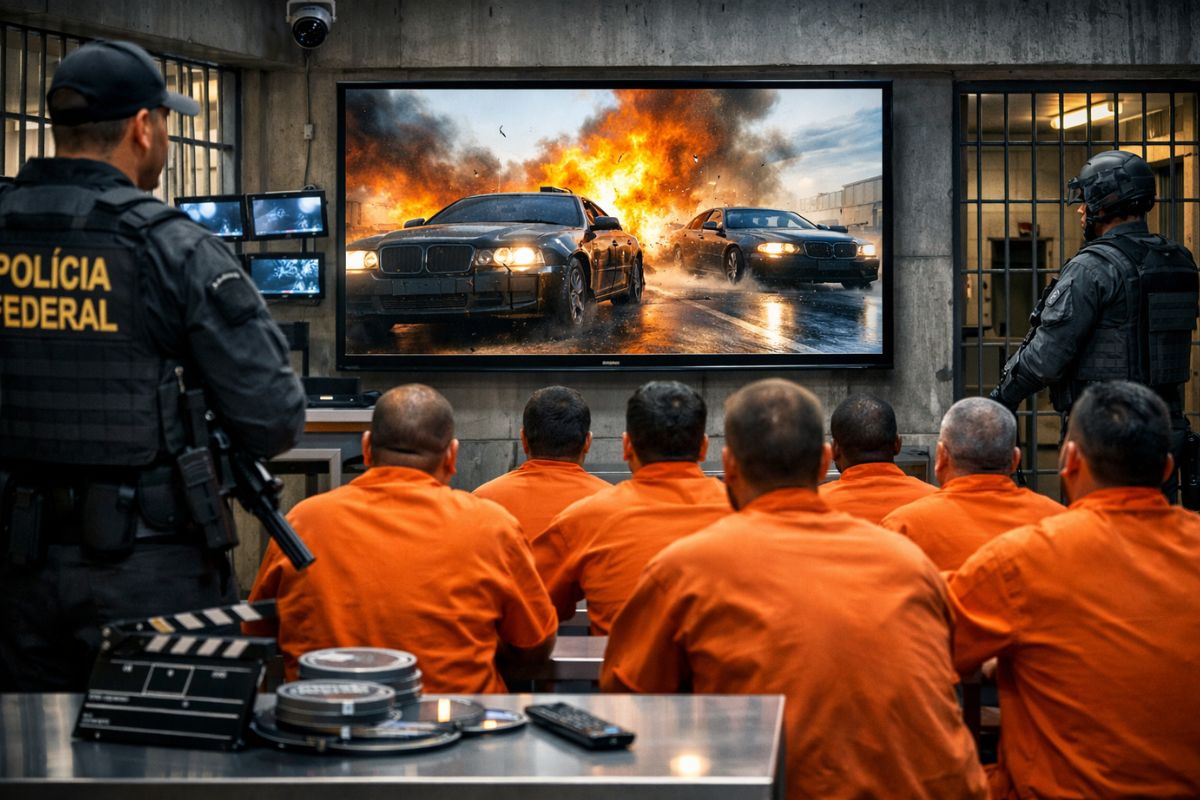
The Federal Government Claims That the 40 Smart TVs Will Be Used in Cinema Sessions of ReintegraCINE, With Pre-Selection of Movies, Total Internet Blocking, and Dual Internal Security Analysis, While the Prison System Exchanges DVDs and VHS for Current Technology Under Declared Investment of R$ 85.4 thousand.
The 40 Smart TVs announced for the federal penitentiary system mark an operational change in an activity that already existed in an older format. Instead of screenings with DVDs and VHS, the proposal shifts to using digital equipment with technical restrictions, within ReintegraCINE, an initiative aimed at the reintegration of people deprived of liberty.
According to information posted by the OGlobo portal, the plan involves maximum-security federal prisons, institutional control in multiple stages, and an implementation deadline until February 2026, after complete delivery and configuration. At the same time, the measure has entered the public debate radar due to individual requests for TV access in custody environments, which has broadened the discussion on criteria, purpose, and priority of penal policy.
What Changes Practically With the Adoption of the 40 Smart TVs in the Federal System
The main change is in the infrastructure and governance of audiovisual activity. The government, through the National Secretariat for Penal Policies (Senappen), presents the 40 Smart TVs as a modernization of a practice previously offered by the prison Cinemateca. Administratively speaking, this is not about inaugurating a new assistance but updating the technological support of an already standardized routine.
-
The government requests the Federal Revenue Service for a new system to automate the income tax declaration, reducing errors, time, and bureaucracy for millions of Brazilians.

-
Pix in installments, international Pix, and contactless payment without internet: the Central Bank revealed the new features coming to the tool that is already used by almost every adult in Brazil.

-
Mercado Livre has just started selling medications with delivery in up to three hours to your door, and this move could completely change the way Brazilians buy medicines on a daily basis.

-
In Dubai, rising tensions from the war in the Middle East are causing super-rich individuals to leave the Gulf and direct their fortunes to a new financial refuge in Asia.


This update is framed within the set of assists provided for in the penal execution, based on the Federal Penitentiary System Assistance Manual, approved on March 21, 2022.
The central point is that cinema, in this design, appears as a tool for cultural and recreational assistance within an institutional protocol, and not as free entertainment. The declared logic is of a directed, supervised activity linked to reintegration.
How Content Will Be Controlled and Why There Will Be No Internet
The announced model foresees that the 40 Smart TVs will be pre-configured with strict technical restrictions and without internet access. This means that people deprived of liberty will not have direct access to the devices for browsing, installing applications, or using open connected functionalities. The operational design starts from blocking, not from liberalization.
The curation is also tiered: the Division of Rehabilitation of Federal Penitentiaries selects content with ethical, pedagogical, and institutional criteria; then, the Division of Security and Discipline evaluates and approves from a prison security perspective.
After that, the Disciplinary Council of the Inmate of each unit approves the nominal listing of inmates eligible to participate in the sessions. In practice, the process combines content filtering with audience filtering, reinforcing traceability and internal control.
How Much the Modernization Cost and What This Amount Represents
The reported investment was R$ 85,400 for the acquisition of 40 units, resulting in an average of R$ 2,135 per unit. This data helps understand the financial scope of the project: it is not a program of high budget complexity, but a specific expenditure for updating equipment in an already existing assistance front in the federal system.
The official justification for the exchange is the obsolescence of the physical media used before, such as DVDs and VHS. In public management language, the replacement aims to reduce dependence on old formats and maintain the execution of the activity with greater operational stability.
The government’s argument is for functional modernization, not for unrestricted expansion of benefits. Yet, the relevance of the expenditure can be evaluated differently by those monitoring penal policies.
Where the Project Will Be Applied and When It Effectively Starts
The 40 Smart TVs are intended for maximum-security federal penitentiaries, under the coordination of Senappen. The start of sessions in the new format does not occur in a fragmented manner by political announcement but after two cumulative conditions: complete delivery of equipment and full configuration according to technical and disciplinary protocols.
The defined time frame is February 2026 as the deadline for full implementation. This indicates a planned transition rather than immediate activation.
The schedule matters because it conditions expectation and oversight: any concrete evaluation of results will depend on when each unit is effectively operating with the new display standard.
Reintegration, Internal Routine, and Objectives’ Limits of the Initiative
In institutional discourse, ReintegraCINE associates the 40 Smart TVs with the reintegration policy, by offering audiovisual content within pedagogical and ethical parameters. In theory, the proposal seeks to organize cultural moments with predictability, reducing improvisation and maintaining adherence to the assistance framework already provided for the federal penitentiary system.
At the same time, it is essential to recognize the limit of the instrument. Cinema sessions, in themselves, do not replace formal education, mental health, legal assistance, or post-incarceration social reintegration policies.
The real impact depends on integration with other service fronts, institutional continuity, and monitoring of results over time, not just on the physical presence of the devices in the units.
The Political Context That Amplified the Repercussion of the Theme
The discussion gained traction because, during the same period, the defense of former president Jair Bolsonaro presented a request to the Supreme Court for the inclusion of a Smart TV in the room where he is serving his sentence at the Federal Police Superintendency in Brasília, in addition to requesting remittance for reading and religious assistance.
In the request, the defense cites interest in news programming, including YouTube.
This point creates a direct contrast with the design of the 40 Smart TVs in the federal system: in Senappen’s project, there is no internet access and the content is subject to security approval.
Minister Alexandre de Moraes ordered the Prosecutor General’s Office to express its opinion on the defense’s requests. The temporal coincidence between public policy and individual demand intensified the debate, but the objects and rules are distinct.
The installation of the 40 Smart TVs in federal prisons combines technological modernization, strict institutional control, and a declared objective of reintegration through cultural activity. The project has a defined cost, a schedule until February 2026, and a security architecture that limits access, content, and participation.
The decisive test, however, will be the concrete execution: regularity of sessions, quality of curation, and effect on internal routine without relaxing protocols.
In your view, does this model of cinema without internet and with multi-layer selection tend to contribute to discipline and reintegration, or does it merely become an equipment exchange without structural results? And, if you had to define three mandatory criteria for choosing the movies, what would they be?









-

2 pessoas reagiram a isso.