





 Portuguese
  English
  Spanish
  5 min of reading
  0 comments


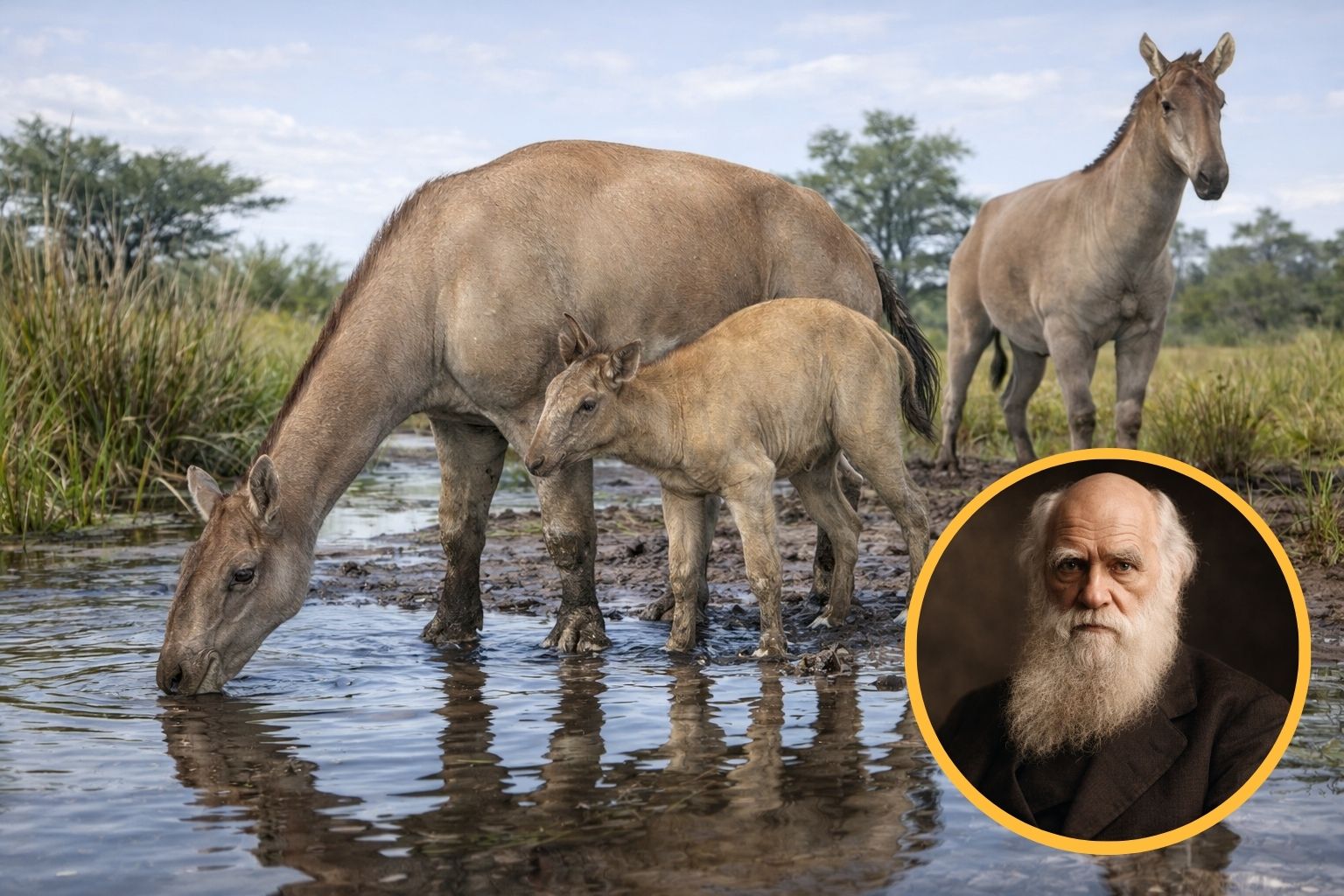
Fossil of the South American Macrauchenia patachonica Reveals a Long-Necked Herbivore with High Nostrils and Presence in Brazil During the Pleistocene, Intriguing Darwin and Modern Paleontologists.
The image of South American Pleistocene megafauna often revolves around giant sloths, armored glyptodonts, and knowledge about extinctions caused by climate change. However, among these giants existed a herbivore that confused the naturalists who discovered it. This is the Macrauchenia patachonica, a medium to large mammal with an elongated neck, nostrils positioned on top of its skull, and limbs adapted for running, which inhabited much of South America — including areas of Brazil — until about 10,000 years ago.
When Charles Darwin found Macrauchenia remains in 1834 during the HMS Beagle expedition, the anatomical enigma was immediate. That animal resembled neither equines, nor camelids, nor cervids. It was a creature that, at first glance, evoked a “camel without a hump,” but with cranial characteristics that did not fit into any modern group. Almost two centuries later, the fascination persists. The Macrauchenia remains one of the most interesting testimonies of mammalian evolution in the Southern Cone.
The South American Pleistocene and the World of Macrauchenia
To understand the ecology of the Macrauchenia, it is necessary to understand the geological and climatic scenario of the Pleistocene. Between 2.6 million and 11,700 years ago, South America experienced cycles of glaciation and interglaciation, alternating cold, dry periods with warmer, wetter phases. These cycles produced distinct environments: open pampas, cold steppes in the Southern Cone, treed savannas in the interior of the continent, and mosaics of forests and fields in regions that today correspond to Brazil’s Southeast and Midwest.
-
He started running at 66 years old, broke records at 82, and is now a subject of study for having a metabolic age comparable to that of a 20-year-old, in a case that is intriguing scientists and inspiring the world.

-
Oldest tree on the planet reappears after 130 years of searches: Wattieza, 385 million years old, was 10 meters tall and had no leaves or seeds; Gilboa fossils in New York solved the mystery in 2007.

-
A 48-square-meter house assembled in hours with 4,000 bricks made of recycled plastic that does not absorb moisture, has natural thermal insulation, and costs less than 90,000 reais in a complete kit.

-
Luciano Hang revealed that Havan’s air fleet has already accumulated more than 20,000 landings, 10,000 flight hours, and 6 million kilometers traveled, and he says that without the planes, the company would never have grown so quickly.



Fossils attributed to Macrauchenia have been found in Argentina, Uruguay, Bolivia, Paraguay, Chile, and also in Brazil, with records in areas of Rio Grande do Sul, portions of the interior, and deposits associated with floodplain and open field environments. These findings indicate that it was not an animal restricted to a specific biome, but rather a herbivore adapted to varied and expansive landscapes.
What strengthens this argument is its locomotor morphology: relatively long and robust legs, with an upright stance and joints that suggest running capability. This fits into a world dominated by large herbivores, where mobility meant access to resources and defense against predators.
Unique Anatomy: Neck, Nostrils, and Posture
One of the most intriguing characteristics of the Macrauchenia is the position of its nostrils. Instead of being at the tip of the snout, as in modern equines, they were located on top of the skull, near the eye. This anatomy inspired hypotheses about the presence of a small muscular trunk, perhaps similar to that of a modern saiga or the short proboscis of a tapir. There is no consensus since soft tissues rarely fossilize, but the hypothesis is consistent with the bony morphology.

Another striking point is the elongated neck. Although not as long as that of giraffes, the neck of the Macrauchenia had enough length and flexibility to allow access to higher foliage and visual scanning of the environment. This combination — high nostrils, long neck, and strong limbs — suggests an herbivore that explored both grasslands and shrubs as well as small trees.
Taxonomically, the Macrauchenia belongs to the Litopterna, a group of endemic South American mammals that evolved in isolation for tens of millions of years due to the continental isolation of the supercontinent Gondwana. It was only when South America connected to North America via the Isthmus of Panama, during the so-called Great American Biotic Interchange, that this fauna began to face competition from equines, camelids, cervids, and large carnivores from the northern hemisphere.
Feeding Ecology and Ecological Role
The dentition of the Macrauchenia indicates a grazing-browsing herbivore, capable of consuming both grasses and higher plant parts. The largely open environment of parts of South America during the Pleistocene favored fast, generalist herbivores, and Macrauchenia seems to have occupied exactly this intermediate niche, without directly competing with large terrestrial sloths specialized in arboreal vegetation, nor with camelids adapted to strict grasslands.
The animal must have coexisted with powerful predators, such as saber-toothed cats (Smilodon populator), declining terror birds, and even South American canids. In this landscape, the best defense was not extreme size but the ability to accelerate and maintain pace. The upright posture and long limbs suggest efficient movement, akin to that of a modern antelope.
Darwin, the Discovery, and Scientific Perplexity
When Darwin collected bones attributed to Macrauchenia in Patagonia during the 1830s, he noted his perplexity. The animal did not fit into familiar European groups. At that moment, concepts such as evolution, adaptive radiation, and evolutionary convergence were just beginning to form. The Macrauchenia was an intellectual blow that helped undermine the idea that current animals were static models.
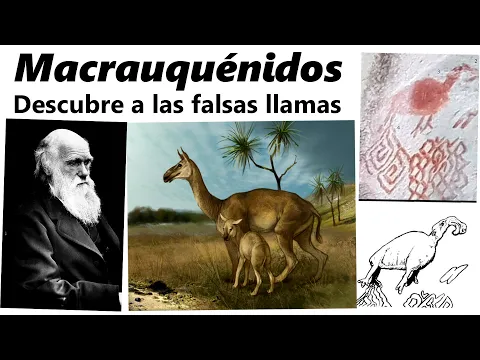

The “South American camel” without a hump pointed to an independent evolutionary history shaped by the geographic isolation of South America. It is one of the reasons Darwin repeatedly mentions the uniqueness of South American fauna in his post-Beagle writings.
Extinction and Environmental Transformations
The Macrauchenia disappeared around the end of the Pleistocene, a period marked by two relevant events:
- rapid climate changes, involving temperature and humidity fluctuations;
- human expansion on the continent, initially occupying open areas and riverbanks.
There is academic debate about the relative weight of these factors. The litopterns, the group to which Macrauchenia belongs, were particularly vulnerable to the arrival of competitors from the north and to sudden environmental changes. While some introduced herbivores, such as horses and camels, adapted well (although native horses disappeared and only returned with European colonizers), the litopterns vanished completely.
What the Macrauchenia Represents for Science Today
Studying Macrauchenia means exploring larger themes in evolutionary biology:
- biogeographic isolation,
- evolutionary convergence with camels and horses,
- Pleistocene extinctions,
- peculiar fauna of South America,
- niche sharing with megafauna.
It is a reminder that modern lineages — horses, deer, camels — are merely recent survivors of very complex processes. The Macrauchenia symbolizes an evolutionary radiation that flourished, persisted, and disappeared without leaving direct descendants.
Beyond scientific value, there is cultural value: imagining South American fields populated by “camels without humps,” giant sloths, and saber-toothed felines helps break the myth that interesting prehistoric fauna existed only in Africa or North America.
By reconstructing this past, paleontologists recover not only extinct animals but also the very creativity of nature — a creativity that often surpasses fiction.









-

-

-

-

-

-

62 pessoas reagiram a isso.