





 Portuguese
  English
  Spanish
  5 min of reading
  0 comments


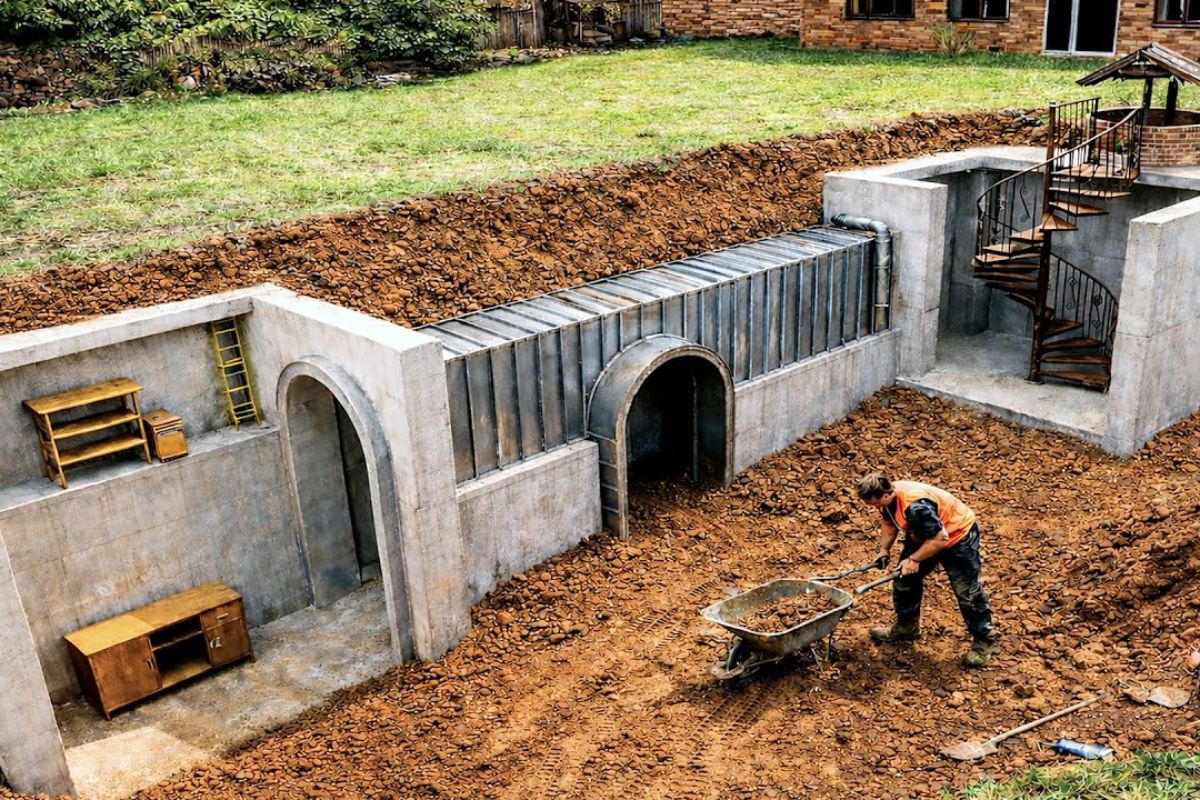
In A Residential Neighborhood, A Subterranean Bunker In The Backyard Reappears After A Decade Buried And Forgotten. The Owner Returns To The Subsoil, Reinforces Walls With Steel Panels, Sets Up Tracks With An Electric Cart, Improvises A Tunnel Boring Machine And Installs A Water Pump Until Opening A Hatch Towards The Surface With Real Risks
A subterranean bunker in the backyard is often imagined as a ready and silent shelter, but here it becomes an active construction site, with noise, metal clatter, and decisions made under pressure. After 11 years off the radar, Dave (@Tornado_Dave) resumes the buried space and turns the return into a continuous excavation operation.
What draws attention is not just the persistence. It’s the combination of improvisation with survival engineering, because the tunnel advances in unstable soil, faces groundwater, relies on internal transport, and requires sealing so that the exit does not become the weakest point of the entire structure.
The Return To The Subsoil That Changes The Status Of The Bunker

The starting point is simple and unsettling: there was a buried and forgotten bunker, and it comes back to life when the owner decides to reopen access and excavate a new path.
-
Friends have been building a small “town” for 30 years to grow old together, with compact houses, a common area, nature surrounding it, and a collective life project designed for friendship, coexistence, and simplicity.

-
This small town in Germany created its own currency 24 years ago, today it circulates millions per year, is accepted in over 300 stores, and the German government allowed all of this to happen under one condition.

-
Curitiba is shrinking and is expected to lose 97,000 residents by 2050, while inland cities in Paraná such as Sarandi, Araucária, and Toledo are experiencing accelerated growth that is changing the entire state’s map.

-
Tourists were poisoned on Everest in a million-dollar fraud scheme involving helicopters that diverted over $19 million and shocked international authorities.


The subterranean bunker in the backyard ceases to be a stored curiosity and becomes a work in progress, with the tunnel forming beneath the ground and pointing toward the surface.
This choice repositions the risk. Excavating is always negotiating with the weight of the terrain, because removing material too quickly can displace walls, open cracks, and cause failures.
With each advancement, the project depends less on force and more on control, soil reading, and structural reinforcement to prevent progress itself from becoming a trap.
Steel, Sealing, And The End Of Easy Openings

The first response to stability appears in the lining: steel panels act as a structural skin, holding the soil and reducing the chance of local collapse.
In the subterranean bunker in the backyard, the logic is straightforward: a reinforced wall broadens the safety margin for working and reduces the vulnerability of newly opened sections.
However, reinforcing is not just about “putting metal”. Even steel can flex, and gaps become paths for loose soil and infiltration.
Therefore, strips and metal joints appear at the seams, aiming to lock critical points and maintain continuity because a poorly sealed joint concentrates tension and pays the price when ground pressure increases.
Tracks, Electric Cart, And The Logistics That Decide The Rhythm
As excavation grows, the problem ceases to be just digging and becomes removing.
The subterranean bunker in the backyard requires internal logistics: tracks reduce friction, organize transport, and create predictability, while an electric cart takes on the role of carrying earth and tools without depending on manual loading with each cycle.
The solution is not decorative; it is operational. A track system reduces round trip time, lowers fatigue, and reduces the risk of tripping and getting stuck in tight spaces.
In underground construction, productivity is safety, because spending more time exposed in a vulnerable section increases the chance of error, and errors in the subsoil are rarely small.
Improvised Machines And The Limit Between Creativity And Risk

The project also advances with machines built from what is available, including a structure that functions as a conveyor belt to keep the removal of material flowing more continuously.
In a subterranean bunker in the backyard, this type of improvisation becomes an acceleration tool, but it also adds variables: vibration, alignment, jamming, and the need for constant maintenance.
There is also the use of a repurposed children’s electric cart kit as an improvised crane, showing how a “common” piece gains a critical function.
The gain is obvious, but the dependence is too, because when improvised equipment becomes a link in the process, any failure changes the pace and can create a risk window at the most delicate moment, the transition between removal and reinforcement.
Groundwater, Pump, And The Enemy That Does Not Negotiate
The most persistent issue is water. Even small puddles in the tunnel can hide instability, increase slipping, and compromise the integrity of newly reinforced sections.
In the subterranean bunker in the backyard, the immediate response is pragmatic: a pump keeps the environment usable and preserves progress without infiltration shutting everything down.
However, water serves as a reminder that the subsoil has its own rules. It appears unexpectedly, forces adaptations, and requires redundancy, because a system that fails at the wrong moment turns work into an emergency.
Therefore, the project includes drainage, collection, and direction, seeking to control what cannot be eliminated.
The Opening To The Surface And The Hatch As A Critical Point
When the tunnel finds an exit, the problem changes again. An exposed opening becomes a vulnerability for water, dirt, and local collapse, hence the steel hatch emerges as a closure solution.
In the subterranean bunker in the backyard, the hatch is not a final detail: it is a structural component that protects access and prevents the top from becoming the failure point.
The construction of the hatch and the reinforcement around the entrance show a clear logic: the access opens and closes repeatedly and bears continuous load from the environment above.
If the perimeter of the entrance gives way, the rest of the tunnel loses its meaning, because the route that should free becomes the first place to need rescue and repair.
Inspiration In The Great Escape And The Dilemma Of What Remains Outside
The symbolic engine comes from The Great Escape, seen as a direct reference to legendary tunnels and the imaginary of escape.
This inspiration gives narrative to the project, but does not erase the trades: aesthetics, time, cost, and coexistence with a space that requires discipline and care to not turn into a permanent domestic risk.
At its core, the subterranean bunker in the backyard becomes a case about limits: how far is it worth taking an underground project within a normal routine, with persistent water, the weight of the terrain, and technical decisions that do not allow innocent improvisation.
The question that remains is not just “if it works,” but what is accepted to be lost to keep a hidden world functioning.
In your neighborhood, what would be the biggest personal limit: living with construction in the backyard for years, accepting the risk of water and unstable soil, or giving up the idea before it becomes routine? And if you have seen someone undertake an extreme project at home, what made you think “that went too far”?










-

-

2 pessoas reagiram a isso.