





 Portuguese
  English
  Spanish
  6 min of reading
  0 comments


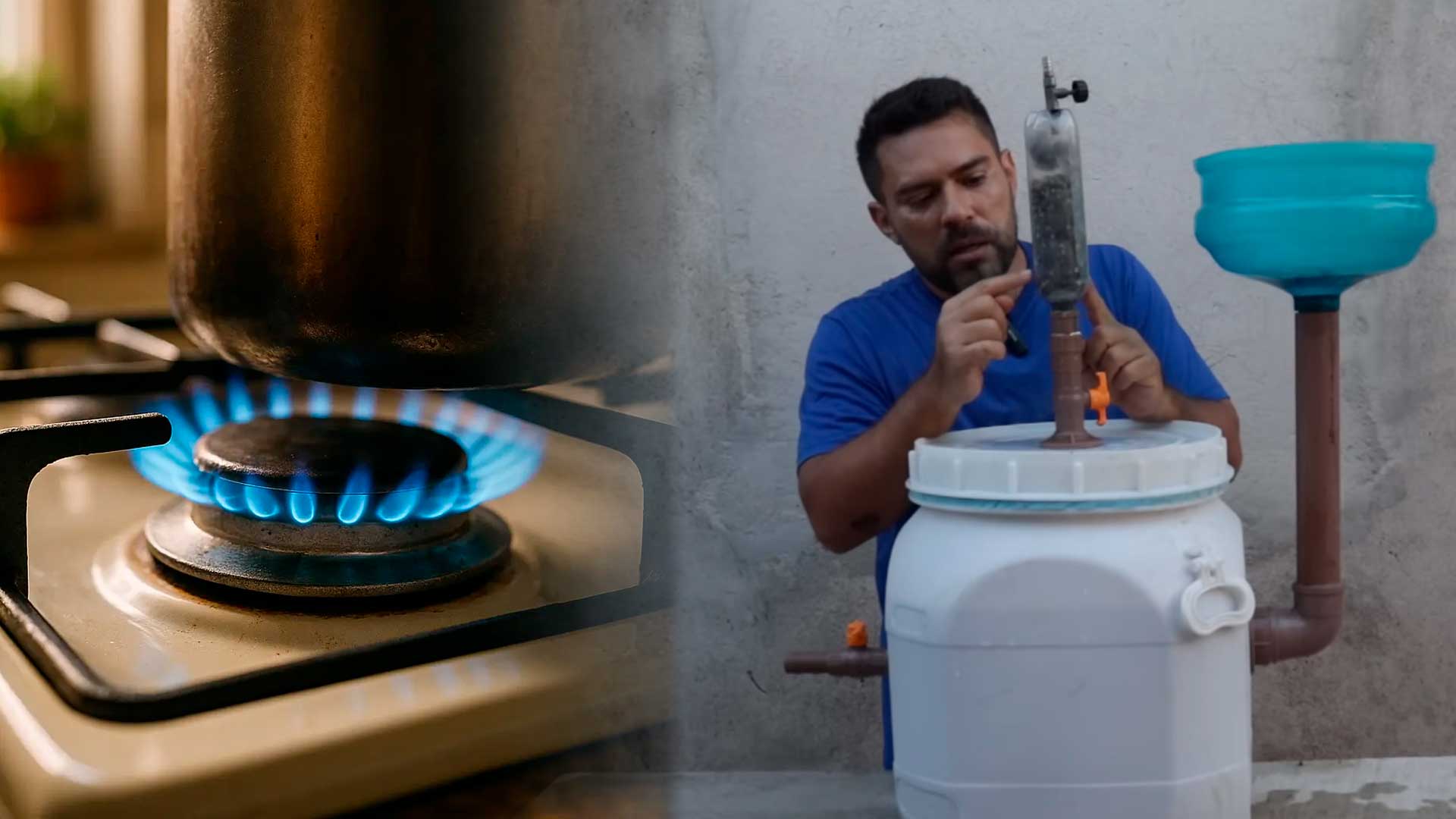
Sustainable Method Transforms Organic Waste into Cooking Gas Through Homemade Biogas Digester, Promising Savings and Energy Independence for Brazilian Families
A Brazilian taught how to build a homemade biogas production system, capable of generating cooking gas from organic waste. The content creator demonstrated the entire process of assembling a biogas digester using accessible materials such as drums, PVC pipes, and valves, sparking the interest of thousands of people looking for economical alternatives to conventional gas cylinders.
In the video, the man explains in detail how to assemble the structure using a plastic drum, sewage pipes, and water, as well as a filtration system with steel wool.
He demonstrates that, after adding a mixture of 50% chicken manure and 50% water, the system starts producing gas in approximately six days. The installation includes a siphon for feeding, a tap for removing the biofertilizer, and a filter for gas purification.
-
Friends have been building a small “town” for 30 years to grow old together, with compact houses, a common area, nature surrounding it, and a collective life project designed for friendship, coexistence, and simplicity.

-
This small town in Germany created its own currency 24 years ago, today it circulates millions per year, is accepted in over 300 stores, and the German government allowed all of this to happen under one condition.

-
Curitiba is shrinking and is expected to lose 97,000 residents by 2050, while inland cities in Paraná such as Sarandi, Araucária, and Toledo are experiencing accelerated growth that is changing the entire state’s map.

-
Tourists were poisoned on Everest in a million-dollar fraud scheme involving helicopters that diverted over $19 million and shocked international authorities.


The process shown in the video yielded practical results. After a week of operation, the creator was able to light a regular stove using only the biogas produced by the homemade system. He emphasizes, however, that the model demonstrated has limited storage capacity and mainly serves as an educational prototype.
Biogas Digester System Transforms Waste into Renewable Energy
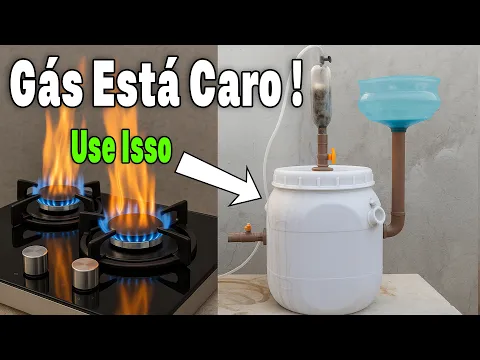

According to renewable energy specialists, homemade biogas digesters operate through an anaerobic decomposition process, where microorganisms break down organic matter in the absence of oxygen, releasing methane and other gases. This biogas can be used for cooking, heating spaces, or even generating electricity in more complex systems.
According to information from Ecycle, a sustainability-focused platform, a residential biogas digester takes about 30 days to start producing biogas steadily. Production can be equivalent to one gas cylinder per month, varying according to the type of biomass used, ambient temperature, particle size, and movement of the waste. The system also generates biofertilizer, a liquid byproduct rich in nutrients that can be used in gardens and flower beds.
The operation of the residential biogas digester is divided into two main parts: the anaerobic digester, where the decomposition of organic matter occurs, and the gasometer located at the top, responsible for storing the produced gas. Accepted organic materials include manure from herbivorous animals, food scraps, grass clippings, and other plant waste, provided they do not contain salt, soap, or chemical substances that could kill the bacteria responsible for gas production.
Studies published by UNILUS Teaching and Research Magazine show that about 51.4% of urban solid waste generated in Brazil is organic, representing enormous potential for generating sustainable energy. Researchers have been developing homemade biogas digester prototypes as an economically viable and ecologically friendly alternative for waste treatment and energy production.
Technical Standards and Safety in the Installation of Biogas Digesters
The installation of homemade biogas systems has specific regulatory parameters. The NBR ISO 23590 of 2022 establishes requirements for the design, installation, operation, maintenance, and safety of homemade biogas systems, producing biogas at a quantity equivalent to a capacity of less than 100 MWh per year. According to information from Target Normas, the collection, transfer, and control system must be designed to safely move the biogas produced within the digester to the utilization equipment.
Experts warn that biogas is a flammable fuel and requires appropriate safety measures throughout the installation and use process. The system should have safety valves, hermetic connections to prevent leaks, and should be positioned in an outdoor location, preferably receiving solar heat to accelerate gas production. Constant leak checks and regular maintenance of the filters are essential for the safe operation of the equipment.
According to the GEF Biogas Brazil project, cited by Sebrae, biogas generation systems can operate without the need for electricity or pressurized water. However, for effective domestic use, experts recommend digesters with a minimum capacity of 1000 liters, much larger than the model shown in the viral video, which mainly serves as an educational experiment.
Fábio Miranda, founder of Periferia Sustentável, an organization that offers courses on digesters in São Paulo, explains that the main function of the system is to provide the correct disposal of kitchen solid waste. Peels, seeds, and other parts of food that would be discarded become raw materials that return as cooking gas, ensuring a healthy disposal of organic waste and reducing the amount sent to landfills.
Limitations and Challenges of Homemade Biogas Production
Despite the enthusiasm generated by the video, experts highlight important limitations of improvised homemade digesters. The model presented in the viral content does not have sufficient capacity to store all the gas produced, resulting in only a few seconds of use on the stove. The creator of the video admits that the system operates under limited pressure and would require a larger container for continuous household use.
Specialized companies offer ready-made commercial systems, with greater efficiency and safety. According to information from the company, commercial digesters are “plug-and-play” solutions designed for quick installation and easy operation, eliminating the need for civil construction or major residential adaptations. These systems are scalable and can be expanded as the user’s needs grow.
The Roge Foundation, through the Academia do Leite project, has developed educational prototypes of digesters with Agricultural Technical Course students. The institution demonstrates that, although it is possible to create digesters with simple resources, effective implementation requires technical knowledge, professional supervision, and adequate infrastructure to ensure safety and efficiency in biogas production.
Another significant challenge involves the regular maintenance of the system. Users need to provide a constant feed of organic matter, periodically empty the biofertilizer, change filters every six months, and monitor for possible gas leaks. In cold climates, biogas production is drastically reduced, making the system less efficient in certain regions of the country.
Economic Viability and Environmental Impact of the Technology
The economic aspect is one of the main attractions of homemade digesters. With the price of a 13 kg gas cylinder ranging between R$ 100 and R$ 130 in various regions of Brazil, the possibility of producing one’s own gas represents significant savings over time. However, the initial investment in quality materials and regular maintenance must be considered in the financial viability calculation.
Environmentally, the benefits are considerable. According to data from the United Nations Development Program (UNDP), the utilization of organic waste through digesters reduces greenhouse gas emissions, prevents soil and water contamination by waste, and diminishes the amount of trash sent to landfills. The biofertilizer produced replaces chemical fertilizers, promoting more sustainable agriculture.
Academic research shows that adding residual cooking vegetable oil to the digester can significantly increase methane production. Studies published by UNILUS indicate that materials rich in glycerin compounds and high carbon content act as a direct subsidy for methane formation, enhancing the system’s efficiency. However, the amount of oil should be controlled, not exceeding 5% of the total mixture.
The digester technology represents a promising alternative for rural communities and urban peripheries, where access to garbage collection services may be limited. Organizations like Periferia Sustentável are working to empower communities in building and operating these systems, promoting energy autonomy and environmental awareness among low-income families.
And you, would you have the courage to build a homemade digester to produce your own cooking gas? While the technology seems promising and sustainable, experts warn about safety risks in improvised installations. Does the economy outweigh the technical challenges and the need for constant maintenance? Share your thoughts in the comments.










-

-

-

-

8 pessoas reagiram a isso.