





 Portuguese
  English
  Spanish
  6 min of reading
  0 comments


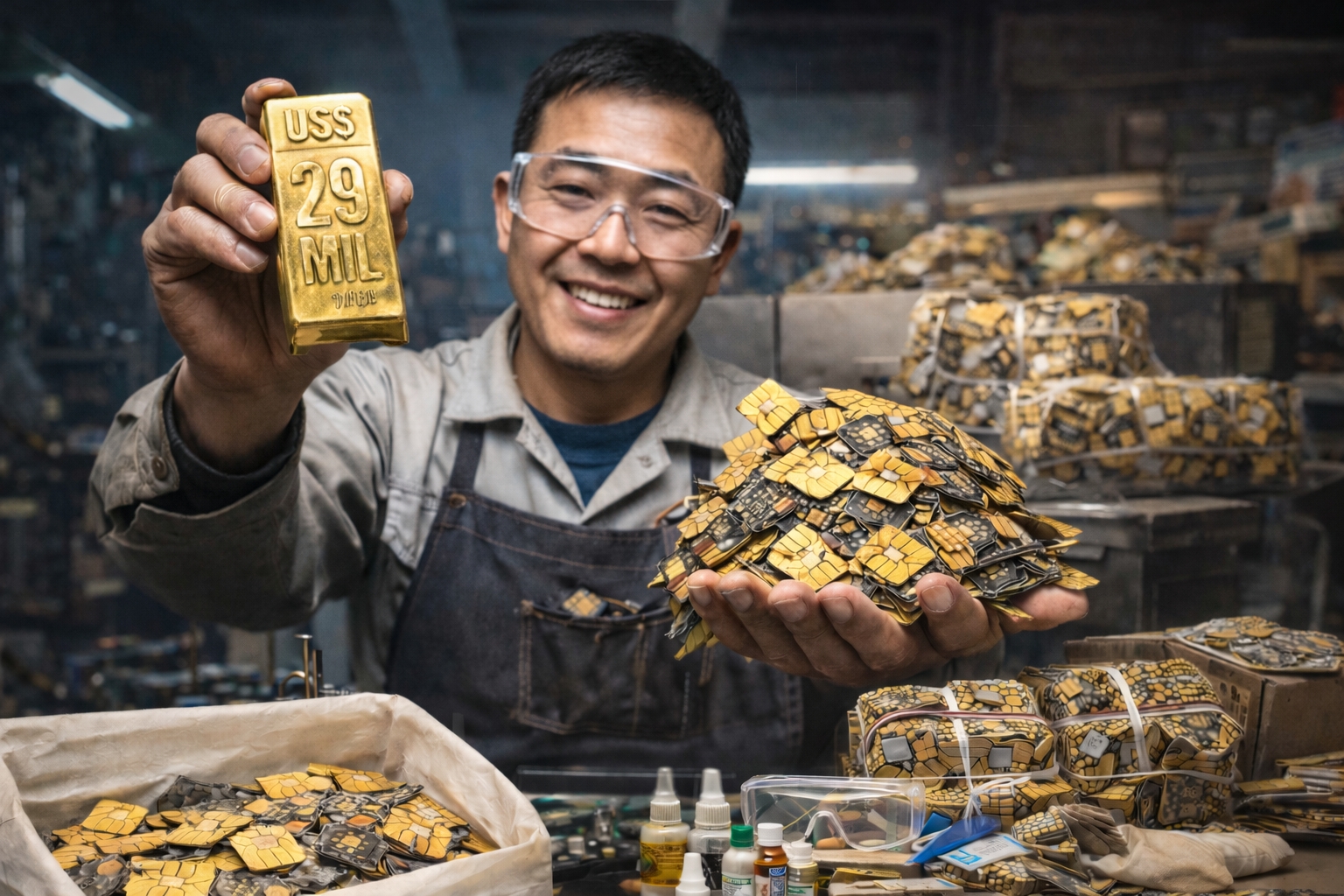
After Going Viral, Platforms Start Selling Batches of SIM Cards as “Gold Raw Material” and Courses and Kits for Amateurs Emerge; Experts Warn That the Promise of Quick Enrichment Can Lead to Poisoning, Explosion, and Environmental Crime
From Trash to Gold Bar: Qiao is a professional precious metals refiner working in Huizhou, Guangdong Province, in southern China. On January 20, 2026, he published a video showing him pouring piles of used SIM cards and telecom chip scrap into barrels with chemicals, filtering the material, and ultimately melting it down into a gold bar.
The result was a bar weighing about 191 to 192 grams of gold, valued at approximately 200,000 yuan, roughly 27,000 to 29,000 dollars, depending on the exchange rate.
The images, featuring colorful liquids, vapors, and the metallic sheen of the final bar, earned Qiao the nickname “alchemist” and garnered millions of views within a few days.
-
Friends have been building a small “town” for 30 years to grow old together, with compact houses, a common area, nature surrounding it, and a collective life project designed for friendship, coexistence, and simplicity.

-
This small town in Germany created its own currency 24 years ago, today it circulates millions per year, is accepted in over 300 stores, and the German government allowed all of this to happen under one condition.

-
Curitiba is shrinking and is expected to lose 97,000 residents by 2050, while inland cities in Paraná such as Sarandi, Araucária, and Toledo are experiencing accelerated growth that is changing the entire state’s map.

-
Tourists were poisoned on Everest in a million-dollar fraud scheme involving helicopters that diverted over $19 million and shocked international authorities.


While many viewers believed that the gold came exclusively from SIM cards, Qiao later clarified that the processed material included nearly two tons of industrial electronic waste, especially gold-plated chips and components from the telecommunications sector.
How Gold Extraction from Electronic Waste Works


The extraction of gold from electronic waste is a complex chemical process, known in the recycling industry as precious metals refining. Broadly speaking, it involves four main stages:
- Preparation and Shredding
Plates, chips, SIM cards, and other components are separated from plastics and non-metal parts and then shredded into very small fragments. The goal is to expose as much of the metal surfaces coated with gold, silver, or other valuable metals as possible. - Chemical Dissolution (Aqua Regia)
The most critical step is dissolving the gold with an extremely corrosive mixture called aqua regia, made up of concentrated nitric acid and hydrochloric acid. This solution can dissolve gold and other metals, forming a liquid solution filled with metal ions, but it can also release toxic gases and cause severe burns upon contact with skin. - Precipitation and Filtration
Next, reagents are added that cause only the gold to precipitate, forming a “sludge” or “gold paste” at the bottom of the containers. This residue is filtered, washed, and dried, removing impurities, solvents, and remaining acids. - Melting and Final Refining
The resulting gold powder is heated in furnaces or crucibles until it melts, forming a solid piece, like the bar displayed by Qiao. In professional facilities, refining may also include additional steps to increase the purity of the metal, approaching nearly pure gold.
This entire cycle can take weeks, requires strict control of temperature, pH, and ventilation, and generates hazardous waste that needs specialized treatment to avoid contaminating soil, water, and air.
The Myth of “Easy Gold” in SIM Cards
The viral nature of the video led many people to believe that simply gathering old SIM cards would make them rich, but the numbers tell a different story.
- Studies and industry professionals estimate that a modern SIM card contains less than 0.001 grams of gold — in many cases, something in the range of a few milligrams or even fractions of a milligram.
- This implies that hundreds of thousands of cards (on the order of 400,000 units) would be needed to get close to the approximately 191 grams extracted by Qiao.
- One expert reported, for example, that he extracted only 1.93 grams of gold from 9.7 kilograms of old SIM cards and ICs, showing that the concentration of gold is extremely low.
In cards and chips, the gold is not found in thick wires or thick layers, but in an ultra-thin coating over copper or nickel contacts.
This coating serves to prevent corrosion and ensure reliable electrical contact, not to store value.
In other words, the “gold in chips” exists, but it is more an engineering detail than an easily accessible hidden treasure.
Despite this, Qiao’s video triggered a small frenzy of buying and selling used SIM cards in China.
Resale platforms began advertising batches of cards as “gold raw material,” and even people emerged selling courses and chemical extraction kits for amateurs.
Technical, Environmental, and Legal Risks
Experts warn that trying to replicate what Qiao does in a professional environment at home is extremely dangerous.
- Chemical Hazards
Aqua regia and other reagents used in the extraction can release toxic gases, cause deep burns, and react violently if mishandled. Without proper ventilation, specialized PPE, and training, the risk of poisoning, fire, or explosion is real. - Hazardous Waste
The process generates acidic solutions with heavy metals that cannot be disposed of in sinks, rivers, or soil. If discarded improperly, this waste can contaminate waterways, poison ecosystems, and affect communities for a long time. - Legal Issues
In various countries, including China, certain concentrated acids and electronic waste are strictly regulated. Refining electronic scrap or handling large quantities of reagents without a permit can lead to heavy fines and even imprisonment.
Qiao himself emphasized in interviews and new videos that the purpose of his posts is to show the value of professional recycling of metals, not to encourage ordinary people to try “making gold” in their garages.
He stresses that his work occurs in a controlled industrial environment, with appropriate equipment and registration with the authorities.
Electronic Waste, Urban Mining, and Sustainability
The success of the Chinese “alchemist” highlights a larger theme: the potential and risks of so-called urban mining from electronic waste.
Cell phones, computers, televisions, routers, and other devices contain small amounts of precious metals like gold, silver, palladium, and platinum, as well as copper, aluminum, and other valuable materials.
In large volumes, such as those processed by Qiao and specialized companies, this “urban ore” can be an important source of resources, reducing the need for traditional mining and helping to recover materials that would otherwise be discarded.
However, when this extraction is done informally or clandestinely:
- Workers are exposed to toxic chemicals and fumes without protection.
- Entire communities may suffer from water, soil, and air pollution.
- The burning and improper disposal of circuit boards, cables, and plastics release carcinogenic and persistent substances into the environment.
For this reason, environmental organizations and recycling experts advocate that the recovery of precious metals from electronic waste be carried out by licensed companies, with appropriate technology, waste tracking, and oversight.
At the same time, public policies that encourage the proper disposal of devices, collection points, and reverse logistics are crucial to prevent the problem from expanding.
What the Case Teaches the Public
The story of the man who turned electronic scrap into nearly 200,000 yuan of gold is seductive because it seems to prove that “one person’s trash is another person’s treasure.” But a closer reading shows that:
- The gold comes from tons of industrial waste processed by a specialist, not from a few forgotten cards in a drawer.
- The process requires advanced technical knowledge, suitable equipment, and legal permissions.
- The health and environmental risks are significant if the extraction is done amateurishly.
Instead of encouraging dangerous home attempts, Qiao’s case could serve as a starting point for discussing the hidden value of electronic waste and the need for organized systems for professional collection and recycling.
It also reminds us that, in an increasingly digital economy, taking care of the fate of our old devices is as important as keeping up with the release of the next model.










-

-

-

-

-

-

16 pessoas reagiram a isso.