





 Portuguese
  English
  Spanish
  5 min of reading
  16 comments


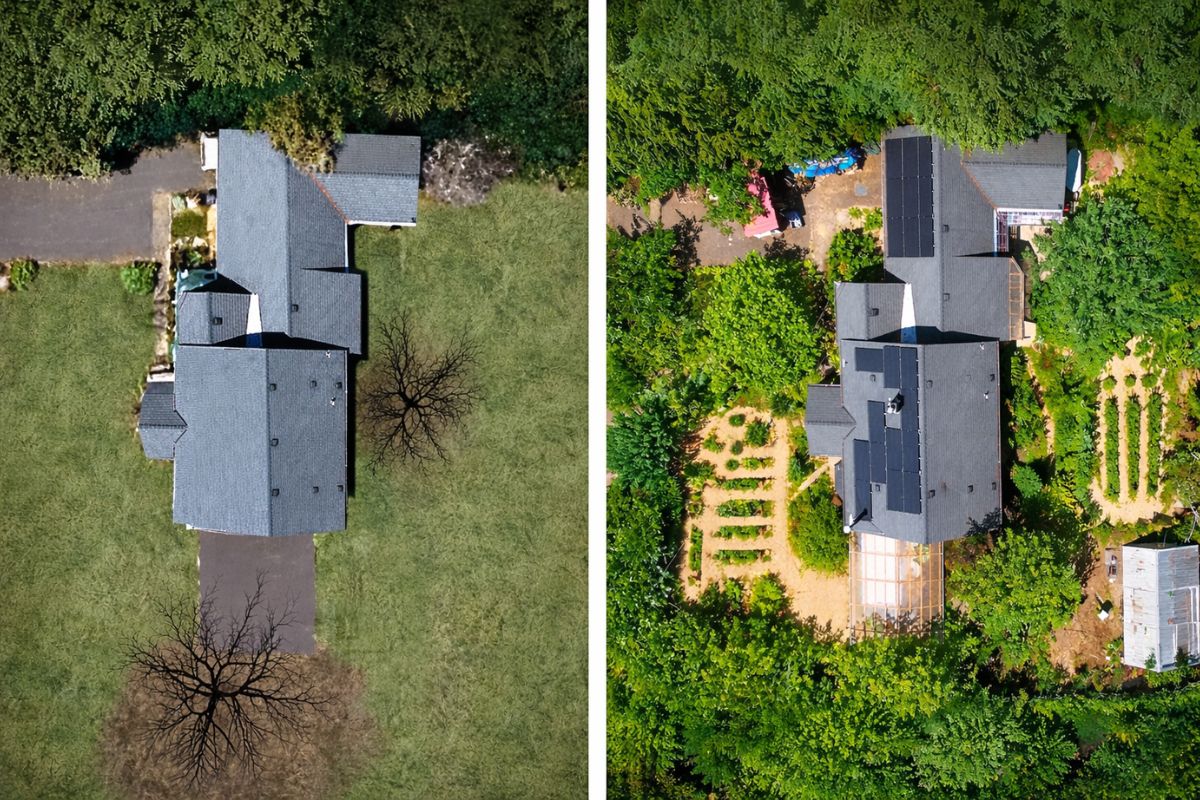


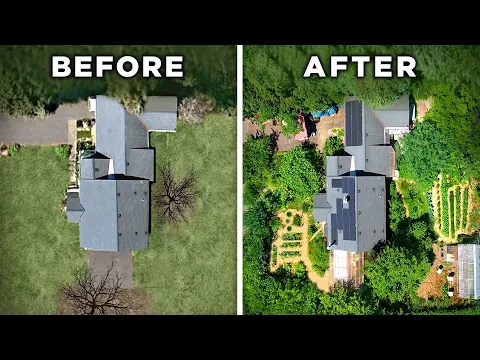
After 15 Years Of Adjustments, A Suburban Lot In The Willamette Valley, Western Oregon, Stopped Being Lawns And Became A Permaculture-Based Mini Farm: Fruits In Multiple Layers, Beehives For Honey, Chickens In Rotation For Eggs And Fertilization, Recycled Greenhouse, And Microclimates That Reduce Waste And Daily Shopping.
The mini farm described by a permaculture instructor in western Oregon does not arise from “large areas”, but from design and maintenance: productive edges, grafted trees, perennial plants, chicken rotation, and a beehive system that collects nectar from the entire neighborhood. On 0.6 hectare, the backyard starts to operate as food infrastructure.
The less obvious point is that the mini farm does not depend on a single product. It combines fruits, eggs, and honey with annual horticulture and microclimates, so that the risk of failure of one crop does not collapse the whole. The practical result is a reduction in the grocery bill, more availability of fresh foods, and more circulation of surpluses among neighbors.
Productive Edges And The Backyard That Begins On The Sidewalk

The first strategy is to treat the edge of the backyard as a production area, not as a “decorative strip”.
-
Friends have been building a small “town” for 30 years to grow old together, with compact houses, a common area, nature surrounding it, and a collective life project designed for friendship, coexistence, and simplicity.

-
This small town in Germany created its own currency 24 years ago, today it circulates millions per year, is accepted in over 300 stores, and the German government allowed all of this to happen under one condition.

-
Curitiba is shrinking and is expected to lose 97,000 residents by 2050, while inland cities in Paraná such as Sarandi, Araucária, and Toledo are experiencing accelerated growth that is changing the entire state’s map.

-
Tourists were poisoned on Everest in a million-dollar fraud scheme involving helicopters that diverted over $19 million and shocked international authorities.


Trees, vines, shrubs, and flowers form a food corridor along the street, where a table grape vine spreads and fruit trees even arise spontaneously, like an apple tree that grew from a crack in the sidewalk and was later incorporated into the system.
This design creates microclimates based on hard surfaces that accumulate heat. An example is the fig tree planted in a south-facing spot, taking advantage of the radiation reflected from the asphalt and concrete to ripen fruits.
The logic is to use the backyard as a thermal map, choosing each species by the place where it tends to perform better, rather than by aesthetics.
Food Everywhere, Layers And Diversity As Pest Control

The second layer of the project is to replace the lawn with distributed planting. In the front garden, production mixes perennials and a small area of annuals harvested daily.
Perennial artichokes, beds of leafy greens, and a living willow arch function as a portal and structure without blocking light, because the material itself is pruned to maintain sunlight.
Diversity enters as a management tool.
Flowers do not appear as isolated ornamentation: they support predator-prey relationships between insects, reducing pest pressure. This connects to the idea of hyper-diversity, with fruits, flowers, and natives side by side, forming an ecological matrix that attracts local fauna and increases the resilience of the backyard.
When the ecosystem works, human intervention decreases, and the mini farm becomes more predictable throughout the seasons.
Honey As Landscape Indicator And Proof Of Life Inside The Hive
The honey system is described with a technical detail that often goes unnoticed: the inspection seeks signs that the queen is active, which is verified by larvae in the comb.
At the same time, the weight of the frames and the shine of the honey indicate ongoing storage, reinforcing that the hive is converting nectar into reserves.
There is also a territorial dimension. The typical foraging zone mentioned is about one mile in each direction, which means that the honey produced in the backyard is, in practice, a portrait of the neighborhood: nearby gardens, parks, and flower beds enter the same chain.
In the previously mentioned year, the harvest amounted to about five gallons. The honey becomes an informal sensor of flowering and nectar supply, connecting the mini farm to its surroundings.
Eggs And Chicken Rotation As Ecological Service, Not Just Production

The egg production appears coupled with a rotation system, where the chickens alternate enclosures throughout the year.
In summer, they occupy one area, and over their stay, they eat spontaneous herbs, scratch the mulch, consume insect eggs, and fertilize the soil. In autumn and winter, the movement changes, and the “rested” area receives winter cultivation.
This arrangement creates direct synergy: the chickens perform part of the work of controlling spontaneous plants and cycling nutrients, reducing manual tasks.
In intensive production, the backyard gains management rhythm, where planting and mulch combine with the impact of the chickens. Eggs here are a consequence of a soil system, not just an isolated product from the mini farm.
Microclimates, Recycled Greenhouse, And The Engineering Of Food Comfort
The last strategy is to design microclimates in the backyard based on solar orientation and vegetation barriers.
The area is kept open to the east and south, with a “solar basin effect”, while trees are positioned to ensure light in the gardens, even with about 50 trees on the property.
This distribution reduces unwanted shading and preserves productivity.
The greenhouse enters as infrastructure. Built almost entirely from recycled materials, it is designed to maintain a higher temperature than the outside, even when it is slightly below zero outside in winter.
In this environment, citrus and other sensitive species grow, and even the chicken nests can be accessed for collection.
The mini farm also becomes a space for well-being, because daily management reorganizes routine, energy, and the sense of food security.
The mini farm in a 0.6-hectare backyard shows that reducing the grocery bill does not depend on “miracles”, but on design, maintenance, and integration: permaculture applied in edges, layers, microclimates, honey as a reading of the territory, and eggs inserted in the soil cycling.
The gain is not just material, but social, when surpluses start to circulate among neighbors.
Which part of your backyard would you stop treating as a “dead area” this month: the sidewalk, the front of the house, a sunny corner, or a space for rotation? And if you’ve already tried something like this, what impacted your routine the most: fruits, eggs, honey, or the feeling of a mini farm working every day?










Vocês poderiam diminuir esse tanto de propaganda chata, é insuportável ler uma reportagem. Tirando isso vocês tem ótimas matérias
Tbm tenho 2.400 metros quadrados em um so cercado dentro da cidade, crio galinhas, coelhos e tenho 6 caixas de abelhas que produziram mais de 100 kg de mel no último ano, todo os tipos de vegetação florais tenho aqui, ah. Ainda crio um pouquinho todos os anos
Meu pai já dizia que quem tem terra não erra.