





 Portuguese
  English
  Spanish
  5 min of reading
  0 comments


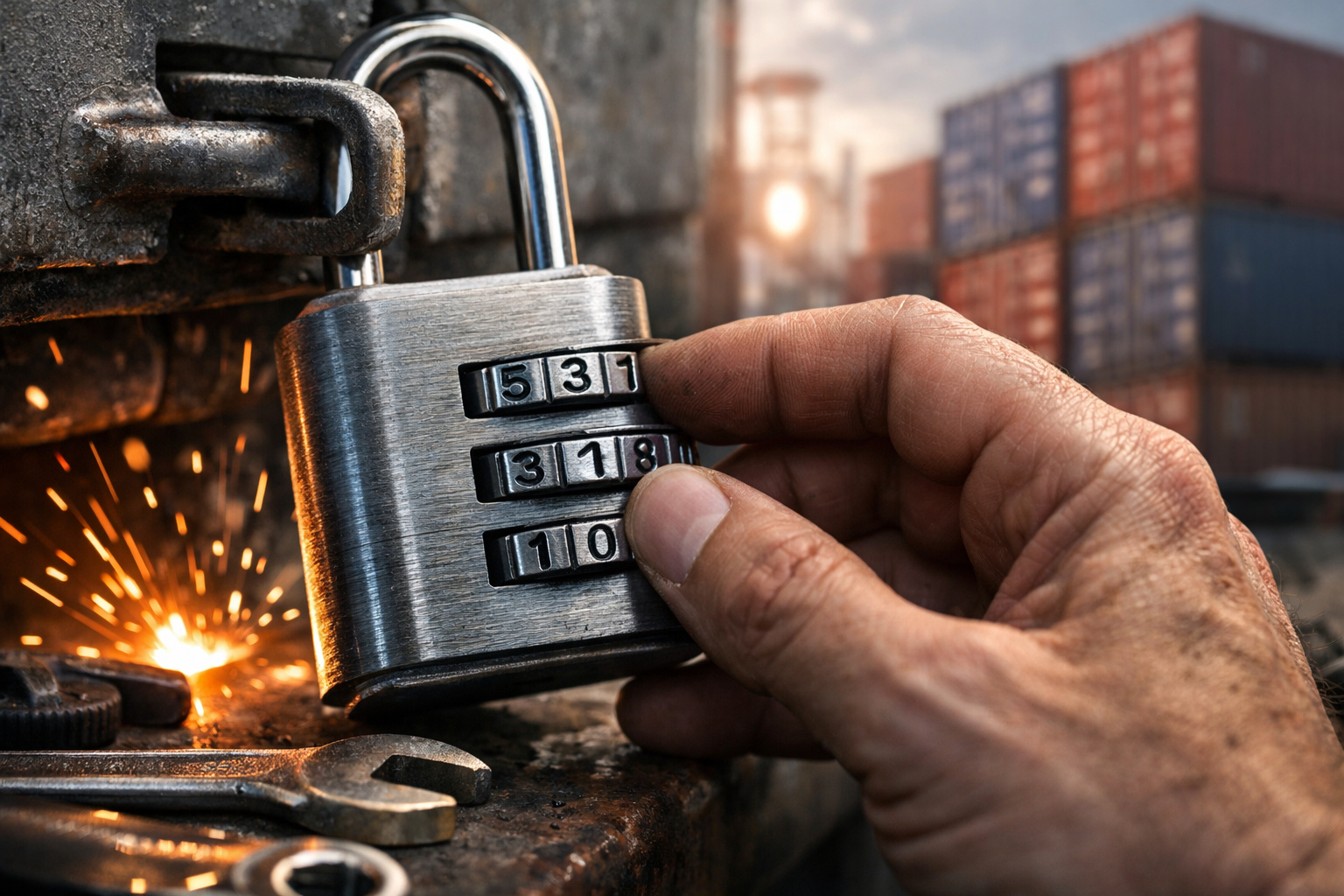
Mechanical Play in Numeric Padlocks Can Generate Touch Signals Under Tension and Trigger Alerts in Workshops, Ports, and Operations with a Domino Effect on Access Control.
A numeric padlock usually conveys a promise of high security. Without the correct combination, no one can get through. In workshops, warehouses, and maintenance areas, it becomes a quick solution to avoid lost keys, unauthorized duplicates, and that last-minute rush to “find the spare.”
But a small detail, hidden in the heart of the mechanism, has started to attract the attention of those who take security seriously. Some numeric padlocks, especially the simpler ones, can give physical signals during a patient attempt to open them.
What seems like “luck” is, in fact, the metal revealing its own fit.
-
Motorola launched the Signature with a gold seal from DxOMark, tying with the iPhone 17 Pro in camera performance, Snapdragon 8 Gen 5 that surpassed 3 million in benchmarks, and a zoom that impresses even at night.

-
Satellites reveal beneath the Sahara a giant river buried for thousands of kilometers: study shows that the largest hot desert on the planet was once traversed by a river system comparable to the largest on Earth.

-
Scientists have captured something never seen in space: newly born stars are creating gigantic rings of light a thousand times larger than the distance between the Earth and the Sun, and this changes everything we knew about stellar birth.

-
Geologists find traces of a continent that disappeared 155 million years ago after separating from Australia and reveal that it did not sink, but broke into fragments scattered across Southeast Asia.

The word that explains it all is a single one: mechanical play. It exists for the set to function. But, when it goes too far, it can turn into a clue.
The Play That Keeps the Padlock Functioning Can Also Create Perceptible “Signals”
Inside, numeric padlocks with a rotating disc rely on parts that need to align to release the shackle. The principle is old and works well when the design is careful. However, every mechanical part operates within tolerances. If it were “zero play,” it would lock up with dirt, wear, and manufacturing variation.
The risk appears when the tolerance turns into too much play. In this scenario, when tension is applied to the shackle and the disc is turned slowly, the set can display small resistances in specific positions. It’s not a total blockage. It’s a “touch” from the mechanism.
This behavior becomes a clue. Instead of the combination being an absolute secret, it can become a sequence easier to infer through sensation and repetition.
There is no official number that indicates how many models exhibit this behavior. It’s also not possible to claim that every numeric padlock is vulnerable. What is known is that there is a possible mechanical pattern and it depends on factors such as manufacturing quality, wear, and internal design.
What Seemed Like a Convenient Solution for Shifts and Maintenance Becomes a Routine Concern
The numeric padlock gained traction because it addresses a real pain point. There’s no key to lose. There’s no key to lend. There’s no key to copy. In places with rotating staff, this seems perfect.
The problem is that the market sold convenience disguised as protection. Many purchases are made on impulse, due to low cost and a promise of practicality. But security is not just about “locking up.” Security is about resisting.
According to experts in physical security, the critical point is when this type of padlock becomes the only barrier for high-value goods, access to internal areas, or storage of supplies. When someone exploits a weakness without making noise, the operation only realizes it later, when the absence is felt.
And the loss rarely stays with the object itself. It spreads.
The Domino Effect in the Operation Chain Is Huge and Unauthorized Access Can Delay Everything
In an industrial and logistical environment, small and repeated losses can be more dangerous than a large and singular event, because they go undetected for too long.
One tool disappears today, another tomorrow. One stock item “vanishes” and turns into an emergency purchase. A maintenance task is delayed due to missing parts. A delivery slips because the process has stalled.
Estimates indicate that this type of control leak generates invisible cost, which appears as rework, short stops, and unplanned purchases. When the padlock is weak, the cost is borne by the entire system.
The topic draws attention because it connects something mundane to an operational risk. It’s not about “locking a gate.” It’s about how small purchasing decisions can turn into security bottlenecks.
The Silent Rivalry in the Lock Market Is Growing, Simple Models Sell Volume While More Robust Designs Reduce Touch and Tension Signals
There is a clear competition, even if few people openly speak about it. On one side, entry-level padlocks, made for scale, with aggressive pricing and basic construction. On the other, designs aiming to reduce mechanical signals, use better materials, and control tolerances more rigorously.
This rivalry is evident in the details. A mechanism that “talks” to the person turning the disc is different from a mechanism that remains neutral even under tension. More robust designs attempt to prevent the disc’s resistance from becoming a clue.
This does not mean that price alone is the solution. Nor that every expensive product is secure. But it means that the design matters, a lot.
When the usage is of low risk, a simple padlock may suffice. When the risk is high, trusting the “feeling of being unbreakable” is a mistake.
What Changes from Now on Is the Criterion and Security Requires Layers
The main consequence of this alert is practice. Those who manage a workshop, warehouse, dry port, shed, or maintenance area need to rethink the role of the numeric padlock.
It can still be useful as a quick control. But it should not be treated as high-level protection when the impact of unauthorized access is significant. Real security works in layers, and this applies to any operation.
When the barrier is unique, it becomes the target. When there are layers, procedures, and controls, attempts meet more resistance, more tracking, and a greater chance of being interrupted.
In the end, this came to light because the feeling that a secret is well kept was threatened, and the discovery that sometimes the metal itself reveals the way has scared many.
Comment: Do you already use a numeric padlock in your work routine, or do you prefer keys and formal control, and why?








Seja o primeiro a reagir!