





 Portuguese
  English
  Spanish
  3 min of reading
  0 comments


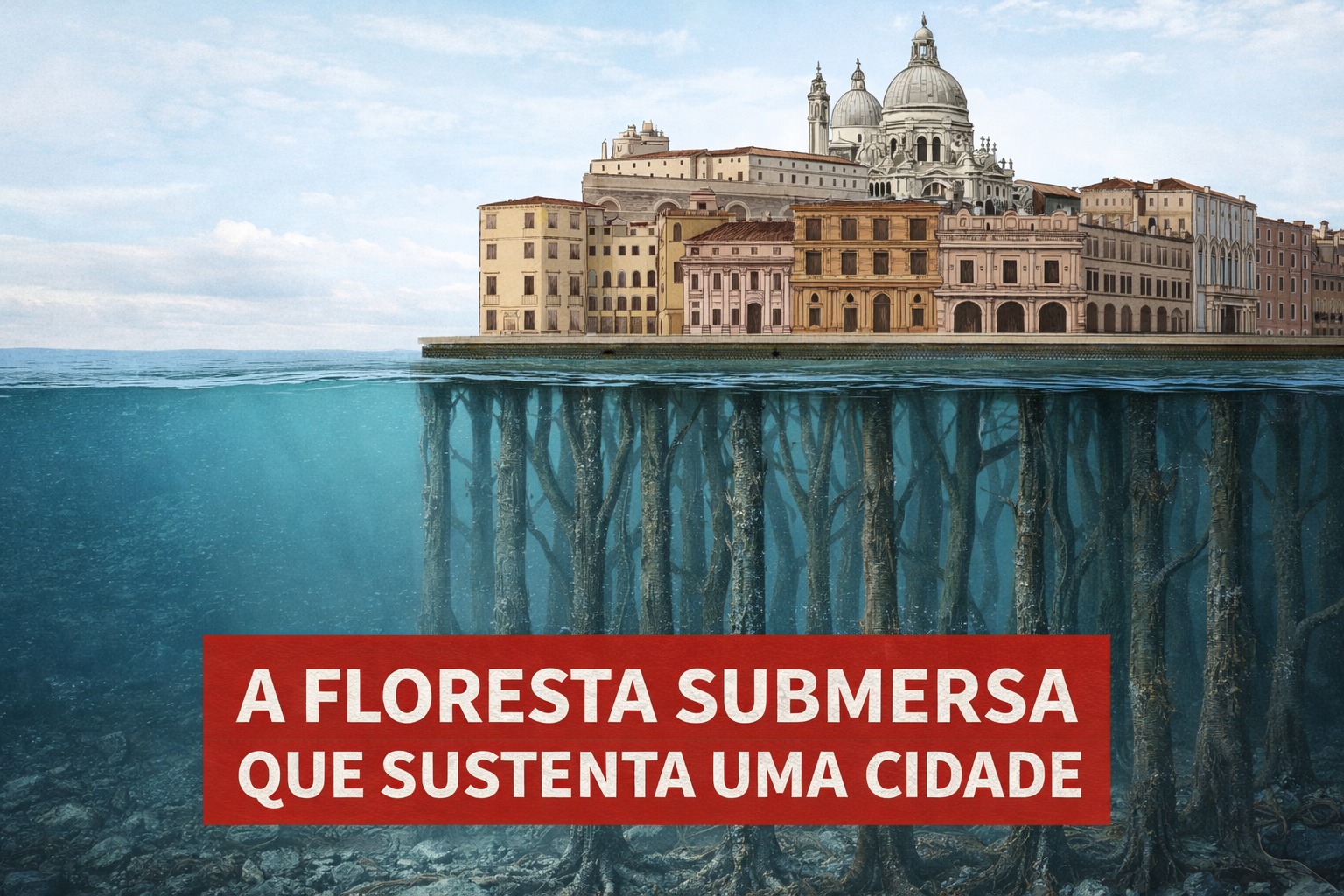
An Invisible Medieval Engineering Supports Italian Palaces and Canals, Using Mineralized Wood, Precise Layers, and Monumental Logistics That Transformed an Unstable Swamp into a Durable City
The stability of Venice, Italy, rests on an engineering solution as ingenious as it is invisible. Beneath the canals and palaces, more than 10 million wooden logs support the city, embedded in the lagoon’s subsoil over centuries.
Instead of firm ground, the historic buildings rely on piles that reach through the mud until they hit a more resilient layer, ensuring balance in a naturally unstable environment.


Why Wood Resists at the Bottom of the Lagoon
The main reason for the durability of these piles lies in the chemical conditions of the lagoon’s bottom. The dense mud creates an environment with very little oxygen, known as anaerobic.
-
Friends have been building a small “town” for 30 years to grow old together, with compact houses, a common area, nature surrounding it, and a collective life project designed for friendship, coexistence, and simplicity.

-
This small town in Germany created its own currency 24 years ago, today it circulates millions per year, is accepted in over 300 stores, and the German government allowed all of this to happen under one condition.

-
Curitiba is shrinking and is expected to lose 97,000 residents by 2050, while inland cities in Paraná such as Sarandi, Araucária, and Toledo are experiencing accelerated growth that is changing the entire state’s map.

-
Tourists were poisoned on Everest in a million-dollar fraud scheme involving helicopters that diverted over $19 million and shocked international authorities.


Without available oxygen, fungi and aerobic microorganisms, responsible for the accelerated decomposition of wood, can hardly act.
Even though anaerobic bacteria are present, their action is extremely slow. This reduced rate allows the piles to remain structurally intact for hundreds of years, capable of supporting enormous loads of marble and masonry without compromising the city’s foundation.
The Natural Hardening of Submerged Log Fibers
Over time, the submerged wood undergoes a process of physical alteration. The brackish water of the lagoon carries minerals and sediments that are slowly absorbed by the log fibers.
These inorganic materials occupy the internal spaces of the wood, progressively making it stiffer.
This is not a transformation into stone, but a hardening that significantly increases the material’s strength.
This natural phenomenon explains why the piles continue to fulfill their structural function, even after centuries of constant pressure exerted by the buildings of Venice.
The Layers That Support the City
To prevent the constructions from sinking, medieval engineers created a precise system of overlapping materials.
The foundation was designed to distribute the vertical weight and prevent moisture from rising to the walls.
The method uses three main elements. First, alder piles are driven deeply until they reach the caranto, a layer of more solid soil.
On top of them, a larch platform forms a leveled surface. Finally, Istrian stone blocks create a waterproof barrier, protecting the palaces from the lagoon’s moisture and ensuring the structure of the buildings.
The Origin of the Trees Used in the Foundation of the Submerged Forest That Supports the City
The construction of Venice required a large-scale logistical operation. Logs were extracted from regions that are now part of Slovenia and Croatia and transported across the Adriatic Sea.
The preference for oak and alder was due to the density and durability of these woods in water-saturated environments.
Those interested in history and urban engineering can find a detailed explanation in a video from the BBC News Brasil channel, which has garnered over 517 thousand views.
In it, André Biernath shows how this invisible forest supports the city to this day, revealing one of the most impressive solutions of medieval engineering.
With information from BMC News.









-

-

-

-

-

-

128 pessoas reagiram a isso.