





 Portuguese
  English
  Spanish
  3 min of reading
  0 comments


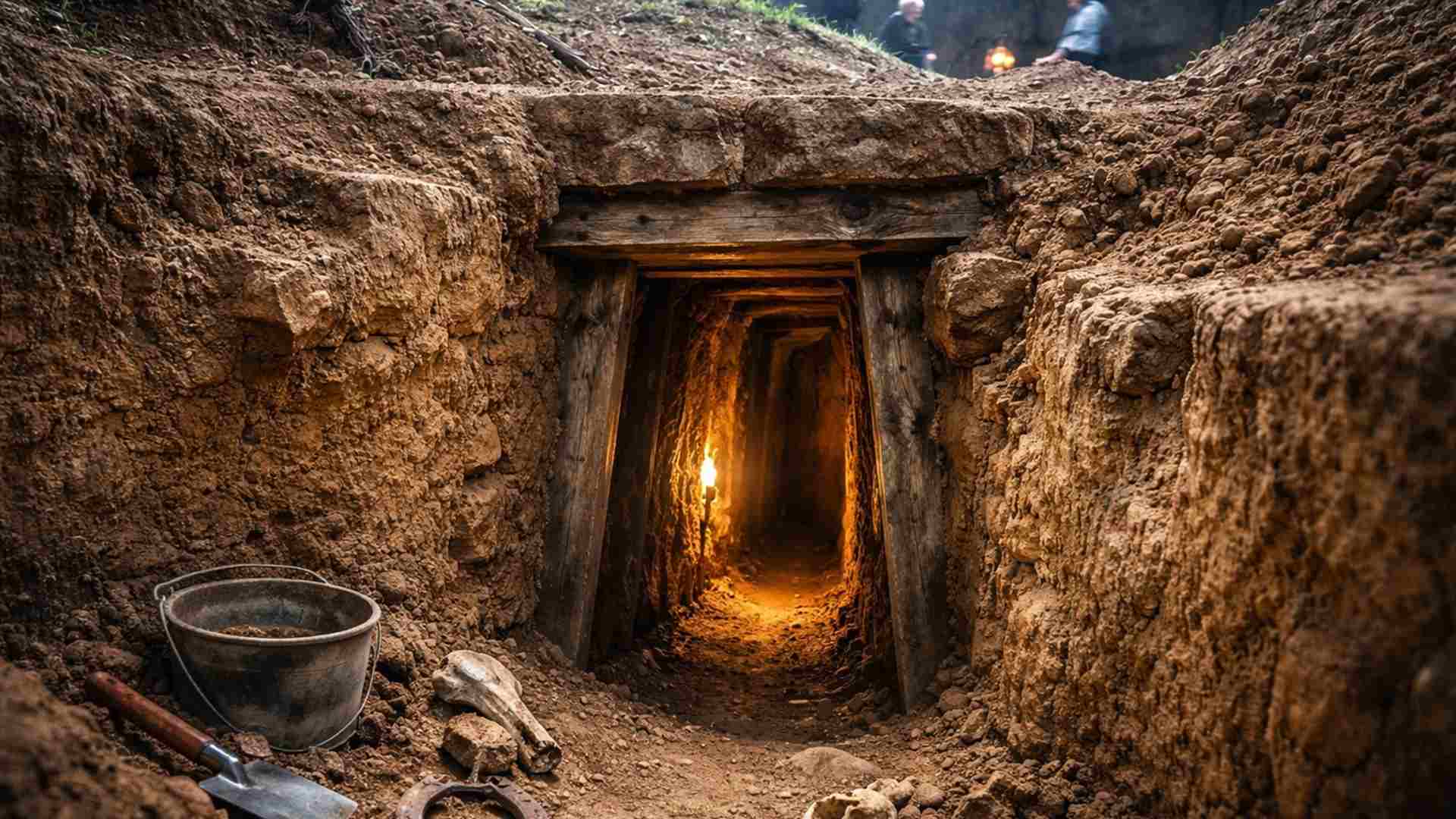
Discovered During Preventive Excavations Related to the Installation of a Wind Farm in Eastern Germany, the Medieval Edrstal Tunnel Was Identified Beneath a Neolithic Trench Approximately 6,000 Years Old, Revealing a Rare Overlap of Structures and Rekindling Archaeological Debates on the Function, Chronology, and Use of These Extremely Narrow Subterranean Corridors in Medieval Central Europe
A medieval underground tunnel was discovered at the end of 2025 during preventive excavations conducted east of Reinstedt, in Saxony-Anhalt, by the regional archaeological authority, prior to the implementation of a wind farm, revealing a rare structure beneath Neolithic remains approximately 6,000 years old.
Preventive Excavations Reveal Hidden Structures Beneath Wind Farm Area
The excavations were initiated by the Landesamt für Denkmalpflege und Archäologie to prevent the destruction of archaeological remains during the wind farm construction. The team initially identified a large trapezoidal trench from the Neolithic period.
As the work progressed, the archaeologists found that other similar trenches were hidden beneath the surface.
-
He started running at 66 years old, broke records at 82, and is now a subject of study for having a metabolic age comparable to that of a 20-year-old, in a case that is intriguing scientists and inspiring the world.

-
Oldest tree on the planet reappears after 130 years of searches: Wattieza, 385 million years old, was 10 meters tall and had no leaves or seeds; Gilboa fossils in New York solved the mystery in 2007.

-
A 48-square-meter house assembled in hours with 4,000 bricks made of recycled plastic that does not absorb moisture, has natural thermal insulation, and costs less than 90,000 reais in a complete kit.

-
Luciano Hang revealed that Havan’s air fleet has already accumulated more than 20,000 landings, 10,000 flight hours, and 6 million kilometers traveled, and he says that without the planes, the company would never have grown so quickly.


In the southern section of the site, a stone slab was located near an oval pit about 75 centimeters in diameter, raising new suspicions about buried structures.
Identification of a Medieval Edrstal Beneath Neolithic Site
When excavating the oval pit, researchers initially believed it to be a grave. This hypothesis was discarded when an edrstal emerged, a medieval underground tunnel approximately 1 meter in height and between 50 and 70 centimeters in width.
These narrow galleries are known in various regions of Central Europe and number in the thousands. According to the LBV, the construction pattern indicates a surprisingly uniform cultural practice, despite the absence of clear indications of its original function.

Material Evidence and Signs of Deliberate Blocking
Inside the passage discovered in Reinstedt, archaeologists found only an iron horseshoe, a fox skeleton, and mammal bones. At the lowest level, traces of a brief low-intensity fire were identified.
Stacked stones at the narrowest point of the entrance suggest that access to the tunnel was deliberately blocked at some point. The material evidence indicates that the structure dates from between the 10th and 13th centuries, much later than the Neolithic trenches beneath which it was excavated.
Hypotheses on the Use and Distribution of Medieval Tunnels
Tax records from Asparn, Austria, from 1449, mention edrstalls for the first time. These passages generally do not exceed 50 meters in length and require their users to move bent or sideways, creating an extremely restrictive environment.
Some tunnels feature more complex structures, with multiple levels, terminal chambers, and parallel entry and exit passages. A recurring element is the “Schlupf,” an even narrower section that requires crawling, reinforcing the unique nature of these constructions.
While no theory has been confirmed, researchers have raised hypotheses ranging from protective functions to symbolic or ritual uses. These tunnels are often found beneath old farms, near churches, cemeteries, or remote forests, maintaining the mystery about their collective and possibly secret purpose.
This article was prepared based on information disclosed by archaeological authorities of Saxony-Anhalt, reports from the LBV, European historical records, and articles from Archaeology News regarding the discovery of the medieval edrstal tunnel in Germany.









-

-

-

-

-

15 pessoas reagiram a isso.