





 Portuguese
  English
  Spanish
  3 min of reading
  0 comments


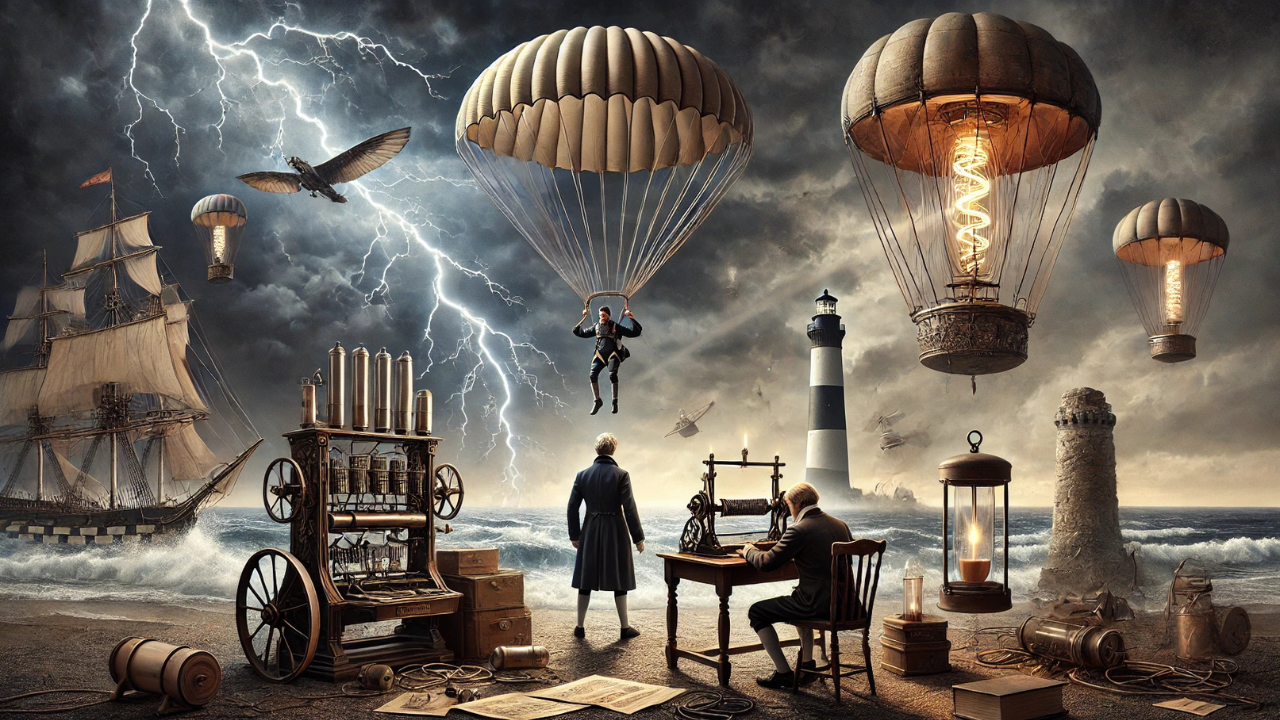
Meet Inventors Who Died Testing Their Own Creations. Tragic Stories of Genius, Innovation, and the Risks of Technological Advancement!
Throughout history, many inventors have become known for their creations, some revolutionary and others peculiar. However, not all scientists are remembered, even if their innovations are used daily. And, in even more dramatic cases, there are those whose death was directly linked to their own inventions.
Below, meet five cases of inventors who lost their lives due to their creations.
The Scientist Struck by His Own Research
In the 18th century, electrical phenomena fascinated scientists, especially after the invention of the Leyden jar.
-
Friends have been building a small “town” for 30 years to grow old together, with compact houses, a common area, nature surrounding it, and a collective life project designed for friendship, coexistence, and simplicity.

-
This small town in Germany created its own currency 24 years ago, today it circulates millions per year, is accepted in over 300 stores, and the German government allowed all of this to happen under one condition.

-
Curitiba is shrinking and is expected to lose 97,000 residents by 2050, while inland cities in Paraná such as Sarandi, Araucária, and Toledo are experiencing accelerated growth that is changing the entire state’s map.

-
Tourists were poisoned on Everest in a million-dollar fraud scheme involving helicopters that diverted over $19 million and shocked international authorities.


One of these enthusiasts was the Russian physicist of German-Baltic descent Georg Wilhelm Richmann, who developed an electrometer to measure the intensity of atmospheric electricity.
On August 6, 1753, during a storm, Richmann rushed home to observe his equipment in operation.
Witnesses reported that a small ball of lightning jumped from his conductive rod and struck his head, knocking him to the ground.
Subsequently, an explosion destroyed part of the site. Richmann became the first fatality of an electrical experiment.
The Fall from the Skies
Since Greek mythology, humanity has dreamed of flying. The British Robert Cocking was one of those who attempted to fulfill this desire, but ended up starring in the first recorded death in a parachuting accident.
Cocking dedicated years to developing a parachute that he believed was more efficient than those existing at the time.
On July 24, 1834, he decided to test his invention personally, jumping from a balloon at 1,500 meters above London.
However, his calculations did not account for the weight of the parachute itself. During the descent, the fabric tore and Cocking fell freely, dying on impact.
About 80 years later, in 1912, the French tailor Franz Reichelt attempted to test a parachute suit of his own invention, designed for airplane pilots.
He chose the Eiffel Tower as a testing location and, in front of the press, made a surprising announcement: instead of a dummy, he would jump himself.
The result was tragic: the suit failed, and Reichelt died upon hitting the ground.
A Revolutionary Invention and a Tragic Death
Journalism underwent a revolution in the 19th century with the creation of the web rotary press, developed by American William Bullock.
His invention eliminated the need to manually feed presses, allowing for faster and more efficient newspaper production.
However, in 1867, while making adjustments to one of these machines, Bullock attempted to fix a problem by pushing a piece with his foot.
His leg got caught in the mechanism, and he suffered severe injuries. The resulting infection led to the amputation of his leg, but Bullock did not survive the surgery and passed away.
Against the Tide
Henry Winstanley, a clever British engraver, dedicated his life to mechanical and hydraulic inventions. In 1698, after losing vessels to the treacherous rocks of Eddystone, off the English coast, he designed and built the first offshore lighthouse in history.
Convinced of the robustness of his creation, he stated that he would like to remain in the lighthouse during the worst storm ever recorded.
His wish was granted in November 1703, when winds of up to 190 km/h struck the area.
Winstanley was in the lighthouse at the time of the storm, and when the tempest passed, both his structure and its creator had vanished without a trace.
The Legacy of Inventors
These stories demonstrate the risks many inventors take when testing their own creations.
Even though they lost their lives under tragic circumstances, their inventions left a lasting impact on society.
The parachute, maritime lighthouses, electrical studies, and modern press were only made possible by the courage and genius of these pioneers.
The history of humanity is marked by innovation, and the inventors who died for their own creations show that sometimes the price of progress can be high.










-

Uma pessoa reagiu a isso.