





 Portuguese
  English
  Spanish
  5 min of reading
  2 comments


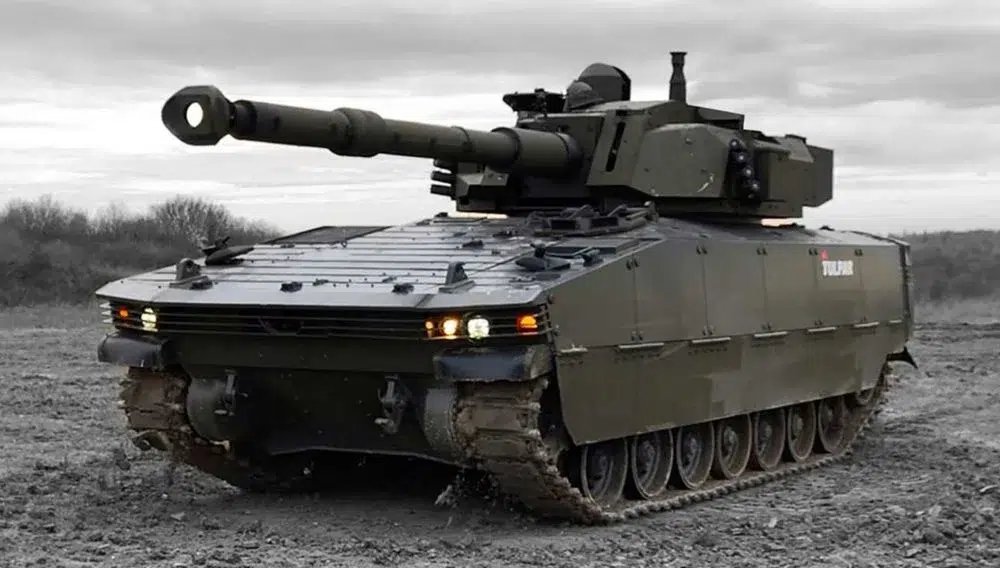


Armored Tank With Cutting-Edge Technology Is Highlighted at LAAD 2025 and May Strengthen the Brazilian Army in the Near Future, Check Out the Details Below.
The Tulpar, one of the most versatile and modern combat vehicles on the international military market, is on display at LAAD Defence & Security 2025 in Rio de Janeiro. The event, which brings together exhibitors and defense authorities from around the world, presents this Turkish model as a potential strategic acquisition for the Brazilian Army. Produced by Otokar, one of the largest defense manufacturers in Turkey, the armored tank Tulpar is not limited to direct combat. Its multifunctional design allows it to serve as troop transport, reconnaissance vehicle, military ambulance, air defense unit, and more, depending on the configuration requested by the purchasing country.
With this, the Brazilian Army is assessing the possibility of incorporating the Tulpar into its fleet as part of the planned equipment renovation for the coming years. The arrival of the cutting-edge technology tank would be a response to the urgent need to replace outdated models like the Leopard 1 and the M-113.
Tulpar Can Be Customized for Different Combat Missions, Transport, and Logistical Support
The great differential of the armored tank Tulpar lies in its operational versatility. It is a tracked vehicle with a front-mounted engine, capable of reaching up to 1,100 horsepower. This, combined with torsion bar suspension and seven dual-support wheels on each side, allows it to tackle various terrains — from mud and rocks to urban areas and dense forests.
-
Motorola launched the Signature with a gold seal from DxOMark, tying with the iPhone 17 Pro in camera performance, Snapdragon 8 Gen 5 that surpassed 3 million in benchmarks, and a zoom that impresses even at night.

-
Satellites reveal beneath the Sahara a giant river buried for thousands of kilometers: study shows that the largest hot desert on the planet was once traversed by a river system comparable to the largest on Earth.

-
Scientists have captured something never seen in space: newly born stars are creating gigantic rings of light a thousand times larger than the distance between the Earth and the Sun, and this changes everything we knew about stellar birth.

-
Geologists find traces of a continent that disappeared 155 million years ago after separating from Australia and reveal that it did not sink, but broke into fragments scattered across Southeast Asia.

This extreme mobility is one of the characteristics that attract the attention of the Brazilian Army, especially due to the varied geography of the country. The Tulpar can overcome obstacles that would hinder the action of other vehicles and stands out for its ability to operate in flooded, uneven regions and even under severe weather conditions.
The armor of the Tulpar also follows international standards. The basic level is STANAG 4569 Level 2, which already offers protection against light weapons. However, the armor can be reinforced up to Level 6, making the vehicle resistant to 30mm munitions and explosions of up to 10 kg underneath its tracks — a vital point for high-risk missions in conflict zones.
Tank With Cutting-Edge Technology Features 120 mm Cannon and Sensors for Next-Generation Combat
The most advanced version of the Tulpar comes equipped with the HITFACT MkII turret from the Italian company Leonardo, armed with an L45 cannon of 120 mm. The main armament follows NATO standards, allowing the use of a variety of lethal munitions against tanks, fortifications, missiles, and enemy vehicles.
The fact that the Brazilian Army already uses the HITFACT MkII turret on the Centauro II tanks currently in operation further facilitates the adaptation of the Tulpar to the national arsenal. This compatibility is seen as a strategically important factor for the integration and maintenance of the new fleet.
The cutting-edge technology tank also stands out for its precision targeting system, capable of operating with high efficiency even with the vehicle in motion. Its protection sensors against drones and cameras with thermal imaging ensure an advantage in low visibility situations and in scenarios with uncrewed aerial threats.
Moreover, the Tulpar has an open architecture, meaning it can be adapted with technologies already used by Brazil. This includes the installation of new sensors, national armaments, and communication systems, offering flexibility and technological independence.
Brazilian Army Studies the Purchase of Up to 143 Units of the Tulpar With Partial Production in the Country
The replacement of the current fleet of armored vehicles of the Brazilian Army is expected to begin in 2028, and the Tulpar emerges as a strong candidate to fill this gap with a cutting-edge technology tank and multiple capabilities.
According to information from the specialized portal Army Recognition Group, the Brazilian Armed Forces have already conducted evaluations of the model, and there is an expectation that the deal will advance. Otokar’s proposal includes technology transfer and the possibility of local production, an additional attraction for the national defense industry.
The speculated agreement includes the acquisition of 65 units of the main battle tank version, equipped with the 120 mm cannon, and 78 infantry fighting vehicles, which could receive 30 mm turrets or armaments manufactured in Brazil. The production of part of the vehicles in Brazilian territory would also generate jobs and develop the local logistics chain.
Besides Brazil, Otokar is negotiating the sale of the armored tank Tulpar with countries like Poland and Bangladesh. The Turkish army is also estimated to acquire around 400 units of the model, consolidating the vehicle as one of the most promising of the new generation of tanks.
Tulpar Can Mark a New Era for the Armed Forces With a Multifunctional and Powerful Armored Tank
If the negotiation with Otokar progresses, the Brazilian Army could have one of the most adaptable and powerful cutting-edge technology tanks ever produced. The Tulpar combines firepower, mobility, and resilience with a level of customization difficult to find in other models on the market.
The choice of the Tulpar would reinforce Brazil’s commitment to modernizing its ground defense, updating a fleet of vehicles that, in many cases, dates back decades. Introducing this armored tank into the Armed Forces’ portfolio would represent a technological and strategic leap for the country.


Besides combat power, the multifunctionality of the Tulpar — which can be quickly converted into an ambulance, support vehicle, or reconnaissance unit — shows how innovation in the military sector can meet different tactical demands with a single base model.
With the final decision still pending, the presence of the Tulpar at LAAD 2025 is already an indication that Brazil is attentive to the latest technologies available on the international stage. And it seems that if the purchase is confirmed, the country will be taking a step forward in building a more modern, efficient, and prepared land force for the challenges of the 21st century.








A guerra da Ucrânia mostrou que devemos investir mais em drones e artilharia.
Até mísseis baratos, disparados no ombro, estão acabando com tanques caríssimos…
Com transferência de tecnologia vale tudo, multitarefas recebendo armamentos do Brasil é uma maneira de queimar etapas, embora necessitemos muito menos forças terrestres.
Quem precisa acelerar é a marinha e a aeronáutica.