





 Portuguese
  English
  Spanish
 5 min of reading
  1 comment


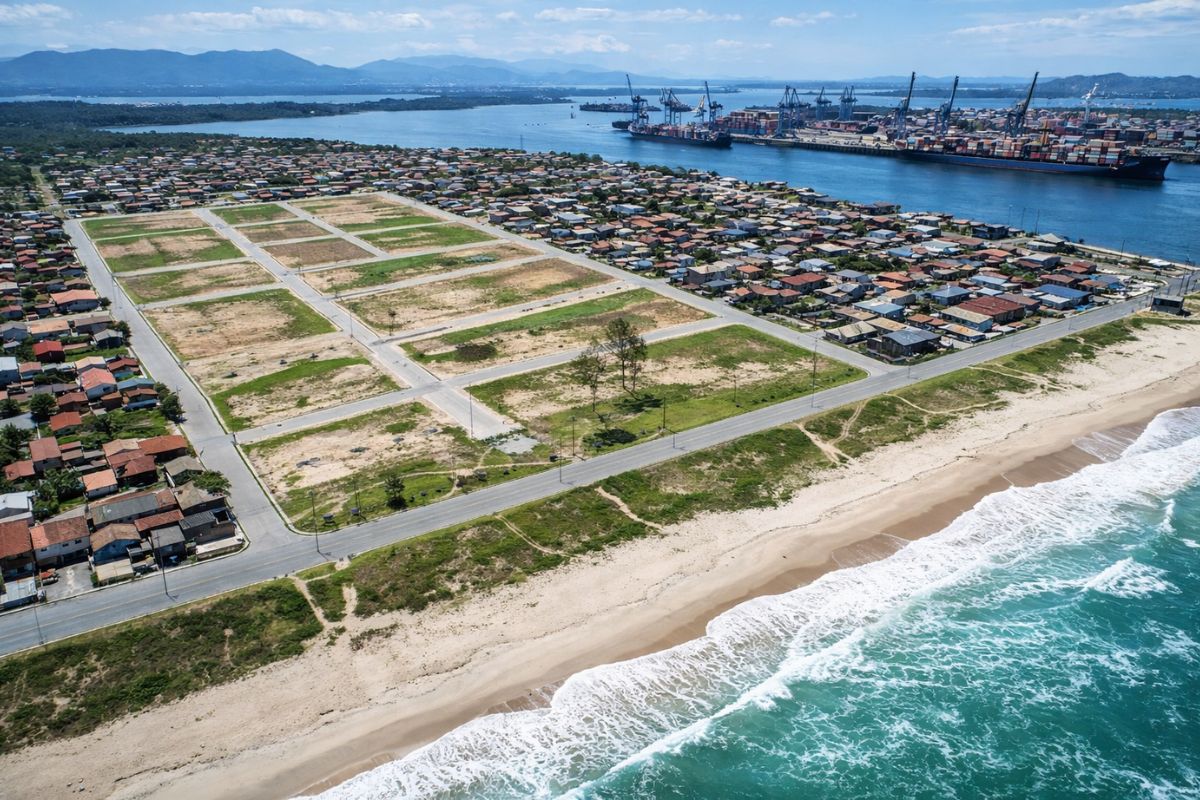


In The Bluest City In Brazil, A New Development In Praia Grande Launches 138 Lots On 100 Thousand M², With An Average Price Of R$ 570 Thousand And Installments Of Up To 240 Months, While The Port Of São Francisco Do Sul Hits 17.5 Million Tons And Drives Up The Appreciation Of The Waterfront
In São Francisco do Sul, in the Northern Coastal region of Santa Catarina, the bluest city in Brazil has also become a price thermometer for those dreaming of living by the sea. The latest trigger is the arrival of a new development in Praia Grande, with lots priced at R$ 570 thousand and a “Miami Beach” pitch that mixes tourism, port activities, and investment.
In essence, the numbers have less romance than they appear. The same waterfront that appreciates due to residential demand feels the pressure of the Port of São Francisco do Sul, which moved 17.5 million tons in 2025, and drives jobs, traffic, and urban decisions that redefine what it means to live well in the bluest city in Brazil.
How Much Does The View Cost And What Is The Market Putting In The Price

The number that captures the conversation is R$ 570 thousand, cited as the average price for each lot in the Praia Grande development.
-
The government requests the Federal Revenue Service for a new system to automate the income tax declaration, reducing errors, time, and bureaucracy for millions of Brazilians.

-
Pix in installments, international Pix, and contactless payment without internet: the Central Bank revealed the new features coming to the tool that is already used by almost every adult in Brazil.

-
Mercado Livre has just started selling medications with delivery in up to three hours to your door, and this move could completely change the way Brazilians buy medicines on a daily basis.

-
In Dubai, rising tensions from the war in the Middle East are causing super-rich individuals to leave the Gulf and direct their fortunes to a new financial refuge in Asia.

The comparison mentioned by the sector places São Francisco do Sul at a similar level to Balneário Camboriú, Itajaí, and Itapema, where lots range from R$ 500 thousand to over R$ 1 million.
This framing helps to understand who is in the competition.
It’s not just housing; it’s an asset, and that’s why the bluest city in Brazil is on the radar of investors, families wanting views, and people calculating future liquidity.
The sensitive point is that “average” is not a guarantee, and price jumps often depend on infrastructure, neighborhood, and the pace of construction.
Praia Grande And The Design Of The Development That Wants To Seem Like Another City

The cited development is the Jardim São Francisco Beach condominium, recently launched in Praia Grande.
The announced proposal speaks of more than 100 thousand m², 138 lots in two phases, and complete infrastructure, with installments of up to 240 months, a format that lowers the entry barrier for those who do not buy outright.
The location appears as a central argument.
The development is located 230 meters from SC-301 and less than 15 km from Joinville, distance that places the coastline on a direct route for those who work outside but want to live in the bluest city in Brazil.
This kind of promise transforms the mental map of Praia Grande, as the neighborhood shifts from being just a beach to also being about logistics.
The Promise Of Annual Appreciation Of 20% And What It Requires To Happen
The estimated annual appreciation of 20% is presented as potential, according to the real estate sector, and therefore needs to be read as projection, not as a contract.
In coastal markets, appreciation can accelerate but can also stall, especially when there is an oversupply or when public infrastructure does not keep up with the influx of new residents.
In practice, for Praia Grande to sustain such a curve, the entry price of R$ 570 thousand needs to find recurring buyers.
The driver is real demand, whether for a second home or for permanent relocation to the bluest city in Brazil.
Without this constant flow, the “promise” becomes just marketing, and the discussion returns to the basics: where it is located, how to access it, and what changes around it.
Port Of São Francisco Do Sul, 17.5 Million Tons And The Pressure That Does Not Fit In The Picture
Real estate growth is directly linked to the Port of São Francisco do Sul.
In 2025, the terminal handled 17.5 million tons, the highest volume in seven decades, consolidating state leadership and increasing job generation, according to cited data.
This increases income, attracts people, and elevates the demand for properties near access points.
However, the pressure is ambiguous.
The same Port of São Francisco do Sul that pulls jobs also pulls traffic, and any port city feels the effects of noise, traffic, and competition for strategic areas.
In São Francisco do Sul, the bluest city in Brazil coexists with this contrast because the waterfront appreciation occurs alongside a logistical hub that keeps growing.
Population On The Rise, Oldest City In Santa Catarina And The Weight Of The Blue Title
The cited estimate for the end of 2026 is 56.7 thousand residents, according to IBGE, with the expectation of surpassing 56 thousand inhabitants.
In urban terms, this means pressure for housing, services, and mobility, especially in areas near the sea, where the tourist appeal and residential appeal meet.
São Francisco do Sul also carries the label of the oldest city in Santa Catarina and the marketing of the bluest city in Brazil, associated with water quality and scenery.
When a place becomes a brand, it becomes a price, and Praia Grande feels this in the price per square meter, in the profile of buyers, and in the types of buildings that begin to dominate the beachfront.
The question of how much it costs to live by the sea in the bluest city in Brazil today involves numbers and context.
There is a lot priced at R$ 570 thousand in Praia Grande, there are 138 lots on 100 thousand m², and there are installments of up to 240 months, but there is also the Port of São Francisco do Sul with 17.5 million tons in 2025 pushing the city towards a more intense rhythm.
In the end, the dream of a local “Miami Beach” depends on concrete decisions regarding infrastructure, neighborhood, and coexistence with logistics. Would you pay R$ 570 thousand to live in Praia Grande knowing the weight of the Port of São Francisco do Sul, or does this combination exactly make the bluest city in Brazil a defensible investment for you?









15 km de Joinville…mas 4h de distância na temporada