





 Portuguese
  English
  Spanish
  4 min of reading
  0 comments


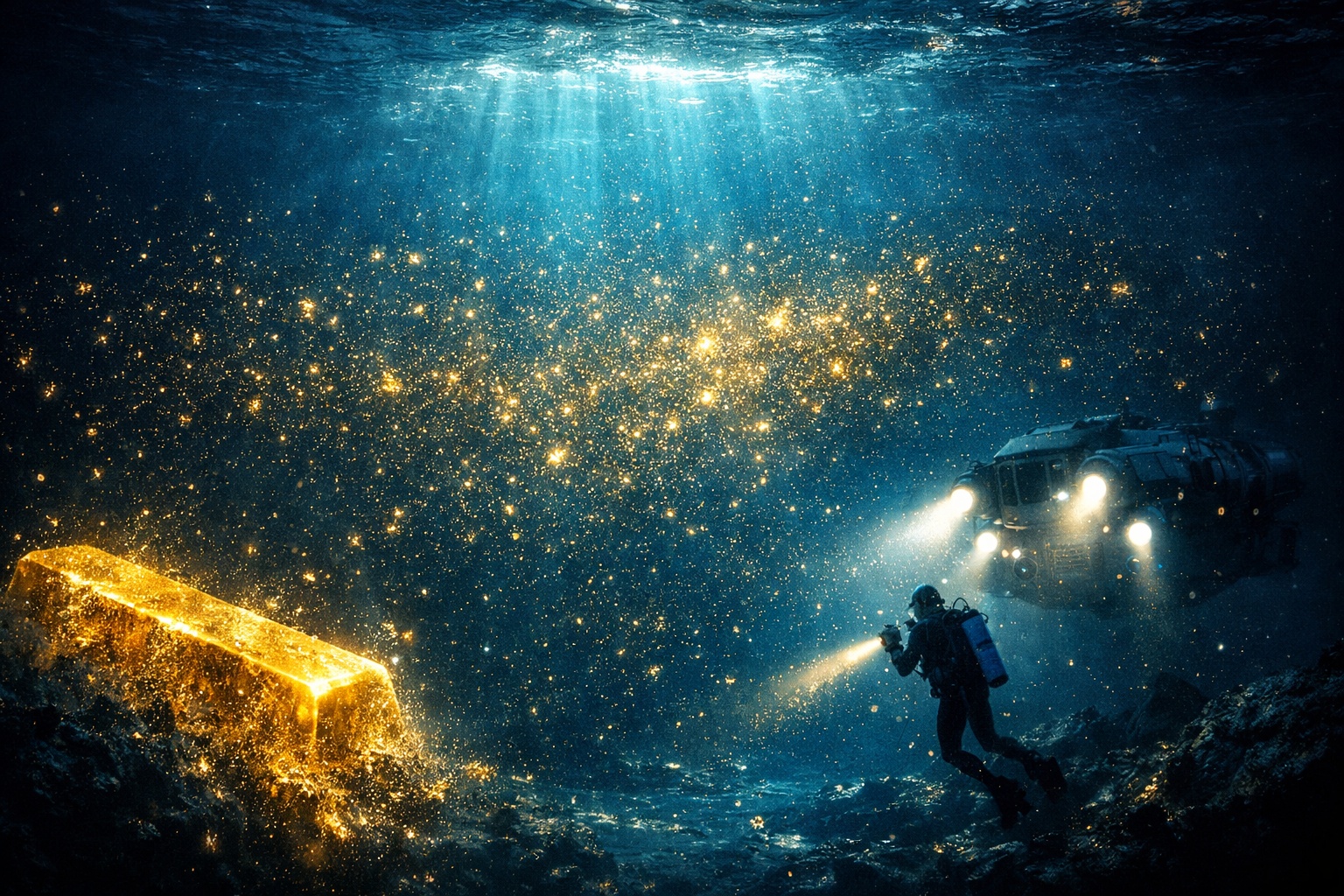
Oceans Contain Millions of Tons of Dissolved Gold in Microscopic Concentrations. Understand Why the Metal is Worth Quadrillions, But Remains Unfeasible to Extract.
There is gold in the oceans. A lot of gold. Not in nuggets, not in visible underwater veins, but dissolved in the sea water itself, in such small concentrations that they challenge any traditional mining method. Studies conducted by institutions such as the National Ocean Service (NOAA) and geochemical analyses published throughout the 20th century show that ocean water contains gold at extremely low levels, typically measured in parts per trillion (ppt) or even parts per quadrillion.
How Much Gold is in Seawater?
The estimated average concentration of gold in seawater ranges from 1 to 10 parts per trillion, depending on the region analyzed.
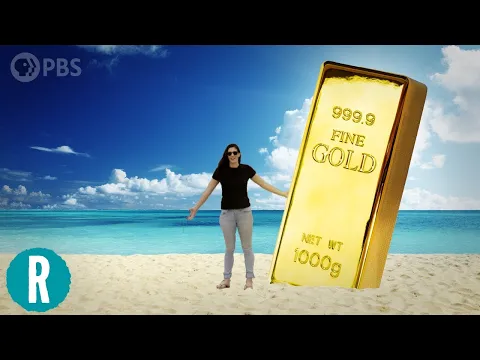
To visualize this scale: 1 part per trillion is approximately equivalent to 1 gram of gold in 1 billion liters of water. This means that one liter of seawater contains only billionths of a gram of the metal.
-
Friends have been building a small “town” for 30 years to grow old together, with compact houses, a common area, nature surrounding it, and a collective life project designed for friendship, coexistence, and simplicity.

-
This small town in Germany created its own currency 24 years ago, today it circulates millions per year, is accepted in over 300 stores, and the German government allowed all of this to happen under one condition.

-
Curitiba is shrinking and is expected to lose 97,000 residents by 2050, while inland cities in Paraná such as Sarandi, Araucária, and Toledo are experiencing accelerated growth that is changing the entire state’s map.

-
Tourists were poisoned on Everest in a million-dollar fraud scheme involving helicopters that diverted over $19 million and shocked international authorities.



Even so, considering that the oceans contain about 1.3 billion cubic kilometers of water, theoretical calculations indicate a total volume of gold that could exceed tens of millions of tons.
In economic terms, this volume could represent values in the range of quadrillions of dollars, depending on the international price of the metal.
Why is Gold Dissolved?
Gold reaches the ocean through different natural processes:
- Erosion of continental rocks
- River transport
- Submarine hydrothermal activity
- Chemical weathering
Over millions of years, microscopic particles and metal ions have been transported to the seas. Part of this gold remains dissolved in ionic form, interacting with chemical compounds present in salt water.
Unlike terrestrial deposits, where the metal concentrates in veins and ores, in the ocean it remains diluted in a practically homogeneous manner.
Historical Attempts at Extraction
The idea of extracting gold from the sea is not new. After World War I, German chemist Fritz Haber investigated the possibility of recovering oceanic gold to help pay reparations imposed on Germany. However, his studies demonstrated that the concentrations were much lower than initially thought.
In the 1940s, electrochemical experiments were also tested, but the energy and operational costs far exceeded the value of the gold recovered. The main obstacle has always been the extreme dilution of the metal.
The Technical Challenge of Extraction
For ocean mining to be economically viable, it would be necessary to:
- Process gigantic volumes of water
- Develop extremely selective filters or reagents
- Minimize energy costs
- Avoid massive environmental impact
Even modern technologies for chemical adsorption and advanced membranes still cannot extract gold from seawater with commercial viability. The energy needed to process billions of liters of water would exceed the value of the metal obtained.
Comparison with Traditional Mining
In terrestrial mining, economically viable deposits can contain some grams of gold per ton of rock. In seawater, we are talking about fractions of micrograms per ton of water.
This difference in concentration is what makes the process unfeasible. Mining relies on concentration. In the ocean, gold is too dispersed.

Research continues to explore materials capable of selectively capturing metal ions, including special polymers and nanostructured materials.
However, so far, no method has managed to demonstrate industrial viability on a large scale. Oceanic gold remains a theoretical wealth, not practical.
Estimated Value: Unreachable Wealth
If it were possible to concentrate and extract all the gold dissolved in the oceans, the economic impact would be global. The supply of the metal would drastically increase, altering the price and dynamics of the international market.
But this hypothesis remains purely mathematical. The extraction cost continues to far exceed the potential return.
In addition to the economic barrier, there is the environmental issue. Processing gigantic volumes of seawater could alter ecosystems, impact fauna, and modify the local chemistry of the ocean.
Any future technology would have to deal with this variable. The planet’s oceans contain millions of tons of gold dissolved in microscopic concentrations. The theoretical value could reach astronomical figures, but physical reality imposes clear limits.
The extremely low concentration makes extraction economically unfeasible with current technology. The gold is there — invisible, dispersed, mathematically abundant, but remains beyond the reach of modern engineering.
For now, the planet’s greatest treasures remain inaccessible, silently dissolved in the blue expanse.










-

-

-

-

-

-

59 pessoas reagiram a isso.