





 Portuguese
  English
  Spanish
  6 min of reading
  3 comments


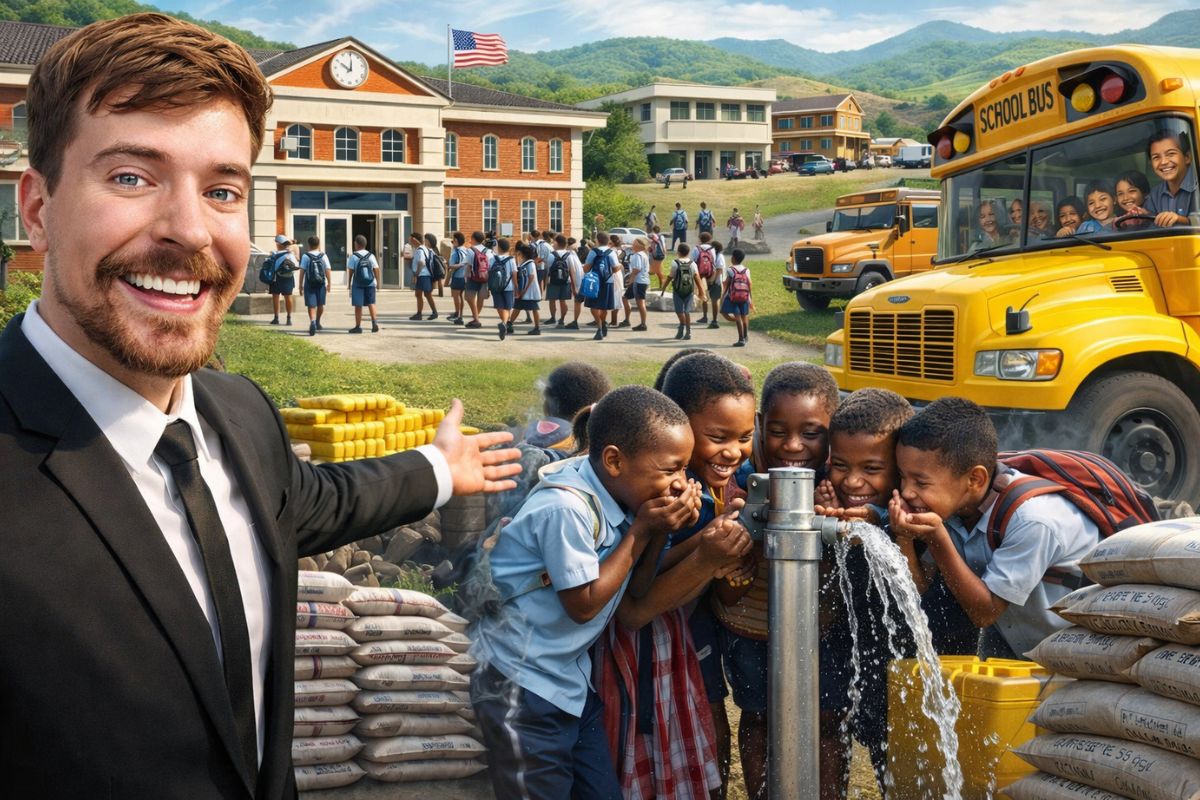


In the video, the creator known as Mr. Beast claims to have invested over 3 million dollars to build 10 schools and renovate precarious buildings, drill wells, install bathrooms, ensure free lunch for five years, and provide buses, homes for teachers, and bridges in different countries with the support of partners.
Presenting the construction of 10 schools around the world, Mr. Beast claims to have directed over 3 million dollars to replace temporary classrooms with new structures, featuring clean water, sanitation, and school meals, in an attempt to reduce absences, preventable diseases, and child labor.
The initiative appears as a series of interventions in communities with very different realities, including Ghana, Ecuador, the United States, and India, involving complete renovations, demolitions of unsafe buildings, and offerings that go beyond the classroom, such as wells, kitchens, bathrooms, metal bridges, and even a bus for long commutes.
What’s at Stake When Discussing 10 Schools

Mr. Beast starts from a straightforward backdrop: more than two hundred million children without safe access to school. The proposal there is not just to “raise walls,” but to attack the bottlenecks that cause schools to fail at the basics, such as roofs that threaten to collapse, classrooms that flood, mud, noise that hinders lessons, and the absence of clean water.
-
Friends have been building a small “town” for 30 years to grow old together, with compact houses, a common area, nature surrounding it, and a collective life project designed for friendship, coexistence, and simplicity.

-
This small town in Germany created its own currency 24 years ago, today it circulates millions per year, is accepted in over 300 stores, and the German government allowed all of this to happen under one condition.

-
Curitiba is shrinking and is expected to lose 97,000 residents by 2050, while inland cities in Paraná such as Sarandi, Araucária, and Toledo are experiencing accelerated growth that is changing the entire state’s map.

-
Tourists were poisoned on Everest in a million-dollar fraud scheme involving helicopters that diverted over $19 million and shocked international authorities.


By positioning 10 schools as a symbol, the narrative ties education to infrastructure: potable water for drinking, bathrooms to prevent students from using the bushes, sinks connected to the well, and kitchens to guarantee daily meals.
It’s a simple yet powerful logic: when the environment doesn’t protect, learning becomes a risk and dropout rates grow.
Ghana as a Snapshot of the “Before and After” of School Infrastructure

At one central point, the first school presented in Ghana appears as an “old school,” so dangerous that authorities would have ordered its demolition.
The showcased solution combines the demolition of the old building, a complete renovation of what could still be salvaged, and the construction of new classrooms with renewed roofs, walls, and floors.
The intervention also goes beyond the gate. Mr. Beast describes a village that has consumed water from a river for over a decade and presents a stark statistic: nearly 80% of the population, including children, with parasitic worms in their intestines.
The displayed response is drilling a well that would serve the school and hundreds of people from the nearby community, in addition to bathrooms and handwashing stations, linking public health and school retention.
Food for Five Years and the Direct Effect on Attendance
One of the most repeated commitments is to provide free lunch every school day for five years. The promise is presented very concretely, with a date chosen on a calendar extending to 2030, to reinforce the duration of the program.
Then the narrative returns to a school where the meal program had already existed for a year, asserting that it continued to operate. It is at this point that a key figure appears: school attendance is said to have increased by 10% thanks to the meals, and it would continue to grow.
Even without going into methodological details, the suggested connection is well-known in public policy: when meals become a guarantee, the school competes better with the everyday economic pressure.
How to Build Quickly Without Losing Durability
The construction shown includes a method with assembled and connected walls, followed by filling with concrete, described as a way to make the structure “last for generations.”
The sequence emphasizes the speed of assembly with structural reinforcement, especially in areas where the demand for places was greater than the capacity.
There are also solutions adapted to the territory. In Ecuador, two schools appear as a response to rain and flooding: metal roofs that hindered classes due to noise, water reaching above the knees, and risk for children.
The alternative displayed is new, elevated buildings to keep students safe during rain, with the estimate of over 50 children being able to return to studying in better conditions.
Access and Safety: When the Path to School Defines Who Studies

In addition to the 10 schools, the project focuses on the journey. In Ecuador, the replacement of a wooden bridge with a metal one is presented as a reduction of risk for children who needed to cross to get to classes. It is a typical community infrastructure intervention: inexpensive compared to large projects, but decisive in everyday life.
In India, Mr. Beast describes an overcrowded school, with over 400 students and only six classrooms. The shown response is a new three-story school and the purchase of a bus because many students walked over an hour in the dark on roads considered dangerous.
Here, the message is clear: it’s not enough for the classroom to exist; it’s essential to reach it safely especially for girls.
Homes for Teachers and the Attempt to Retain Educators

A detail that shifts the focus from students to staff appears when the principal reports that two teachers spent a third of their salary and over an hour a day commuting.
The displayed “solution” is apartments for them, presented as a way to make the job viable and sustainable.
This type of delivery points to a frequent problem in remote areas: turnover and absence of teachers due to transportation costs, distance, and lack of housing.
By including housing in the package, the project attempts to tackle a structural point: without a present teacher, the new school becomes an empty building.
Partnerships, Brands, and What This Changes in Understanding the Impact
Mr. Beast had support from partners: the Rockefeller Foundation to help provide meals in schools in Ghana, Fundación Televisa in a soccer field, and a partnership with Lowe’s in the United States, including volunteering and the creation of an outdoor learning space for neurodivergent students at Hope Creek Academy.
This execution model, with brands and foundations, has two sides. On one hand, it enhances capacity and accelerates deliveries, enabling things like solar-powered wells, equipped kitchens, and school transportation.
On the other hand, it demands transparency and continuity because a social project with a defined deadline can create dependency if the community cannot maintain food, building maintenance, and water system operation afterward.
What Mr. Beast Claims as a Result and What Questions Remain
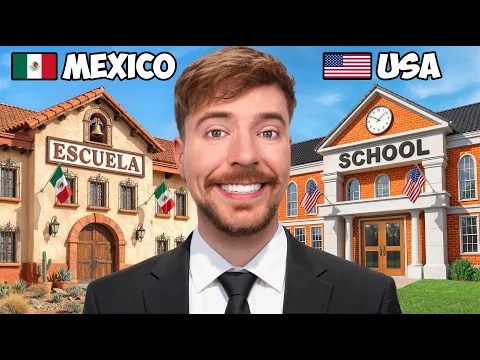

The conclusion brings the broadest data: over 3 million dollars spent on the 10 schools, with an estimated benefit for more than 18,000 students, in addition to potable water wells, buses, bridges, and improvements that “would impact generations.”
In Ghana, the figure of over half a million dollars is also mentioned for a specific complex, predicted to exceed 1 million by the end of the year, combining school and surrounding infrastructure.
At the same time, the very ambition of the project exposes vital questions for any initiative of this size: who assumes recurring costs, such as well and pump maintenance, furniture replacement, daily meals, bus fuel, route safety, bathroom cleaning, and building preservation.
This is where the difference between one-time delivery and lasting transformation becomes more evident.
If you could decide what comes first in a project like this potable water, meals for five years, transportation, bathrooms, housing for teachers, or the building itself what choice would you make and why? And, looking at the role of content creators in social actions, what would make you trust more: public goals, independent audits, continuous accountability, or direct community participation in management?










Vem para o Brasil também!!
O problema é que esse aí é só um “empurrãozinho,” não vai ser pra sempre essa ajuda aí. O governo desses países teria q aproveitar e manter esse nível. Coisa que não vai acontecer, provavelmente a hora q as doações pararem automaticamente o governo vai esquecer q esses projetos existiram algum dia.
São pensamentos como seu que deixa esses países ou pessoas sem oportunidades, se alguém não começar nunca vai mudar.