





 Portuguese
  English
  Spanish
  4 min of reading
  0 comments


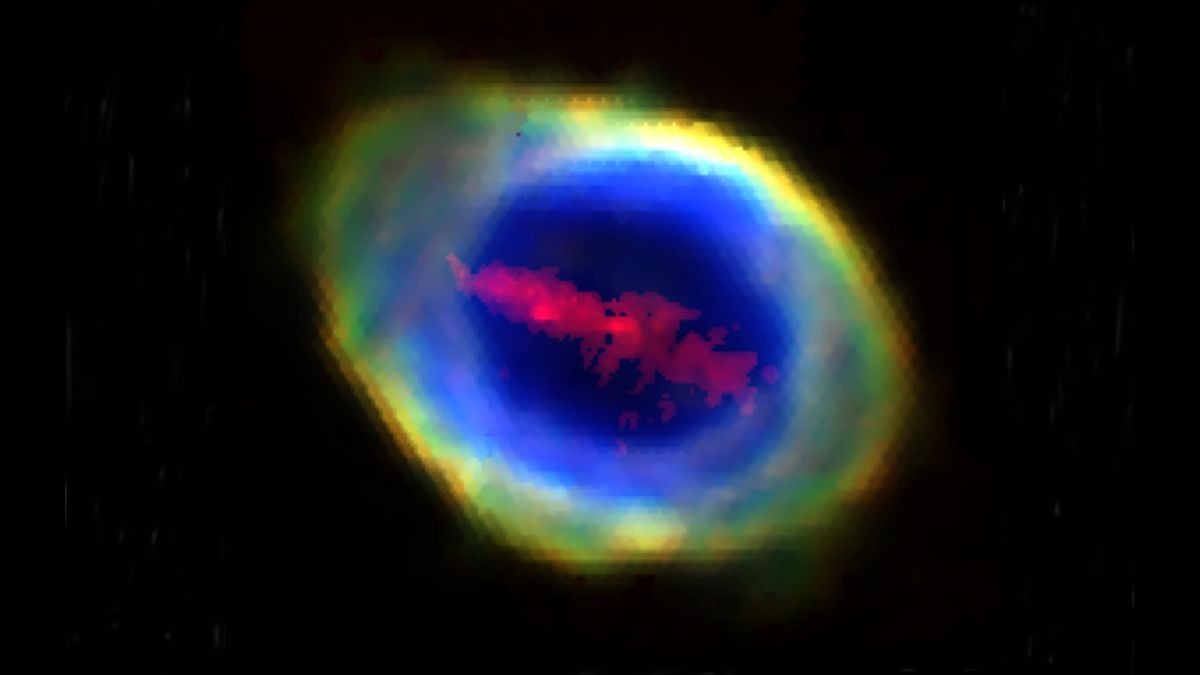
After Almost 250 Years of Continuous Observations, Astronomers Identify in the Core of the Ring Nebula an Unprecedented Linear Structure Composed of Ionized Iron, with an Estimated Mass of 14% of the Earth, Detected by Integral Spectroscopy and Without an Explanation Compatible with Known Models of Planetary Nebulae
The Ring Nebula, observed for almost 250 years, has returned to the center of astronomical debate following the identification of an unprecedented structure in its core: a bright linear bar of ionized iron, with no known explanation, located at the heart of the planetary nebula and revealed by new integral field spectroscopic observations.
The Ring Nebula and Its Known Astrophysical Context
The Ring Nebula is a planetary nebula located 2,570 light-years away in the constellation Lyra, discovered in 1779 by the French astronomer Charles Messier.
Despite the name, these structures have no relation to planets but represent the final stage of stars similar to the Sun.
-
Motorola launched the Signature with a gold seal from DxOMark, tying with the iPhone 17 Pro in camera performance, Snapdragon 8 Gen 5 that surpassed 3 million in benchmarks, and a zoom that impresses even at night.

-
Satellites reveal beneath the Sahara a giant river buried for thousands of kilometers: study shows that the largest hot desert on the planet was once traversed by a river system comparable to the largest on Earth.

-
Scientists have captured something never seen in space: newly born stars are creating gigantic rings of light a thousand times larger than the distance between the Earth and the Sun, and this changes everything we knew about stellar birth.

-
Geologists find traces of a continent that disappeared 155 million years ago after separating from Australia and reveal that it did not sink, but broke into fragments scattered across Southeast Asia.

At the end of their lives, these stars slowly expel their outer layers while the core collapses and transforms into a white dwarf.
Because it is a relatively gentle process, the ejected material tends to form well-defined spherical structures, often symmetrical and predictable.
There are thousands of known or candidate planetary nebulae in the Milky Way. This broad set provides astronomers with a solid reference regarding their physical and morphological properties. The Ring Nebula, one of the most studied, was not considered an object prone to significant structural surprises.
Unprecedented Instrumentation Reveals the Hidden Bar of Iron
The observations responsible for the discovery were conducted using the Large Integral Field Unit mode of the WHT Enhanced Area Velocity Explorer instrument, installed on the 4.2-meter William Herschel Telescope. This mode allows capturing a wide field in a single exposure, providing complete spectroscopic data of the entire object.
According to astronomer Roger Wesson from Cardiff University, the use of WEAVE enabled the Ring Nebula to be observed in a new way, with a level of detail superior to that obtained by previous instruments. While processing the data, the team clearly identified a bar of ionized iron atoms, previously unknown.
Previous observations had only used slit spectroscopy, a technique that analyzes narrow slices of the nebula. This method would only detect the structure if the slit were perfectly aligned with the orientation of the bar, which explains why it remained invisible for so long.
Dynamic and Chemical Properties That Challenge Explanations
The bar of iron presents characteristics that complicate its interpretation. Although it visually resembles a jet of material, detailed analyses show that the central white dwarf of the Ring Nebula is displaced from the center of the bar, making it unlikely to be the direct source of the iron.
Furthermore, the kinematic behavior of the structure does not correspond to that of classical stellar jets. The emission lines indicate that the entire bar is moving away from the observer, without the pattern of one end approaching and the other receding, typical of bipolar jets.
The composition is also unusual. The bar concentrates a mass equivalent to about 14% of the mass of the Earth, formed entirely by bare, ionized iron atoms, a value greater than the mass of Mars. In nebulae, iron is typically bound to dust, not floating freely in ionized form.
JWST Observations and Hypotheses Considered
Images obtained by the James Webb Space Telescope show dust present on both sides of the iron bar, but not overlapping it. This suggests that part of the dust may have been destroyed, releasing the previously trapped iron.
However, there is no evidence for the conditions necessary for this process. The ionization of iron would require intense shock waves or extremely high temperatures. The center of the Ring Nebula is considered serene and shows no signs of these phenomena.
A press release even proposed the destruction of a planet as an explanation. However, planetary debris would not form a straight and perfect bar, nor would it exhibit the observed velocity pattern. Furthermore, it would contain other elements, such as magnesium and silicon, absent in the measurements.
Observational Limitations and Future Perspectives
The researchers emphasize that the complete three-dimensional shape of the iron cloud is not fully known. The structure may extend beyond the current line of sight, similar to a board observed from the side, which limits definitive interpretations.
In the absence of satisfactory explanations, the team sees it as essential to seek similar structures in other nebulae. The expectation is that new observations will reveal more examples, allowing patterns to be identified and hypotheses about the origin of the iron to be narrowed down.
For Wesson, it would be surprising if the bar of the Ring Nebula were a unique case. The identification of similar phenomena in other planetary nebulae may provide the necessary clues to understand how large amounts of ionized iron can be organized in this way.
The research was published in the Monthly Notices of the Royal Astronomical Society, solidifying the iron bar of the Ring Nebula as one of the most intriguing enigmas recently identified in this type of astronomical object.







-

-

2 pessoas reagiram a isso.