





 Portuguese
  English
  Spanish
  4 min of reading
  0 comments


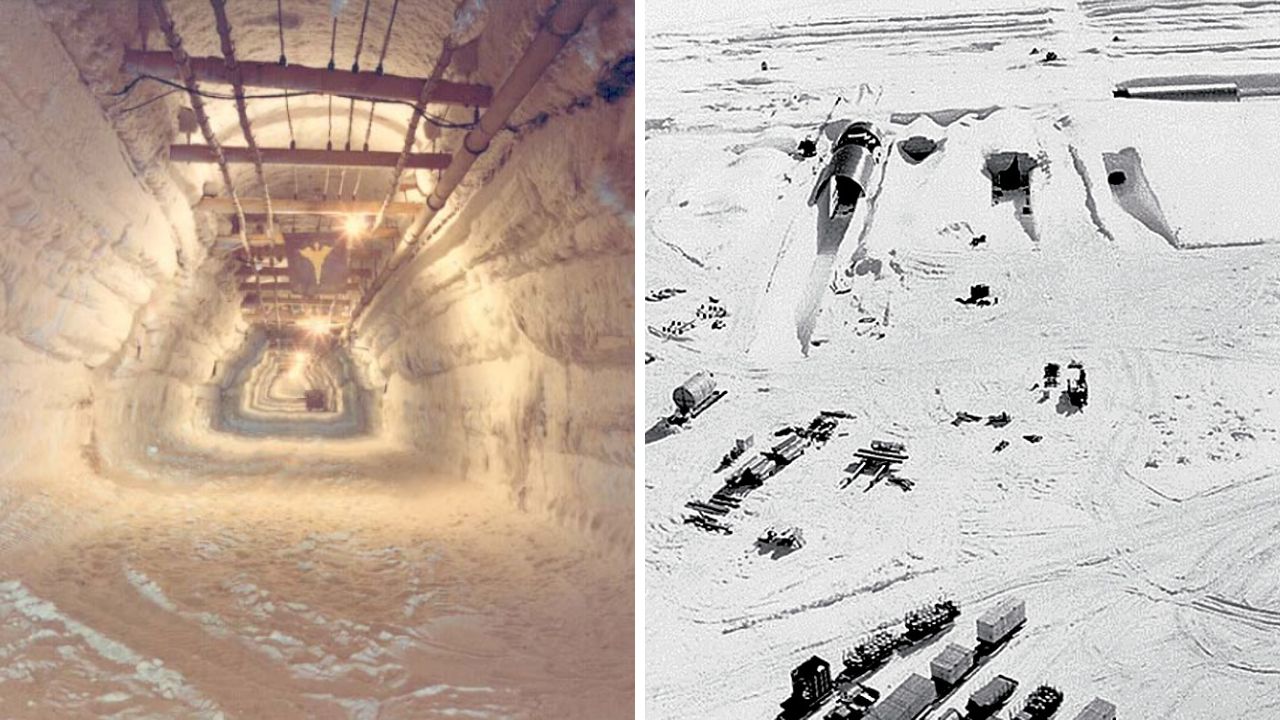
Discover The Story Of Camp Century, The US Secret Base In Greenland, Revealed By NASA. Military Ambitions And Science In The Ice During The Cold War
Hidden for decades beneath the ice of Greenland, the secret base of the United States, known as Camp Century, encapsulates a unique period in history where science, military strategy, and international politics intersected in intriguing ways. Recently rediscovered by NASA radars, its history dates back to the Cold War, a time of global tension when the Arctic became a strategic stage for military and scientific advancements.
United States Offers 100 Million Dollars For Greenland
The narrative begins in 1940, during a period of uncertainties brought by World War II. In a negotiation that seems straight out of a movie, the United States offered Denmark 100 million dollars for the purchase of a part of Greenland. The official justification was the strategic importance of the territory in the North Atlantic.
At that time, Greenland was seen as a valuable geopolitical asset, especially for monitoring enemy troop movements and conducting logistical operations. However, the offer was declined by Denmark, which wanted to maintain its sovereignty over the territory. Despite this, American support during World War II left a lasting impression on the Danish government, which later granted the United States permission to build military bases on the territory.
-
With a cost per shot close to zero, the DragonFire laser could change naval warfare in 2027 and provide British ships with nearly unlimited defense against drones.

-
A British startup creates tires that generate electricity in electric vehicles when passing over potholes, speed bumps, and cracks.

-
Scientists have created robots made with living cells that have their own nervous system, swim on their own, explore the environment, and self-organize without any genetic engineering, and now they want to do the same with human cells.

-
Students create a solar-powered ambulance that operates without a plug, without fuel, and still keeps medical equipment running in remote areas.



The Creation Of Camp Century: A Futuristic City Beneath The Ice
In 1959, the United States began construction of Camp Century, located about 150 km from Thule Air Base (now Pituffik Space Base). The project was not only a demonstration of technological power but also an attempt to explore the possibilities of life and operation in extreme conditions. The base consisted of 21 interconnected steel tunnels, totaling nearly three kilometers in length, capable of housing up to 200 soldiers.
Camp Century included innovative infrastructure: dormitories, recreational areas, a hospital, a kitchen, and even a nuclear reactor (PM-2), which provided power and heating for the entire facility. Engineers also developed advanced systems to melt ice and extract water, as well as create ventilation methods that ensured habitability under temperatures of up to -57°C and winds exceeding 190 km/h.
However, declassified documents revealed that the project went beyond a simple scientific effort. It was part of a larger strategic plan, known as Project Iceworm, aimed at storing nuclear weapons beneath the ice for use against the Soviet Union in the event of war.
Project Iceworm And Its Nuclear Ambitions

The Iceworm Project was one of the most audacious secrets of the Cold War. It envisioned the construction of a subterranean network of tunnels in the ice of Greenland, where the United States could hide up to 2,100 nuclear missiles. The idea was to keep these missiles in constant motion, using underground railways to prevent them from being detected by Soviet satellites. Additionally, the network would include 60 launch control centers, ensuring a quick response in the event of an attack.
However, the natural conditions of Greenland posed insurmountable challenges. The instability of the ice made it unfeasible to maintain the structures, leading to the project’s termination in 1967. Despite this, Camp Century served as an important laboratory for testing construction and storage technologies in polar environments.
Thule-Gate: Declassified Secrets And International Scandals
Decades after the abandonment of Camp Century, declassified documents revealed revelations that shook international politics. It was discovered that, during the 1960s, the United States had stored nuclear weapons at Thule Air Base, in violation of agreements made with Denmark. Additionally, regular flights of bombers with nuclear armament over Greenland were conducted, increasing the risk of catastrophic accidents.
The scandal, known as Thule-Gate, also exposed the complicity of the Danish government, which had hidden these practices from its citizens for over 30 years. The revelation sparked public outrage in Denmark and highlighted Greenland’s central role in Cold War military strategies.
The Scientific Importance Of Camp Century

Although shrouded in controversies, Camp Century left a valuable legacy for science. During its operation, American engineers drilled deep into Greenland’s ice, extracting the first cores containing climate records from thousands of years. These cores allowed scientists to study the relationship between greenhouse gases and climate change over time, providing essential data for future projections.
The recent rediscovery of Camp Century, made by NASA using UAVSAR radar, reinforces its relevance. The radar, initially designed to map ice layers, revealed the base’s structures in impressive detail, opening new possibilities for studying sites buried in the Arctic.








Seja o primeiro a reagir!