





 Portuguese
  English
  Spanish
  3 min of reading
  1 comment


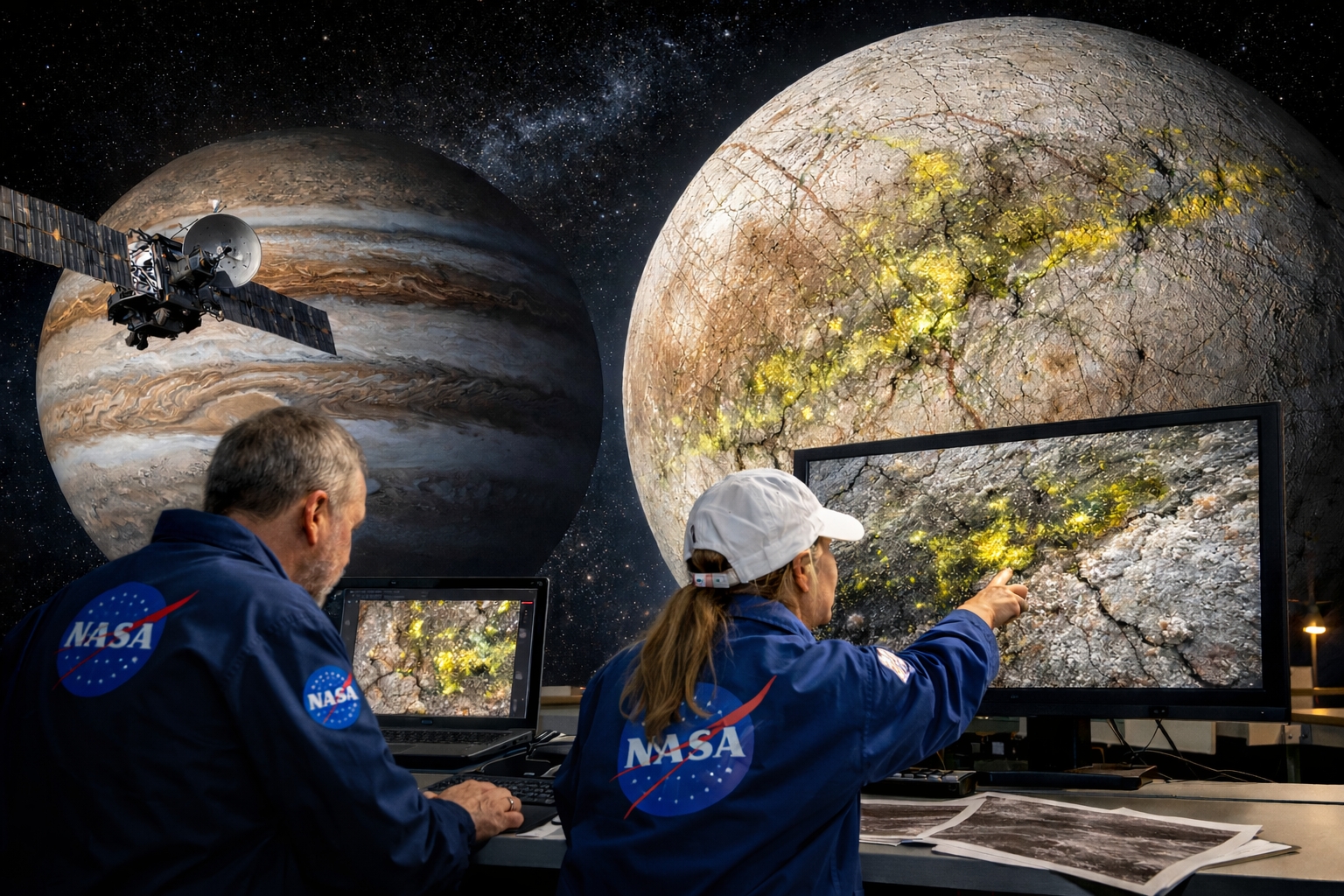


In The Orbit Of Jupiter, NASA Researchers Conducted New Analysis Of Galileo Spacecraft Data With Records From 1995 To 2003 To Identify Ammonia Compounds On The Surface Of Europa, Igniting New Scientific Interest And Capturing The Attention Of The Europa Clipper Mission.
One Of The Most Intriguing Celestial Bodies In The Solar System Has Returned To The Spotlight. Europa, A Moon Of Jupiter, Was Already Considered Promising In The Search For Life Beyond Earth. Now, A New Study Has Rekindled That Interest By Revealing The Presence Of Ammonia On Its Surface.
The Detail That Stood Out The Most Is That The Data Is Not Recent. It Was Collected Between 1995 And 2003 By NASA’s Galileo Spacecraft And Has Only Now Undergone A Detailed Reanalysis.
Review Of Old Data Revealed Essential Compound For Life
The Discovery Emerged From A Review Of The Information Obtained By The Spectrometer Of The Galileo Mission.
-
Motorola launched the Signature with a gold seal from DxOMark, tying with the iPhone 17 Pro in camera performance, Snapdragon 8 Gen 5 that surpassed 3 million in benchmarks, and a zoom that impresses even at night.

-
Satellites reveal beneath the Sahara a giant river buried for thousands of kilometers: study shows that the largest hot desert on the planet was once traversed by a river system comparable to the largest on Earth.

-
Scientists have captured something never seen in space: newly born stars are creating gigantic rings of light a thousand times larger than the distance between the Earth and the Sun, and this changes everything we knew about stellar birth.

-
Geologists find traces of a continent that disappeared 155 million years ago after separating from Australia and reveal that it did not sink, but broke into fragments scattered across Southeast Asia.

The Researchers Identified, For The First Time, Compounds Containing Ammonia Spread Across The Surface Of Europa. The Signals Were Detected Primarily Near Fractures In The Ice Layer Covering The Moon.
Ammonia Contains Nitrogen, An Element Considered Essential For Life As We Know It. This Fact Alone Puts Europa Back On The Astrobiology Radar.
Fractures In The Ice May Indicate Active Geological Activity
Europa Is Covered By A Thick Layer Of Ice. Below It, There Is Believed To Be A Large Subterranean Ocean.
The Ammonia Compounds Were Found Near Cracks In The Frozen Crust. According To Experts, This May Be Linked To Internal Geological Processes.
One Of The Most Discussed Hypotheses Is Cryovolcanism, A Kind Of Icy Volcanism Capable Of Transporting Material From The Subterranean Ocean To The Surface. If Confirmed, This Phenomenon Could Indicate More Dynamic Internal Activity Than Previously Imagined.
Ammonia Acts As A Natural Antifreeze And May Indicate Recent Material
The Presence Of Ammonia Is Not Just Curious; It Plays A Strategic Role.
The Molecule Lowers The Freezing Point Of Water, Acting As A Natural Antifreeze. This Could Facilitate The Maintenance Of Liquid Water Beneath The Frozen Surface.
Another Relevant Point Is That Ammonia Does Not Remain For Long Periods Exposed To The Space Environment. This Suggests That Its Deposition May Have Occurred Relatively Recently, Which Heightens Scientific Interest.
What Once Seemed Just A Chemical Trace May Indicate Current Activity On Europa.
New Discovery Expands Expectations For The Europa Clipper Mission
Europa Was Already On The Short List Of Promising Locations In The Solar System Considered In The Search For Life Beyond Earth.
The Moon Has A Large Subterranean Ocean Beneath Its Outer Ice Layer. However, Recent Research Has Also Raised Doubts About Its Habitability.
After Modeling The Internal Conditions, Scientists Indicated That The Moon’s Rocky Floor May Be Mechanically Too Strong To Allow Certain Types Of Geological Activity Essential For Habitability.
Even So, The Identification Of Ammonia Reignites The Debate.
The Results Are Expected To Guide Future Observations Of The Europa Clipper Mission, Which Will Study The Moon In More Detail Over The Next Decade. The Expectation Is That New Data Will Help Clarify Whether Europa Truly Meets The Conditions To Support Life.
The Discovery Shows That Even Decades After The Original Collection, Spatial Data Can Still Reveal Surprises Capable Of Changing The Course Of Research On Life Beyond Earth.
Do You Believe That Europa Could Harbor Life In The Subterranean Ocean? Share Your Opinion In The Comments And Join This Discussion That Could Redefine What We Know About The Solar System.








Eu creio que o homem nao é só nesse grande espaço. Quanto ao oceano abrigar vida, tudo é possível