





 Portuguese
  English
  Spanish
  3 min of reading
  19 comments


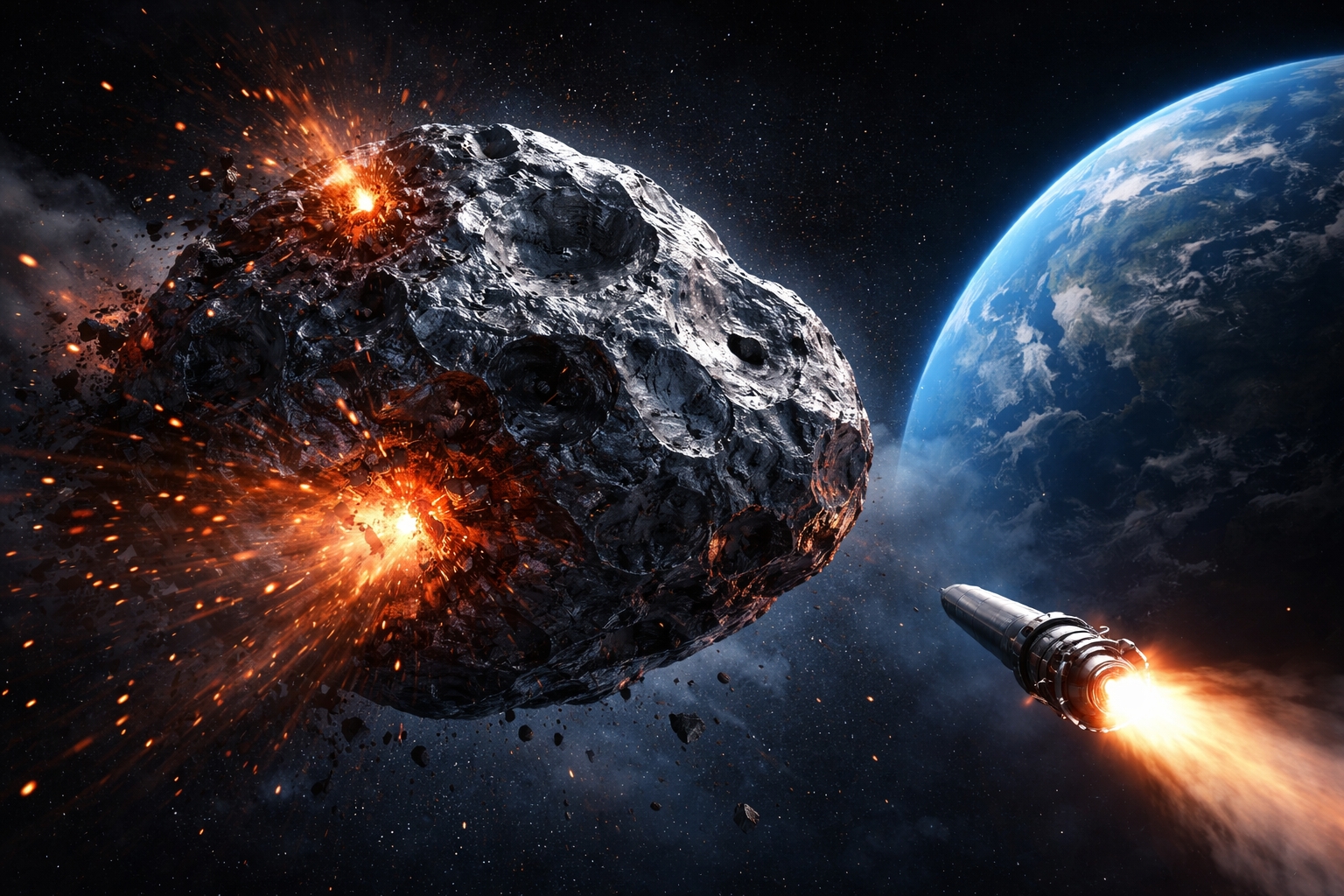


Rich Iron Asteroids Might Be Harder Than We Imagined and This Complicates Earth Defense Plans: Proton Beam Tests at CERN Indicate That Iron and Nickel-Rich Materials Absorb More Energy Without Breaking, A Detail That Could Alter Simulations and Deflection Strategies.
When we think about deflecting a dangerous asteroid, the most intuitive idea is: hit hard enough to break it or change its course. However, a newly published study suggests that this logic may fail for a specific type of space body: metallic asteroids, rich in iron and nickel.
The research, involving physicists from the University of Oxford, was released on January 8, 2026 and points out that these materials can withstand much more energy without breaking than previous estimates indicated, something that directly impacts how we model “what happens” after an extreme collision.
The Concerned Finding: More Energy… and Less Fracture
In simple terms: the “metallic asteroid-type” material absorbs a larger amount of energy under rapid and extreme conditions without disintegrating.
-
With a cost per shot close to zero, the DragonFire laser could change naval warfare in 2027 and provide British ships with nearly unlimited defense against drones.

-
A British startup creates tires that generate electricity in electric vehicles when passing over potholes, speed bumps, and cracks.

-
Scientists have created robots made with living cells that have their own nervous system, swim on their own, explore the environment, and self-organize without any genetic engineering, and now they want to do the same with human cells.

-
Students create a solar-powered ambulance that operates without a plug, without fuel, and still keeps medical equipment running in remote areas.
This is unsettling for a practical reason: many mitigation scenarios depend on how the object fractures (or doesn’t) when it experiences a violent impact or brutal heating. If the rock “does not behave” as the model assumes, the real outcome could be very different.
How They Simulated a “Cosmic Impact” Without Needing a Real Asteroid
The most striking detail of the study is the method.
The researchers used the HiRadMat facility at CERN to bombard a sample of the iron meteorite Campo del Cielo (used as an analogue for a metallic asteroid) with 440 GeV proton beams coming from the Super Proton Synchrotron (SPS).
And to observe the “stress” happening in the material in real-time, they applied laser Doppler vibrometry, a technique that measures tiny vibrations on the surface and helps to reconstruct how stress waves propagate during the thermal/mechanical shock.
Translation to the Real World: if a metallic asteroid enters the atmosphere or receives an artificial impact (from a mission, for example), the way it propagates stresses and maintains integrity may be very different from a porous rocky asteroid or a “rubble pile” (a cluster of gravitational debris).
Why This Affects Planetary Defense
Planetary defense is not just science fiction: in 2022, NASA’s DART mission intentionally collided with the asteroid Dimorphos and managed to alter its orbital period by dozens of minutes — a real proof of the kinetic impactor method.
The point is that the efficiency of this type of impact depends on the target: structure, cohesion, porosity, and how much material is ejected after the collision (the “extra push” that can enhance deflection).
And this is where the new concern comes in: if an iron-rich asteroid does not break as expected and resists more, the outcome of an impact may not align with simulations based on more fragile materials.







E se usar um propulsor de atração gravitacional com eletro-imãs gigantes através de um satélite? sendo usado antes da chegada eles poderiam induzir a trajetória devido ao metal que possui. Isso desviará a rota do cometa.
Ao invés de tentar dar porrada no asteroide, não seria mais inteligente criar um campo magnética que o repila ou um que o atraia para outro planeta ou até mesmo para a Lua? A Lua seria interessante para possivelmente mineirá-la depois.
A idéia de coletar o lixo espacial e mantê-lo em órbita para ser compactado e lançado em direção a um risco eminente de colisão é interessante.