





 Portuguese
  English
  Spanish
 3 min of reading
  0 comments


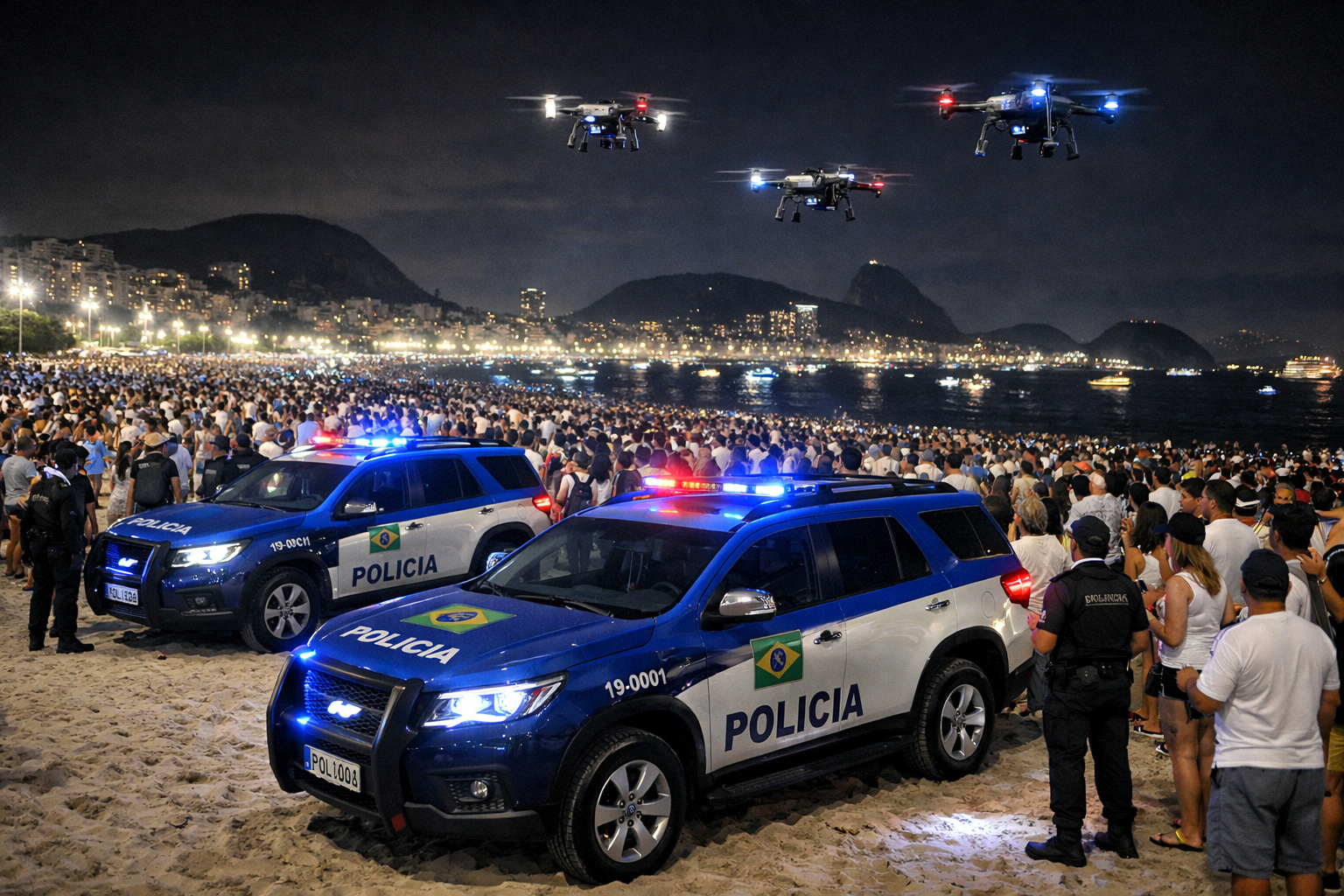
With Intelligent Vehicles, Drones, and Strategic Division of the Shore, Military Police Expands Control and Prevention to Ensure Public Safety at the Country’s Largest New Year’s Eve Celebration

The New Year’s Eve in Copacabana, one of the largest open-air events in the world, will feature an unprecedented technological reinforcement in public safety to welcome approximately 2.5 million people. To ensure the tranquility of the audience during the New Year’s transition, the Military Police is betting on advanced monitoring, intelligence, and access control solutions along the entire shore.
This information was released through official communication channels and reinforced in statements from the security forces of Rio de Janeiro. According to the authorities, the special operation was planned to integrate technology, police presence, and preventive actions, creating a safer environment for residents and tourists.
For the first time, the Military Police vehicles used for New Year’s Eve in Copacabana will be equipped with facial recognition cameras and automatic license plate reading systems. With this, agents can identify individuals wanted by the Justice and vehicles with restrictions in real-time, increasing the response capacity during the celebration.
-
The Argentine government celebrates the lowest poverty rate in 7 years, but experts warn that the methodology has changed, real wages have fallen, unemployment has risen, and the number of people on the streets of Buenos Aires has increased by 57% since Milei took office.

-
7.8 magnitude earthquake in Indonesia frightens the population, triggers tsunami alert, and hits an island with over 200,000 inhabitants this Thursday.
-
Google will finally let you change that embarrassing Gmail address you created in your teenage years without losing any accounts, logins, or old emails: the feature is already available in the United States.

-
Heading to Brazil in a Bonanza F33 single-engine aircraft: a couple departs from Florida on a visual flight, makes technical stops in the Caribbean to refuel and organize paperwork, and begins the staged crossing until they reach the country.

Technology Expands Surveillance and Quick Response on the Shore

In addition to intelligent vehicles, the security operation will include monitoring drones that will fly over strategic areas of the shore. These devices allow for a broad view of the flow of people, facilitating the identification of risk situations and assisting in the quick deployment of ground teams.
To make control even more efficient, the Copacabana shore has been divided into five major operational areas. Each sector will have fixed checkpoints, visible policing, and constant monitoring. This way, the Military Police aims to reduce bottlenecks, prevent crowds, and act preventively.
Furthermore, the technological systems will be integrated into command centers, allowing for data cross-referencing and real-time tracking of occurrences. Thus, public safety gains more agility and precision during a large-scale event.
Access Rules and Prohibited Items Strengthen Prevention
As part of the security plan, authorities have established strict rules for access to the shore. Sharp, piercing objects and glass bottles are prohibited during the event. This measure aims to reduce the risk of accidents and avoid violence.
Meanwhile, specialized teams will conduct searches at predefined entry points. This strategy, combined with the use of technology, seeks to balance fluid access and strict prevention.
According to information released by security agencies, the main focus is to anticipate problems, preventing occurrences from turning into serious incidents. In this way, the combination of technology and police presence becomes essential for the operation’s success.
Sea Conditions Require Increased Attention from the Public
In addition to land security, authorities also warn of risks at sea. According to responsible agencies, the sea will present high waves during the New Year transition. For this reason, diving is not advised throughout the night.
Rescue and support teams will be positioned along the shore. Still, the recommendation is that the public follow directions and avoid entering the sea, especially during peak times of crowding.
Finally, the Military Police emphasizes that the operation’s success also depends on the cooperation of attendees. The conscious use of public space, respect for rules, and attention to warnings contribute to a safer celebration.
With the use of facial recognition, drones, and intelligent vehicles, do you support this technological strategy becoming the standard for public safety at large events in Brazil?










-

Uma pessoa reagiu a isso.