





 Portuguese
  English
  Spanish
  4 min of reading
  5 comments


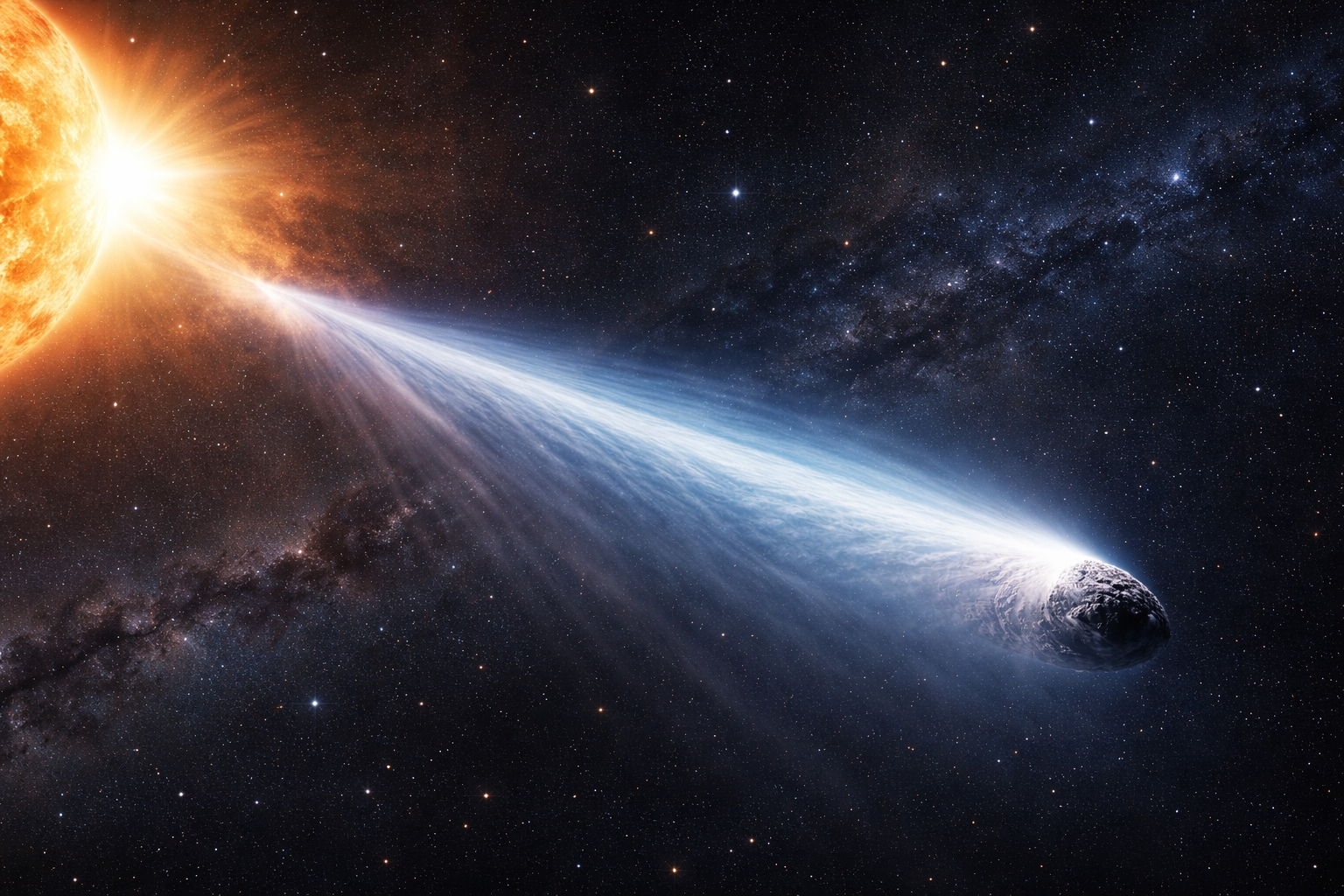


The Anticola of 3I/ATLAS Displayed Unusual Behavior Near the Sun and Raised New Hypotheses About What Drives This Jet.
The interstellar comet 3I/ATLAS was the most talked-about space object of 2025 and continues to be in the spotlight. The interest increased after the closest approach to Earth on December 19.
The most striking point is the anticola, a jet that appears toward the Sun. This pattern deviates from what is expected for a typical cometary tail and keeps the debate about what sustains this behavior ongoing.

The Anticola of 3I/ATLAS Grew Toward the Sun After Perihelion
The most observed period occurred in the two months after perihelion, when the comet is closest to the Sun. During this time, the anticola would have extended for several hundred thousand kilometers toward the Sun.
-
What if the Sun disappeared suddenly? Simulation shows Earth in darkness within minutes, extreme cold, and rapid collapse of life on the planet.

-
A 2,400-year-old iron foundry has been discovered in Senegal with 100 tons of slag, 35 furnace bases, and signs of nearly eight centuries of continuous metallurgical activity.
-
Four humans are flying towards the Moon inside the Orion capsule launched by the SLS rocket, and on April 6, Artemis II will disappear behind the far side of the Moon without communication with Earth for nearly an hour.
-
Worlds covered by water, atmospheres filled with hydrogen, and the possibility of life beyond Earth: ocean planets are rewriting the map of cosmic search and forcing scientists to rethink where to look.


This direction is opposite to what is usually seen in comets. The situation raised doubts about the composition of the object and how dust and gas are distributed.
The theme gained traction because the anticola does not seem to depend solely on one type of material. The comparison between dust and gas became the focus of analysis.
Dust and Gas Do Not React the Same Way in Space
Dust can be pushed by the gas that escapes from the comet’s nucleus. It can reach great distances and then lose speed due to solar radiation pressure.
This effect helps explain why a jet can grow so much even when the gas does not appear clearly. Dust follows its own dynamics and can remain visible for a long time.
Gas encounters another type of obstacle. The strongest interaction occurs with the solar wind, which influences the path of the material released by the nucleus.
The Role of Ice and Sublimation in the Comet’s Nucleus
In a natural comet, gas release typically occurs through sublimation of ices. This process transforms ice into gas when the object heats up as it approaches the Sun.
An example cited for this mechanism is carbon dioxide CO2. The presence of this type of ice helps sustain the formation of gas jets in comets.
The discussion shifts to the ability of this process to support the observed pattern in the anticola. The doubt centers on the energy required to maintain the gas’s movement.
What Hubble Showed About the Anticola Jet
Observations from the Hubble Space Telescope indicated that the anticola includes gas moving over 5,000 kilometers from the nucleus of 3I/ATLAS. This detail has been regarded as unusual.
The presence of gas so far from the nucleus changes the weight of the analysis. It is not merely dust dragged to form a visible trail.
This behavior opens up the possibility of discussing whether the ejection speed would be greater than expected for common sublimation. The focus shifts to the speed of the expelled material.
The Hypothesis of Technological Propulsion and the Size of the Effect
Avi Loeb associated the anticola with the possibility of a technological propulsor. The idea links the ejection speed of the jet to an artificial mechanism.
In this hypothesis, gas could flow toward the Sun on even larger scales. The basis is that a propulsor would sustain a more intense pattern than natural processes.
The topic remains controversial, but the anticola of 3I/ATLAS continues to raise questions about what is behind this jet. The direct consequence is to keep the comet as a priority observation target.
What Could Happen From Now On and Why 3I/ATLAS May Still Surprise
The comet 3I/ATLAS is expected to remain a reference in the coming years due to the behavior of the anticola. The phenomenon highlights the challenge of explaining jets toward the Sun with the most common models.
From here, the most likely path is an expansion of analyses on dust, gas and the interaction with solar wind. Each new piece of data tends to weigh into the debate about the object’s origin.
The interstellar comet 3I/ATLAS maintained attention even after its peak proximity to Earth on December 19. The anticola toward the Sun remains the hardest point to fit into typical behavior.
With indications of gas over 5,000 kilometers from the nucleus, the debate takes on a new level of complexity. The practical impact is clear; the comet remains on the radar and may influence how cometary phenomena are interpreted going forward.









Eu acho que ele usa energia solar, que é o que existe bastante no Universo. Quem sabe, foi por isso que ele passou do lado contrário à Terra, por ela ser habitada. Se forem seres com tecnologia, devem ter uma consciência cósmica bem avançada para chegar até aqui. Eu pensei nisso, pois quando vi falei em casa, ele deve carregando, abastecendo.
Isso n faz sentido algum,já foi provado que ele tem vulcões de gelo no núcleo
Anticola? Não teria ficado melhor “anticauda”
O núcleo do 3i Atlas segundo a analilese do Espectrógrafo de Infravermelho Próximo (NIRSpec) do JW, detectou que em sua maior parte é composto por (Níquel), um metal ainda encontrado em terras raras. Ele não é formado por nenhum tipo de Cristal.