





 Portuguese
  English
  Spanish
 4 min of reading
  0 comments


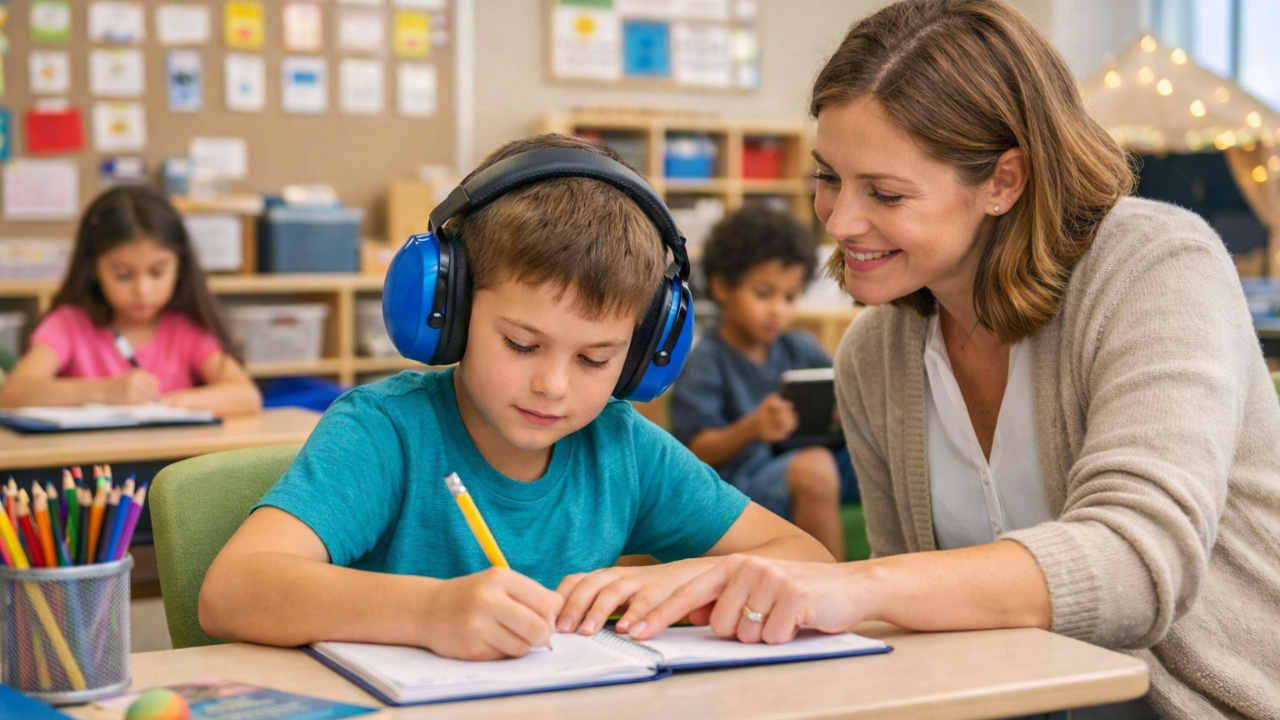
Commission Approves Noise-Canceling Headphones for School Autism, Expanding Sensory Accessibility and Inclusive Education in Schools.
The Education Commission of the Chamber of Deputies approved, in December, a bill that provides for the mandatory provision of noise-canceling headphones and other assistive technology resources for students with Autism Spectrum Disorder (ASD) in public and private schools across the country.
The measure aims to enhance sensory accessibility within the school environment, reducing the impacts of sound stimuli that directly affect learning.
The proposal was analyzed in Brasília and will still undergo legislative processing.
-
Friends have been building a small “town” for 30 years to grow old together, with compact houses, a common area, nature surrounding it, and a collective life project designed for friendship, coexistence, and simplicity.

-
This small town in Germany created its own currency 24 years ago, today it circulates millions per year, is accepted in over 300 stores, and the German government allowed all of this to happen under one condition.

-
Curitiba is shrinking and is expected to lose 97,000 residents by 2050, while inland cities in Paraná such as Sarandi, Araucária, and Toledo are experiencing accelerated growth that is changing the entire state’s map.

-
Tourists were poisoned on Everest in a million-dollar fraud scheme involving helicopters that diverted over $19 million and shocked international authorities.


The objective is to promote inclusive education through adaptations that minimize auditory overload and favor classroom participation.
The initiative amends the National Policy for the Protection of the Rights of Persons with ASD.
In practice, it obligates educational institutions to provide devices that assist in controlling excessive noise.
Therefore, students with auditory hypersensitivity will be able to have better conditions for concentration and school interaction.
Sensory Accessibility Gains Ground in the Debate on School Autism
The approval rekindles the discussion on sensory accessibility within the context of school autism.
Autistic children, especially those with auditory hypersensitivity, can suffer from everyday noises — such as simultaneous conversations, bells, or dragging chairs.
According to occupational therapist Pabline Cavalcante from the Toca do Tamanduá Clinic, the issue is directly related to neurological functioning.
“When we talk about sensory sensitivity, we are referring to how the nervous system perceives, organizes, and responds to internal and external stimuli that come through sensory systems, such as touch, hearing, sight, smell, and taste.
It is from this organization that the brain can generate responses, including learning,” she explains.
In other words, excess stimuli can compromise not only comfort but also educational development.
Auditory Overload Can Affect Learning and Participation
In clinical practice, the lack of sensory accessibility adaptations can have significant impacts on school performance.
“When hypersensitivity is ignored, the brain enters a constant state of alert, of hypervigilance.
This drastically reduces the capacity to learn because the brain does not prioritize learning when it is busy trying to organize uncomfortable sensations,” she asserts.
This continuous state of alert makes focusing, memory, and social interaction difficult.
Therefore, simple measures can make a big difference in the educational routine.
Noise-Canceling Headphones Are a Strategy, but Not the Only Solution
Although noise-canceling headphones are central to the project, experts warn that they do not solve everything on their own.
“Ear protection is a compensatory strategy. It helps to reduce the intensity of the auditory stimulus that reaches the nervous system, but it does not change sensory processing.
The child still has hypersensitivity, and therefore other adaptations need to be made, in addition to therapeutic interventions focused on sensory integration,” she says.
Thus, assistive technology must be combined with therapeutic interventions and environmental adjustments.
Simple Measures Reinforce Inclusive Education
In addition to devices, structural changes can enhance inclusive education.
“Protective pads on the feet of chairs and tables, reducing the use of bells or loud sounds, predictability with well-defined visual routines, and avoiding shouting in the classroom already significantly reduce sensory overload,” she states.
These actions have low cost and high impact.
Consequently, they promote student engagement.
Assistive Technology Expands Possibilities Beyond Protectors
The original text only provided for earmuffs of the shell type.
However, the substitute expanded the scope to different solutions of assistive technology.
This includes other acoustic control devices.
The change allows greater flexibility for schools to adopt resources suitable for each reality.
The project rapporteur highlighted the measure’s reach.
“The approved measure seeks to promote sensory accessibility and ensure reasonable adaptations in the school environment for these students,” said Congressman Duarte Jr. (PSB-MA).
Adaptation Deadline and Next Steps of the Project
The substitute establishes a 180-day period for implementation after eventual sanction of the law.
This period will serve for institutions to adapt to the requirements.
According to the rapporteur, the time is necessary for budget planning and equipment acquisition.
Before becoming law, the proposal will still be analyzed by the Finance and Taxation and Constitution, Justice, and Citizenship committees.
Then, it will proceed to a vote in the Chamber and the Senate.
Sensory Accessibility as a Right in School Autism
From a therapeutic point of view, specialists emphasize that sensory accessibility is not optional.
“Accessibility is a right and a basic condition for the nervous system to function in a state compatible with learning.
The brain only learns efficiently when it is regulated,” she explains.
She adds:
“If the environment imposes a sensory load greater than the child’s modulation capacity, performance drops.
The goal of Occupational Therapy is to ensure functional participation, and this requires facilitating, adapting, and including.”
Expected Impact on Educational Inclusion
If finally approved, the project could represent a structural advancement in Brazilian inclusive education.
The provision of noise-canceling headphones and other assistive technology resources tends to reduce invisible barriers in everyday school life.
Moreover, it strengthens public policies aimed at school autism.
In practice, it creates more equitable conditions for learning, participation, and development.
See more at: Commission Approves Offer of Noise-Canceling Headphones to Autistic Students – Early Childhood Blog










Seja o primeiro a reagir!