





 Portuguese
  English
  Spanish
  5 min of reading
  2 comments


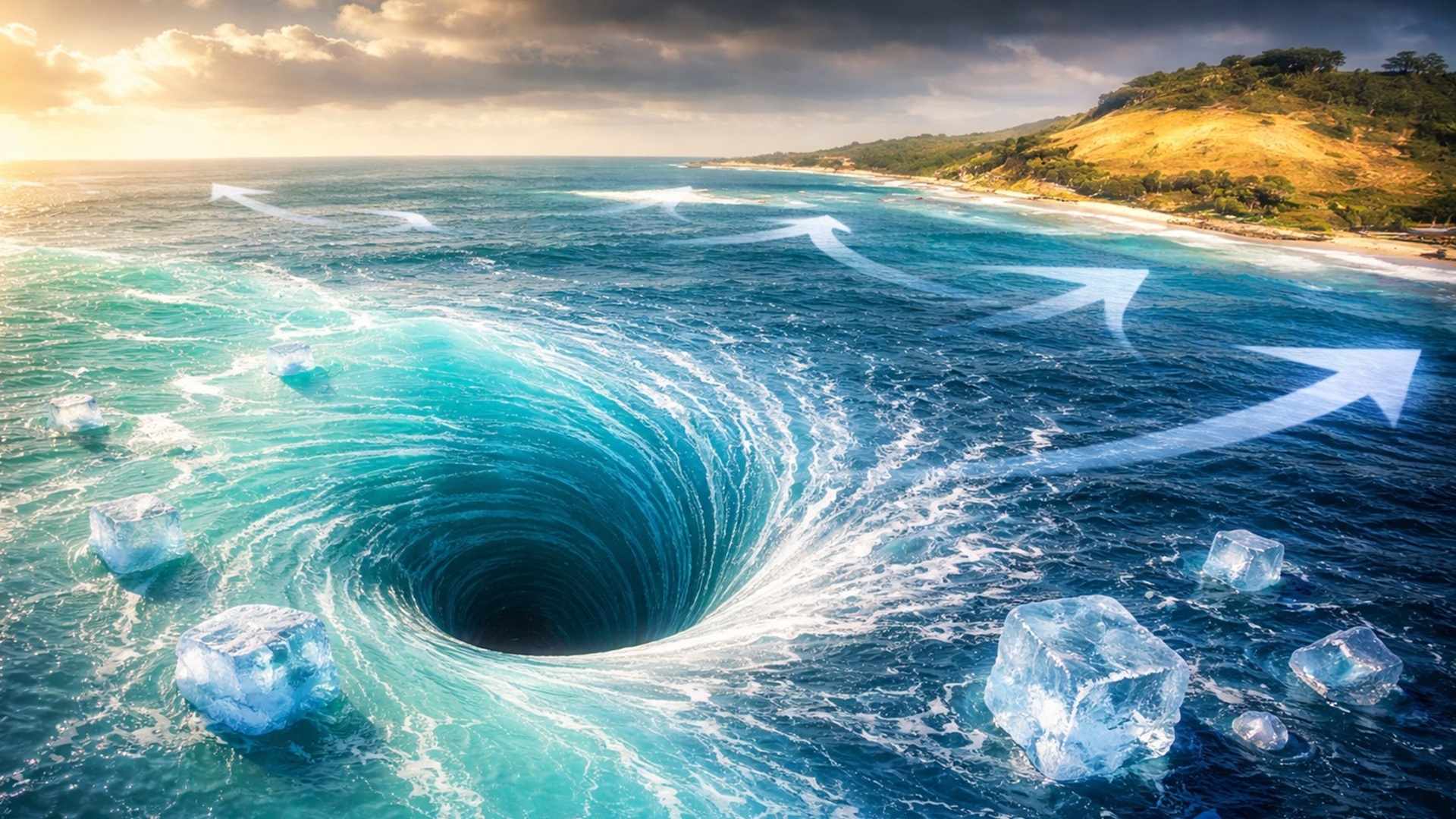


Study Led by the University of Colorado Boulder Points Out That One of the Saltiest Oceanic Regions in the Southern Indian Ocean Has Lost 30% of Its Saline Area in Six Decades, with Annual Influx of Freshwater Equivalent to 60% of the Volume of Lake Tahoe and Possible Impacts on Global Thermohaline Circulation
One of the saltiest oceanic regions on Earth, located in the southern Indian Ocean off the west coast of Australia, is rapidly becoming less salty. Study points to a 30% reduction over six decades and correlates the phenomenon with climate change in oceanic regions.
Water in the southern Indian Ocean shows a visible decrease in salinity at a rate that has surprised researchers. According to the study, the phenomenon is not an isolated local problem but part of a broader shift in the way freshwater is transported across the oceanic regions of the planet.
The research was led by scientists at the University of Colorado Boulder. The work links the change in salinity to global warming, which has been reshaping wind patterns and ocean currents over decades in tropical oceanic regions.
-
Motorola launched the Signature with a gold seal from DxOMark, tying with the iPhone 17 Pro in camera performance, Snapdragon 8 Gen 5 that surpassed 3 million in benchmarks, and a zoom that impresses even at night.

-
Satellites reveal beneath the Sahara a giant river buried for thousands of kilometers: study shows that the largest hot desert on the planet was once traversed by a river system comparable to the largest on Earth.

-
Scientists have captured something never seen in space: newly born stars are creating gigantic rings of light a thousand times larger than the distance between the Earth and the Sun, and this changes everything we knew about stellar birth.

-
Geologists find traces of a continent that disappeared 155 million years ago after separating from Australia and reveal that it did not sink, but broke into fragments scattered across Southeast Asia.

The authors warn that the change could create a cascading effect. The alteration of salinity could affect the interaction between ocean and atmosphere, disrupt circulation systems, and create negative impacts on marine life in different oceanic regions.
Renewal of Indian Ocean Waters in Oceanic Regions
Salinity corresponds to the amount of salt dissolved in seawater. On average, seawater has about 3.5% salinity, equivalent to dissolving about one and a half teaspoons of salt in a cup of water.
The ocean does not have uniform salinity. There is a vast tropical zone where surface waters are naturally fresher due to high rainfall rates and lower evaporation.
This area extends from the eastern Indian Ocean to the western Pacific and is known as the Indo-Pacific freshwater pool. It is one of the central oceanic regions in the redistribution of freshwater.
“We are witnessing a large-scale change in how freshwater moves through the ocean,” said Weiqing Han, a professor in the Department of Atmospheric and Oceanic Sciences at CU Boulder.
According to him, the phenomenon occurs in a region that plays a crucial role in global ocean circulation, with implications that extend beyond the local boundaries of the involved oceanic regions.
Thermohaline Circulation and the Global Conveyor Belt in Oceanic Regions
The mass of freshwater is associated with a large ocean circulation system that transports heat, salt, and freshwater around the world. This system is known as thermohaline circulation.
It channels warm, fresh surface waters from the Indo-Pacific flow toward the Atlantic Ocean, contributing to the temperate climate of Western Europe.
In the North Atlantic, the water cools, becomes saltier and denser, sinks, and flows southward into the depths, returning to the Indian and Pacific Oceans.
Changes in the balance between saltwater and freshwater can affect the functioning of this system. Therefore, the changes observed off the southwest coast of Australia are drawing scientists’ attention.
Historically, the southern Indian Ocean near Australia is salty because the region is dry and evaporation exceeds precipitation.
30% Reduction in Saline Area and Annual Influx of Freshwater in Oceanic Regions
Observation records indicate a long-term decline in salinity in the southern Indian Ocean. Han and his team estimated that the area of saltwater has decreased by 30% over the past six decades.
The researchers describe the phenomenon as the fastest increase of freshwater ever recorded in the Southern Hemisphere in the analyzed oceanic regions.
The first author of the study, Gengxin Chen, is a visiting researcher in the Department of Atmospheric and Oceanic Sciences and a senior scientist at the South China Sea Institute of Oceanology at the Chinese Academy of Sciences.
According to Chen, the increase in freshwater is equivalent to adding about 60% of the volume of freshwater from Lake Tahoe to the area each year.
He stated that the annual volume of freshwater flowing into this oceanic area would be enough to supply the entire US population with drinking water for over 380 years.
Changes in Winds and Redirection of Freshwater in Oceanic Regions
The researchers investigated whether the phenomenon is related to increased local precipitation. The team argues that this is not the main cause.
According to the study, the increase in precipitation does not result from local changes in rainfall patterns.
Based on observations and computational simulations, scientists concluded that global warming is altering surface winds in the tropical Indian and Pacific Oceans.
Changes in wind direction drive ocean currents that channel more water from the Indo-Pacific freshwater reserve to the southern Indian Ocean.
Thus, the water off the west coast of Australia is becoming less salty not due to immediate local processes, but through the redirection of the large-scale ocean hydraulic system in the oceanic regions.
Stratification, Vertical Mixing, and Ecological Impacts in Oceanic Regions
Salinity influences the density of seawater. When water becomes less salty, its density decreases.
Fresher water tends to stay on top of saltier, denser water, increasing stratification.
With greater stratification, the separation between surface and deep waters becomes more pronounced. This may weaken vertical mixing.
Mixing is responsible for transporting heat and nutrients between layers. If weakened, the surface and deep layers become more isolated.
The study highlights that the reduction in mixing may result in fewer nutrients reaching the sunlit surface waters, which much marine life depends on.
It may also mean heat retention near the surface, instead of being transported to deeper layers.
Previous research has already indicated that climate change may slow down part of the thermohaline circulation due to the influx of freshwater into the North Atlantic from melting ice.
The new study adds another possible influence: the expansion of the freshwater reserve could further influence the system, transporting less salty water to the Atlantic.
The authors state that this does not imply a sudden collapse or shutdown but represents another push in the same direction of changes in salinity patterns.
From an ecological viewpoint, scientists warn that less intense mixing may place greater pressure on marine ecosystems.
Less mixing may mean less food for organisms near the surface and warmer surface waters that do not dissipate heat easily.
“Changes in salinity may affect plankton and seagrasses. They are the base of the marine food chain. Changes in them can have a far-reaching impact on the biodiversity of our oceans,” Chen concluded, summarizing the central concern of the study.








Olá bom dia !
Oque está acontecendo foi predito pelo criador dos céus e da terra .
O SENHOR
O altíssimo DEUS, O TODO PODEROSO .
Oque está na ESCRITURA: Estas mudanças no planeta Terra são prelúdio do fim . Vai haver uma separação entre os que tem fé e os que não creram .
Estamos todos fudidos, porque **** climáticos, mal intencionados ou não, continuam atrapalhando os avanços nas medidas de mitigação dos impactos, mas só temos 1 planeta e todos pagarão por essas **** de decisões egoístas, os mais pobres sofrendo muitos mais do que os ricos que causam a maior proporção dos impactos. Chupem essa manga envenenada.