





 Portuguese
  English
  Spanish
  5 min of reading
  13 comments


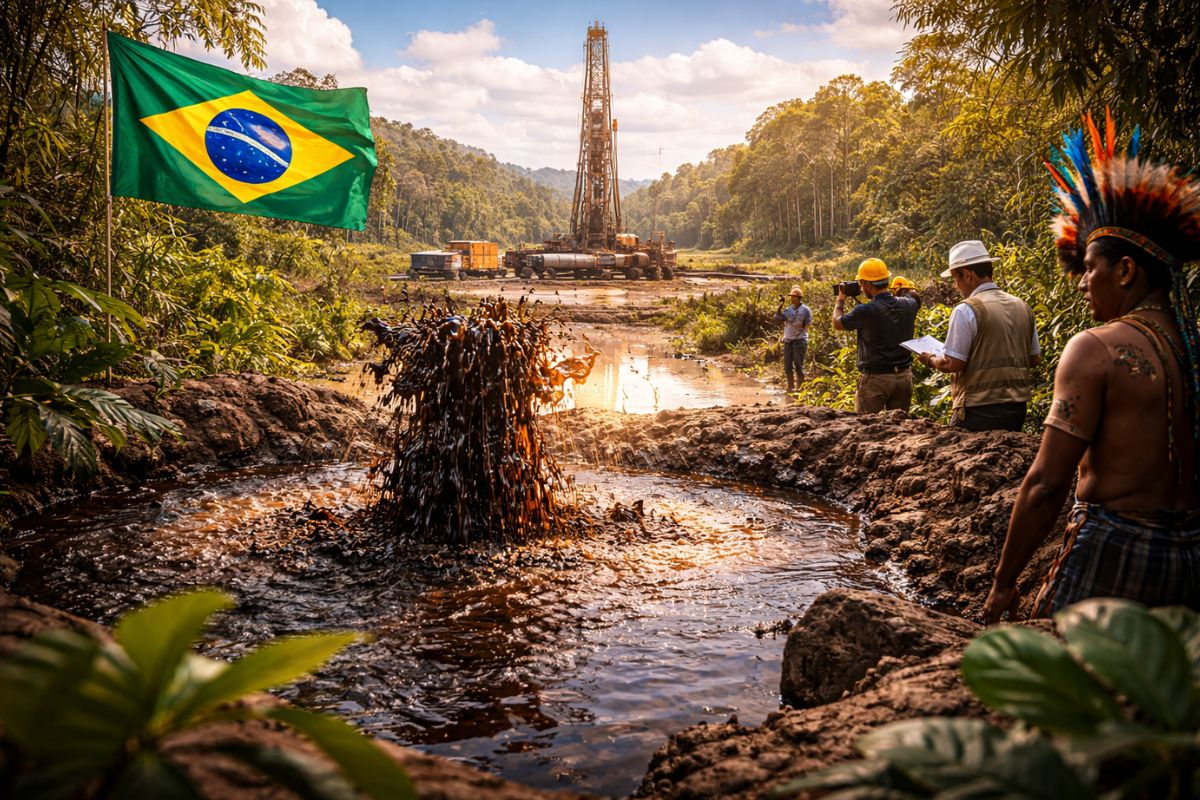


Oil Found at 17 Meters in Rupununi, Guyana, Reinforces the Tacutu Basin as a Rare Land Frontier: Two Wells Spaced 30 Meters Apart Indicated Oil and Accelerated International Interest. In Brazil, the ANP Took Areas to the Permanent Offering of Concession, Expanding the Debate on Indigenous Lands, Impact, and Regional Governance.
Oil appeared where almost no one expected it to appear so soon: during the drilling of an artisanal well, in 2025, Brazilian geologist Ygor Sousa identified signs of oil at 17 meters deep in the Rupununi region of Guyana, within the Tacutu basin. The confirmation occurred in wells spaced 30 meters apart, a detail that transformed a casual find into a technical discussion.
The immediate effect is not just economic. The Tacutu basin crosses areas of difficult access and indigenous lands, and the proximity to the Brazilian border puts pressure on what comes next: new exploration campaigns, environmental licensing, governance, and how to measure what is viable without increasing social and ecological risks in a sensitive frontier.
A Shallow Find That Changes the Conversation About the Interior
When oil appears at 17 meters, the first question is where, exactly, did this happen and why now.
-
Petrobras evaluates suspension of sales to distributors and considers canceling the cooking gas auction following guidelines from the Federal Government.
-
Lula reveals a masterstroke by Petrobras to undo a deal made by Bolsonaro, which involves the return of an important refinery that currently produces less than half of what was expected and makes Brazil dependent on international diesel.
-
A study confirms that the natural gas sector will reduce greenhouse gas emissions in Brazil by 0.5% and accelerate the energy transition by 2026.

-
Petrobras implements a severe adjustment and confirms a 55% increase in the price of aviation kerosene with a proposal for installment payments for the companies.


The record attributed to Ygor Sousa locates the point in Rupununi, Guyana, within the Tacutu basin, a sedimentary basin that has been mentioned for years as promising, but that was not associated with the imagery of oil almost at the surface in the popular debate.
The second aspect is the method of observation. The find occurred during the drilling of an artisanal well, not in a planned exploration campaign.
Still, the report mentions two wells spaced 30 meters apart confirming the presence of oil, which reinforces the idea of local continuity of the phenomenon and increases pressure for formal investigation in the Tacutu basin.
What Can Explain Oil So Close to the Surface
In geological terms, the presence of oil at very shallow depths usually raises two operational hypotheses.
The first is the migration of hydrocarbons from deeper levels, with fracture pathways, faults, or permeability zones allowing the fluid to rise to shallow layers.
The second is the occurrence of local accumulations associated with porous units and nearby seals, which would require technical verification to separate indicators from commercial potential.
That’s why oil at 17 meters makes headlines, but doesn’t conclude the diagnosis.
To turn a find into a resource assessment, it is necessary to understand the quality of the fluid, the extent of the oil interval, lateral continuity, and the relationship with the stratigraphy of the Tacutu basin.
In an area like Rupununi, Guyana, logistics and access, combined with indigenous lands, make this path slower and politically more sensitive.
Guyana as a Catalyst and the Interest That Crosses the Border
International interest does not arise in a vacuum. Guyana already stands out for offshore reserves in the Stabroek block, with commercial production starting in 2019.
This history has changed the weight of any new oil hint in Guyanese territory and helps explain why an event in Rupununi quickly gained attention outside the local circle.
The numbers mentioned in the Guyanese context also fuel the narrative of acceleration. Oil production in Guyana is described as having reached 640,000 barrels per day in January 2024, with projections to reach 1.2 million barrels daily by 2027.
When this backdrop meets the Tacutu basin, the result is a timing dispute: who maps first, who controls the pace, and who sets the safeguards, especially on indigenous lands.
ANP, Blocks, and the Direct Effect on the Tacutu Basin in Brazil
The link to Brazil appears through regulatory means. The National Agency of Petroleum (ANP) announced the inclusion of 393 blocks and 5 oil and gas fields in the Permanent Offering of Concessions, and this package includes blocks in the Brazilian part of the Tacutu basin, described as a new exploration frontier.
It is a move that changes the center of gravity of the debate: the topic ceases to be just a find in Rupununi, Guyana, and begins to connect with concession planning and corporate interest.
The technical reading, however, calls for caution with the word proof. A shallow oil find may indicate an active petroleum system, but each step forward requires additional data, especially because the Tacutu basin includes areas of difficult access and indigenous lands.
In other words, the same geology that attracts investment also increases the cost of error, whether due to technical failure or governance failure.
Sustainability and Indigenous Lands as the Center of Risk and Cost
The pressure on sustainability is not a side detail. In the Tacutu basin, the existence of indigenous lands raises questions that cannot be resolved with rapid drilling: which areas can be accessed, which studies need to come first, how to reduce physical impact, and how to ensure that indigenous rights are not treated as a bureaucratic step.
From an operational standpoint, the infrastructure needed to explore oil in remote areas tends to open circulation fronts, mobilize equipment, and alter land use.
In Rupununi, Guyana, this intersects with communities and sensitive ecosystems.
In the Brazilian part of the Tacutu basin, the challenge is similar: reconciling interest in oil with environmental regulations and predictability for those living on indigenous lands.
The oil found at 17 meters in Rupununi, Guyana, repositions the Tacutu basin as a terrestrial frontier of high symbolism and high risk.
The topic brings together objective data, such as the depth of the find, the spacing of 30 meters between wells, and the regulatory movement of the ANP, but also exposes the most difficult point: how to make quick decisions without trampling on sustainability and indigenous lands.
If your focus were to define priorities in the Tacutu basin, what should weigh more first: accelerating oil concessions for economic opportunity, or halting any progress until there are clear and agreed rules for indigenous lands? In which scenario would you trust to reduce conflict and increase transparency?










Se a legislação desse o devido direito aos indígenas sobre os royalties do petróleo eles teriam grana igual xeiques árabes mas o interesse internacional é que só as empresas gringas lucrem né?
O que precisamos é o JUDICIÁRIO BRASILEIRO tomar **** e cortar de vez os auto salários que ganham.
E ainda mais tendo DOIS MESES de férias. Mas mamam bem nas telas do contribuinte brasileiro.
Precisa perfurar logo, a Guiana está chupandi de canudinho o petróleo do Brasil.