





 Portuguese
  English
  Spanish
  5 min of reading
  1 comment


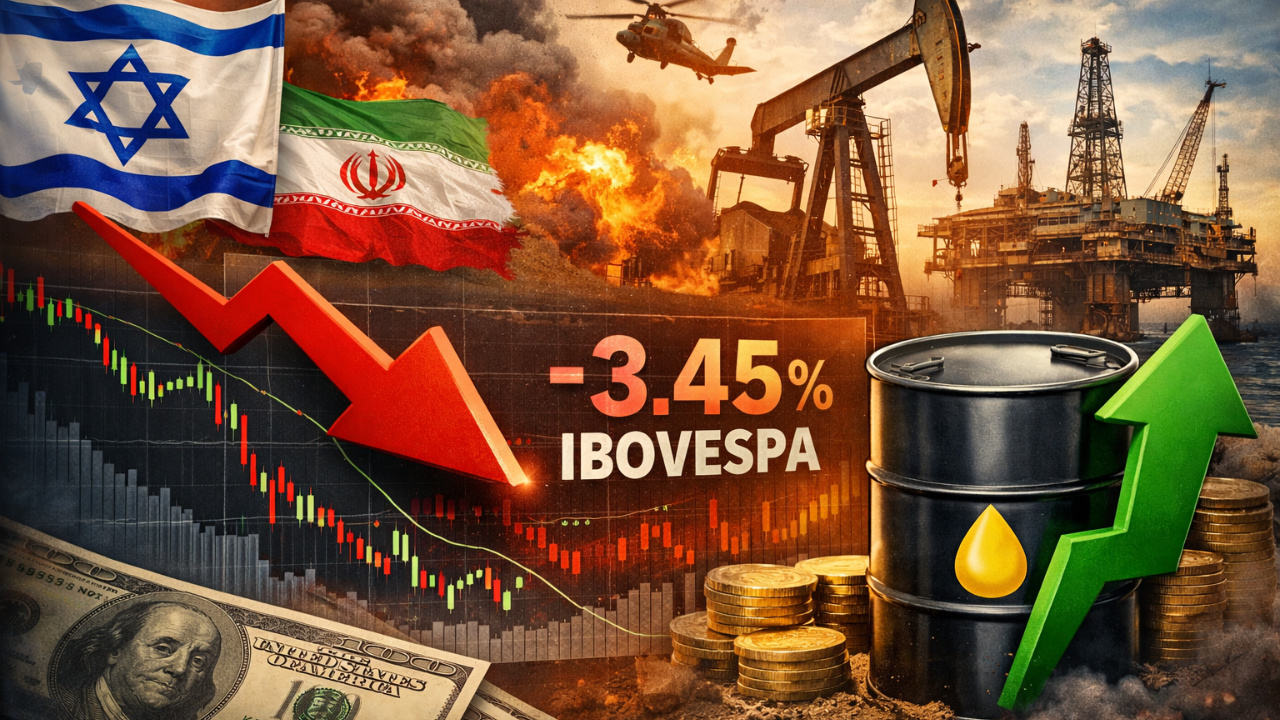


Conflict In The Middle East Drives Oil Prices, Increases Risk Aversion, And Pressures Stock Market With Fall Of Ibovespa.
The escalation of tensions in the Middle East has once again impacted global financial markets and pressured the stock market in the short term.
This movement has been observed in recent days with the fall of the Ibovespa, Brazil’s main stock index, while the dollar has advanced amid increased risk aversion among investors.
The central reason is the fear of disruptions in the global energy supply, especially after threats involving the Strait of Hormuz, a strategic route through which about 20% of the world’s oil consumption passes.
-
Petrobras evaluates suspension of sales to distributors and considers canceling the cooking gas auction following guidelines from the Federal Government.
-
Lula reveals a masterstroke by Petrobras to undo a deal made by Bolsonaro, which involves the return of an important refinery that currently produces less than half of what was expected and makes Brazil dependent on international diesel.
-
A study confirms that the natural gas sector will reduce greenhouse gas emissions in Brazil by 0.5% and accelerate the energy transition by 2026.

-
Petrobras implements a severe adjustment and confirms a 55% increase in the price of aviation kerosene with a proposal for installment payments for the companies.


This scenario has increased volatility in international markets and led investors to seek assets considered safer.
Despite the immediate turbulence, analysts point out that medium- and long-term prospects remain relatively preserved, as long as the conflict does not escalate.
Conflict In The Middle East Increases Risk Aversion And Pressures Stock Market
The advancement of geopolitical tensions in the region has brought uncertainty to financial markets.
As a result, investors began to reduce exposure to riskier assets, such as stocks and currencies of emerging countries.
This behavior is known in the market as risk aversion, when capital migrates to investments considered safer.
Among the main destinations are the dollar, U.S. Treasury bonds, and precious metals.
According to specialists, the immediate impact can be perceived in the Brazilian stock market.
Domestic consumption-related sectors, banks, and retail were some of the most affected by recent losses.
Oil Prices Surge With Risk In The Strait Of Hormuz
The factor that most concerns investors at present is the possibility of disruptions in the global energy flow.
This is because the Strait of Hormuz is one of the world’s most important maritime routes for oil transportation.
According to economist Jucelia Lisboa from Siegen Consultoria, the escalation of tensions between the United States, Israel, and Iran has driven up the price of oil and reignited inflationary concerns.
“With oil prices rising, investors start to revise expectations for interest rate cuts globally and adopt a more defensive stance,” she states.
Thus, when oil rises suddenly due to geopolitical factors, the impact tends to ripple across the global economy, as higher energy costs can put pressure on costs and inflation.
Ibovespa Falls As Investors Seek Protection
The immediate reflection of this scenario was the drop in the Ibovespa, accompanied by the strengthening of the dollar. This movement occurs because global investors seek protection in assets considered safer.
According to Jucelia Lisboa, this repositioning leads to a reduction in exposure to emerging markets.
In other words, part of the capital that was invested in countries like Brazil ends up temporarily migrating to more stable economies.
The exception in the Brazilian stock market is the oil sector companies.
As the price of crude tends to rise in times of tension, oil companies may benefit from the increase in the price of oil.
Geopolitical Shock Increases Volatility In Global Markets
For Gustavo Trotta, partner at Valor Investimentos, conflicts of this magnitude have a direct impact on almost all stock markets around the world.
“There is a risk aversion that redirects flows to metals and U.S. treasuries, which increases volatility in equities,” he explains.
However, the specialist emphasizes that the current oil movement is linked to geopolitical factors and not necessarily to real changes in supply and demand.
Therefore, stock prices do not always fully follow the appreciation of the commodity.
Conflict In The Middle East Could Influence Inflation And Interest Rates
Another point of attention for the market is the indirect impact of oil on inflation.
When the price of oil rises, fuels and energy tend to become more expensive.
Rodrigo Moliterno, head of equities at Veedha Investimentos, states that this effect can influence monetary policy decisions in various countries.
“If it remains confined to the region, the impact tends to be temporary.
The market needs to understand if there will be involvement from other nations and how long oil prices will remain high,” he says.
He explains that higher inflation can reduce the space for faster cuts in the basic interest rate, both in Brazil and in other economies.
Foreign Flows May Temporarily Leave The Stock Market
Another effect observed is the potential change in international capital flows.
In recent months, foreign investors have been increasing their participation in emerging markets.
However, with rising risk aversion, part of that money may return to assets considered safer.
“Part of the capital that was being reallocated to emerging markets tends to go back to safe havens until the scenario becomes clearer,” Moliterno states.
Impact On The Ibovespa Depends On The Duration Of The Conflict
Monte Bravo analyst Bruno Benassi highlights that the main factor for the markets will be the duration of the conflict in the Middle East.
“Oil is an important component in the composition of various industries and countries, pressures inflation, removes cuts from the curve, and increases geopolitical tension,” he says.
According to him, if the conflict intensifies, risk assets tend to face more pressure.
“Brazilian stocks will suffer, but perform relatively well. Because in this risk increase scenario, some of the money that entered Brazil may return to U.S. assets, to the dollar, treasuries, among others,” he assesses.
Long-Term Prospects Remain Positive
Despite the current turbulence, analysts point out that the impact tends to be stronger in the short term.
The immediate trend is for greater volatility and partial profit-taking, especially after the recent rally observed in emerging markets.
As a result, new records in the stock markets may be temporarily suspended.
Nevertheless, if the conflict in the Middle East does not escalate and the price of oil returns to more stable levels, the structural scenario for the Brazilian stock market and the Ibovespa continues to be considered positive in the medium and long term.
Learn more at: Middle East Conflict Pressures Stock Market In The Short Term







VALEU TRUMP! MAIS UMA MERD@ PRA COLEÇÃO. UM DESASTRE COMPLETO