





 Portuguese
  English
  Spanish
  5 min of reading
  0 comments


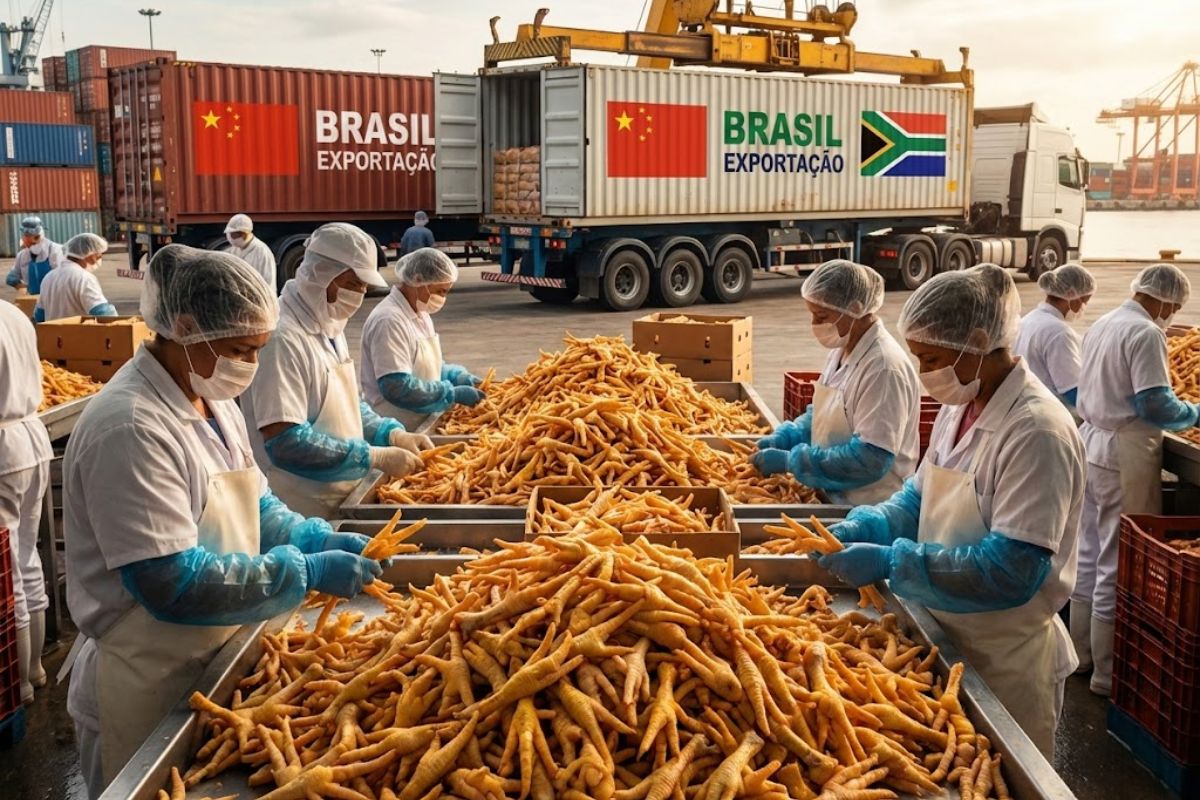
The Advancement of Chicken Feet From Informality to International Trade Explains Why China and South Africa Compete for Brazilian Product While the Domestic Market Faces Price Increases, New Applications in the Pet Industry, and a Shift in Perception About an Offal Once Treated as Waste in Recent Years.
The chicken feet have ceased to be a marginal item and have become a strategic product in different areas of the animal protein chain. The movement was driven by external demand, mainly from Asia, and by new industrial uses in Brazil, which repositioned the price, destination, and perceived value of this offal.
In practice, the change answers central questions of current consumption. Who buys, what do they buy for, in which markets, for how much, and with what local impact. When these points intersect, chicken feet cease to be just a curiosity from the butcher shop and come to represent business, food culture, and commercial competition.
From Leftover in the Butcher Shop to Export Asset

In the late 1990s, there were reports of chicken feet being given away for free in butcher shops, reflecting low demand and little valuation in the Brazilian retail sector. This scenario changed with the opening of commercial exports of chicken meat to the Chinese market, authorized in 2009, which enhanced the economic attractiveness of previously underutilized parts.
-
The sugar-energy sector advances with agricultural technology, but agricultural productivity still raises concerns.

-
The eggshell that almost everyone throws away is made up of about 95% calcium carbonate and can help enrich the soil when crushed, slowly releasing nutrients and being reused in home gardens and vegetable patches.

-
This farm in the United States does not use sunlight, does not use soil, and produces 500 times more food per square meter than traditional agriculture: the secret lies in 42,000 LEDs, hydroponics, and a system that recycles even the heat from the lamps.

-
The water that almost everyone throws away after cooking potatoes carries nutrients released during the preparation and can be reused to help in the development of plants when used correctly at the base of gardens and pots, at no additional cost and without changing the routine.


With the advancement of external sales, chicken feet began to be treated as a relevant revenue item for meatpackers and exporters. Just last year, sales to China totaled US$ 221 million, up 9.5% from 2024. What was once leftover became a revenue line, altering marketing decisions within the industry.
This shift also redefined priorities. When a byproduct has a consistent international buyer and a better price per ton, it ceases to be the “leftover” of the operation and enters into logistical planning, product mix, and companies’ margin strategies.
China and South Africa Explain the New Geography of Consumption
China has established itself as the main destination for chicken feet from Brazil and is noted as the market that pays the best for the product, around US$ 3,000 per ton. In this market, it appears prominently as a snack, even in individual packaging, street vending, and vending machines.
South Africa, on the other hand, operates with a different culinary logic, paying an average of US$ 2,000 per ton and absorbing the product in cooked preparations, such as the renowned “walkie-talkie.”
Even importing less than China, the country has significantly increased purchases, reaching US$ 49 million in 2025, more than quadrupling the financial volume compared to 2024.
These two destinations show that chicken feet meet different demands without losing value. On one side, fast consumption and convenience. On the other, traditional dishes and popular basic food. The same raw material serves distinct cultures, which helps sustain international demand over time.
The Effect on Brazilian Prices and the Domestic Market
In retail, there are reports of chicken feet reaching R$ 14 per kilo in São Paulo. In wholesale, the average state value in 2026 was R$ 5.75, still 41.3% above the average of 2020. This difference between channels is common, but the main point is that the general trend was one of appreciation.
Export does not explain everything. The pet industry also became a relevant buyer, directing part of the chicken feet towards meals and formulations for pet food.
When there are more than one competitive destination for the same item, the domestic market tends to feel price pressure, especially during periods of heated external demand.
For the end consumer, this creates a paradox. Chicken feet continue to be seen by many as an economical option, but it no longer responds solely to the local logic of abundant supply. Today it competes in multiple chains, from traditional dishes to pet food, from national wholesale to export containers.
Why the Product Gained Status and Market Value
There is a decisive cultural factor. In Chinese cuisine, chicken feet are valued for their texture, format of consumption, and versatility, being able to appear in salads, snacks, and bases for denser broths. In South Africa, the value lies in long cooking, seasoning, and the tradition of fully utilizing food.
This context changes the perception of “noble cut” and “secondary cut.” In market terms, noble is what has consistent demand, good remuneration, and purchasing frequency. Value does not arise solely from the appearance of the cut; it comes from social and gastronomic use. Chicken feet have gained exactly that in key markets.
Another point is the diversification of applications. Besides the table, the product participates in industrial and convenience chains.
The more uses an item has, the lower the chance of it reverting to a status of waste. The combination of culinary culture, industrial scale, and foreign trade explains the recent transformation.
What This Turn Indicates for the Future of Brazilian Protein
The trajectory of chicken feet shows how a neglected item can become a competitive asset when it finds international demand, a culinary narrative, and a distribution channel. This tends to encourage the industry to better utilize the entire animal, increasing economic efficiency at various stages of the chain.
It also shows that the debate about internal prices needs to consider the complete system. Export, domestic consumption, and the pet industry do not compete in separate fields. All pull the same product for different reasons, and the result appears in the pockets of retail buyers and in the cash flow of wholesale sellers.
If this trend continues, chicken feet should remain in a strategic position, with more predictability for exporters and more attention from Brazilian consumers to price behavior.
In your neighborhood, are chicken feet still treated as a low-value item, or have they become a sought-after product at the butcher shop? And in your routine, do you prefer to see them more in the domestic market or as an export engine generating revenue for the sector?










-

-

-

-

15 pessoas reagiram a isso.