





 Portuguese
  English
  Spanish
  4 min of reading
  0 comments


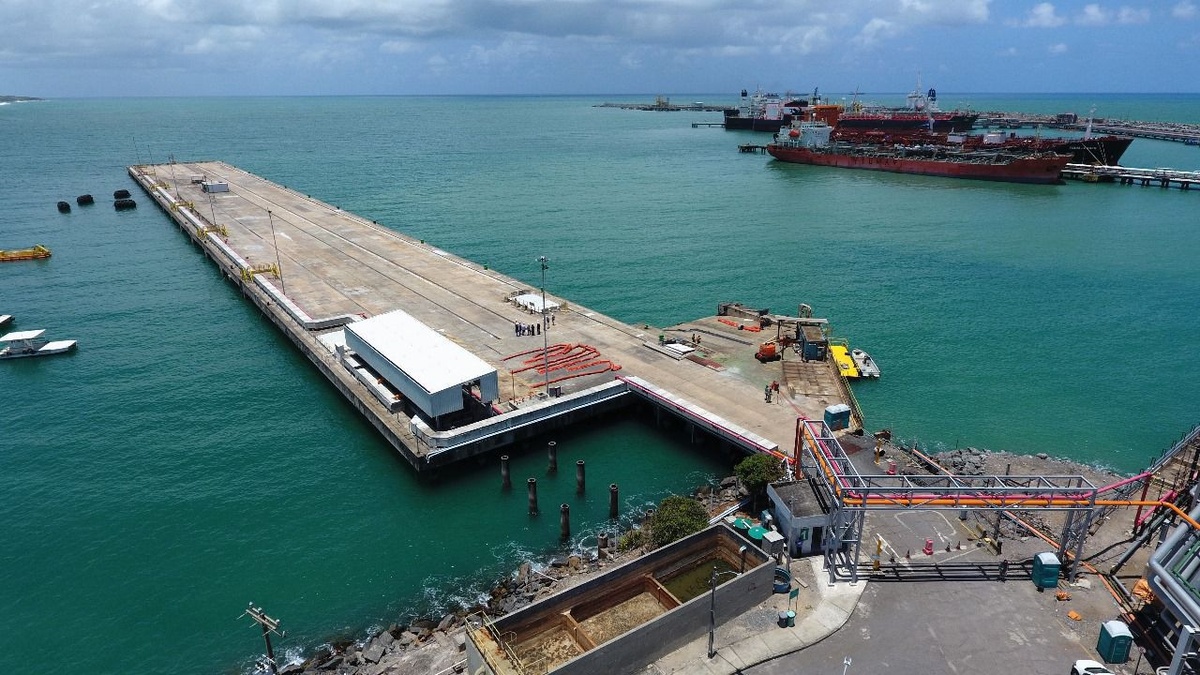
Project in the Port Industrial Complex of Suape Prioritizes Road Distribution of LNG and Expands Access to Natural Gas in Industrial Areas Outside the Piped Network
First, the energy company Oncorp has advanced in its liquefied natural gas (LNG) terminal project in the Port Industrial Complex of Suape, Pernambuco.
Additionally, the company has signed a memorandum of understanding with GNLink, aimed at small-scale LNG distribution.
Thus, the agreement is directed towards the transportation of the fuel by road transport, mainly to regions without gas pipelines.
-
Petrobras evaluates suspension of sales to distributors and considers canceling the cooking gas auction following guidelines from the Federal Government.
-
Lula reveals a masterstroke by Petrobras to undo a deal made by Bolsonaro, which involves the return of an important refinery that currently produces less than half of what was expected and makes Brazil dependent on international diesel.
-
A study confirms that the natural gas sector will reduce greenhouse gas emissions in Brazil by 0.5% and accelerate the energy transition by 2026.

-
Petrobras implements a severe adjustment and confirms a 55% increase in the price of aviation kerosene with a proposal for installment payments for the companies.


According to information released by the company itself in March 2026, the strategy reinforces the interiorization of natural gas in the Northeast.
Strategic Shift Prioritizes the Small-Scale LNG Market
Initially, the project was associated with traditional distribution via pipelines.
However, now the terminal is prioritizing the so-called small-scale market, which allows LNG to reach areas not served by conventional transport infrastructure.
Thus, more remote industrial regions will be able to access the energy fuel.
Additionally, Oncorp’s CEO, João Guilherme Mattos, stated that the agreement represents a significant step towards the terminal’s viability.
According to him, the memorandum of understanding marks the beginning of the strategic focus on the small-scale segment.
Furthermore, the executive noted that Suape’s geographical location expands the project’s reach.
Thus, within an approximate radius of 1,000 kilometers, various regions will be served.
Consequently, areas that currently do not have gas pipelines will be able to adopt liquefied natural gas as an energy alternative.
LNG Can Replace More Polluting Energy Sources in Industrial Regions
At the same time, the expansion of the small-scale model may help reduce the use of more polluting fuels.
For example, some industrial regions still rely on sources with higher carbon emissions.
Among them, the executive mentioned the gypsum cluster in Araripe, located in the Northeast.
In this context, certain industrial activities still use biomass, such as firewood.
Therefore, according to Oncorp, the use of LNG can favor a gradual energy transition.
Moreover, the executive highlighted that the large-scale market, associated with pipelines, already has defined users at the terminal.
Thus, the current focus of the project has been directed towards small-scale supply.
Suape’s Infrastructure Expands Interiorization of Natural Gas
At the same time, the LNG Terminal in Suape is considered a strategic infrastructure to expand the interiorization of natural gas in Brazil.
This occurs primarily in regions where the pipeline network is still limited.
In this scenario, the partnership with GNLink is expected to enable new logistical distribution models.
Among these, specialized cryogenic trucks for LNG transport stand out.
Additionally, there is the possibility of integration with the Transnordestina railway, which connects industrial hubs outside the traditional supply chain.
Partnership with GNLink Strengthens Logistics and LNG Supply
On the other hand, the CEO of GNLink, Marcelo Rodrigues, stated that the partnership expands the interiorization of natural gas.
According to him, the initiative complements the company’s supply capacity to the Brazilian market.
Furthermore, the company has three liquefaction units already in operation, which reinforce the availability of the fuel.
Thus, the small-scale model allows LNG to reach regions that still depend on more polluting energy sources.
Consequently, productive sectors can gain energy efficiency and competitiveness.
GNLink Expands Presence in the Brazilian LNG Market
Currently, GNLink has consolidated its presence in the liquefied natural gas distribution market in the country.
The company won four public calls for LNG supply in local networks, alongside state gas distribution companies.
These contracts were established in the states of Bahia, Alagoas, Ceará, and Pernambuco.
Additionally, GNLink is involved in developing integrated LNG supply solutions for industries and state distributors.
The company is controlled by the management firm Lorinvest and Copa Energia.
Currently, the company operates three natural gas liquefaction and compression units.
These facilities are located in Barra Bonita (PR), Itabuna (BA), and Assú (RN).
Together, they have a total production capacity of 300 thousand cubic meters per day.
Thus, the supply serves locations within a radius of up to 1,000 kilometers without direct access to the piped natural gas network.
In light of this scenario, the advancement of the Suape terminal can expand access to LNG in industrial regions outside the traditional pipeline infrastructure in Brazil.








-

Uma pessoa reagiu a isso.