Portuguese
  Spanish


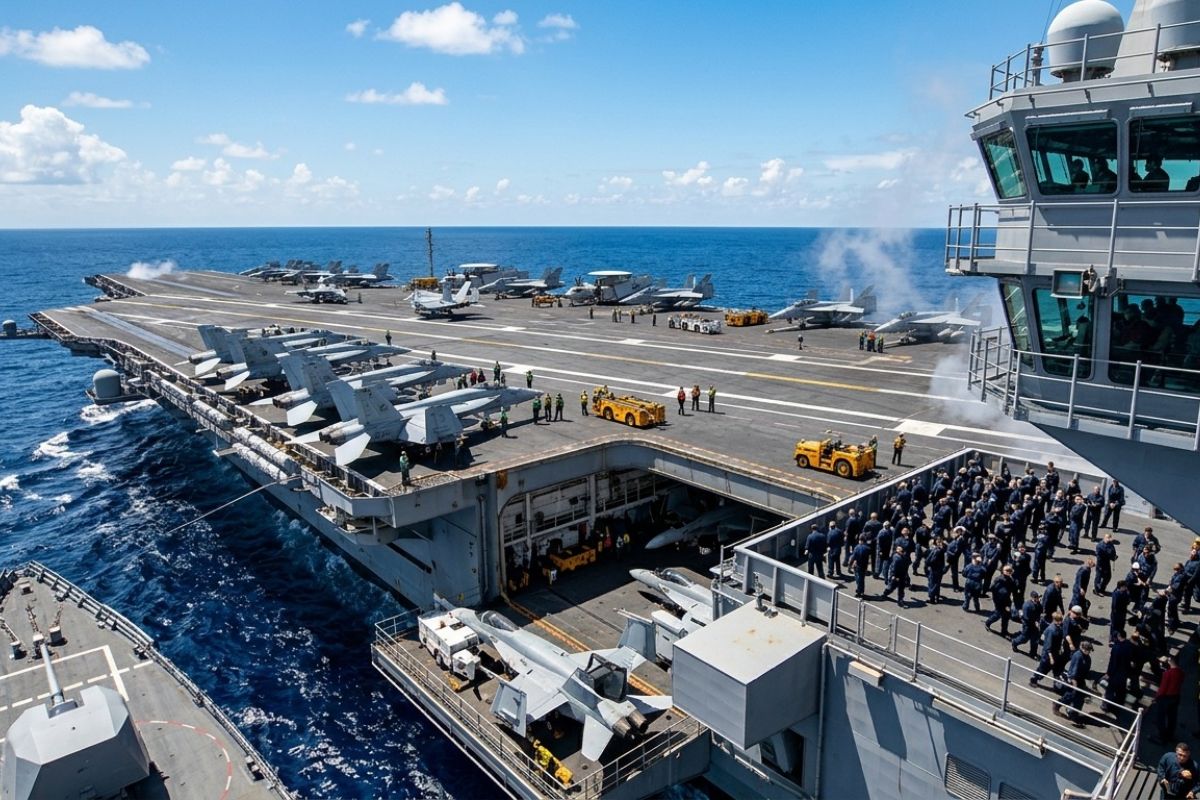


On the USS Gerald R. Ford, this floating city and aircraft carrier keeps sailors in stacked bunks, with hygiene protocols and a wartime routine at sea
At this very moment, 5,000 sailors live inside a floating city for months, without contact with land, while the ship maintains combat operations, industrial routine, and precise discipline. The USS Gerald R. Ford is described as the most expensive war machine ever built, costing $13 billion, and the most impressive part is not just the steel or nuclear propulsion, but the basics functioning flawlessly.
Because within this floating city, eating, sleeping, and staying clean are not habits, they are systems. An operational error can cost lives, so even bathing becomes protocol, resting becomes engineering, and feeding becomes a calculation of grams, shifts, and continuous replenishment at sea.
What makes the USS Gerald R. Ford a floating city
The USS Gerald R. Ford is presented as an aircraft carrier measuring 337 m in length, with 75 fighter jets on board and two nuclear reactors that eliminate the need for refueling for decades. But the ship does not operate solely on energy. It operates because it transforms human needs into operational routine.
-
A Brazilian street cleaner built a machine to recycle PET bottles in the hinterlands of Paraíba, transforming the trash he swept from the streets into threads, brooms, and equipment sold even outside Brazil, and began earning about R$ 7,500 per month with his own invention.

-
In a city where every piece of land is worth gold, he began buying plots in the 1960s and built a real estate empire with over a thousand properties.

-
An artist sank over 500 life-sized human statues at the bottom of the Caribbean Sea, and what seemed like macabre art turned into a living reef covered with corals that attracts divers from all over the world.

-
A fossil kept for years in a small museum in Montreal concealed 450-million-year-old soft tissue, a discovery that has only happened once before in history.


The logic of this floating city is simple and brutal: you can have nuclear technology, catapults, and firepower, but you still need to keep 5,000 people in a condition to operate with precision every day, in the middle of the ocean, with little room for improvisation.
How the floating city serves more than 17,000 meals a day

The first challenge is feeding too many people without a supermarket and without breaks. The floating city embarks with tons of food calculated “to the gram,” with items cataloged and calories planned. Nothing comes in by chance.
At sea, replenishment happens through underway replenishment: two ships sailing in parallel, constant speed, taut cables, and transfer of hundreds of tons without docking. Inside the aircraft carrier, more than 100 culinary specialists operate industrial kitchens 24 hours a day. The result is a routine that seems unreal: more than 17,000 meals every 24 hours, including the midnight meal for night shifts.
And there is one detail that changes the weight of it all: the combat alarm can sound when someone is holding a tray. There is no “I finish my plate and go.” Drop everything and run.
Sleeping in the floating city: stacked bunks and relentless noise

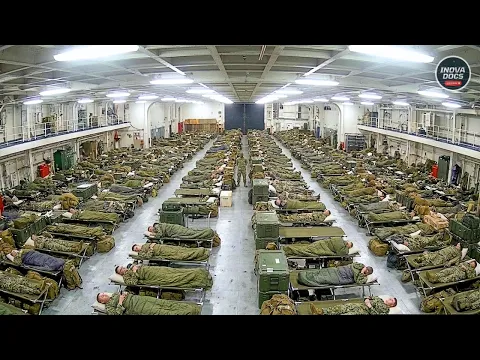
If eating is already a system, sleeping is the toughest point. Each sailor sleeps in a metal compartment described as a “rack,” measuring about 195 cm long by 68 cm wide, stacked in three levels. The space between the head and the upper bunk can be about 50 cm, and the mattress is 7 cm.
The environment does not quiet down. Fighters take off and land just a few meters above, the hull vibrates, metal doors slam, boots echo all day long. Moreover, many dormitories are located inside the ship, without windows and without natural light. Without a reference to the sun, the biological cycle becomes disorganized, and the rotating shifts worsen this: one week during the day, another at dawn, without complete adaptation.
The base text also points out an important change: on Ford-class aircraft carriers, the compartments have been reduced from 180 to 40 people per area, aiming for less noise, less traffic, and more efficiency. The logic is straightforward: a sailor without sleep makes mistakes, and mistakes here cost lives.
Shower of 10 to 20 liters: why hygiene becomes military protocol
The third problem is water. In this floating city, water is treated as a critical resource. That’s why there is a protocol known as the “Navy Shower”: turn on the water, wet the body, turn it off, lather, turn it on again, rinse, and turn it off. Total approximate: 10 to 20 liters per shower.
The bathrooms, called “heads,” can be shared by dozens of sailors, with few showers, few toilets, and almost no privacy. The rule applies to everyone, with no “exceptions for rank.”
Vacuum sewage, failures, and the cost of keeping the floating city operational

The floating city uses a vacuum sewage system, similar to that of aircraft, described as efficient on paper but with recurring failures recorded. When it fails, entire bathrooms are closed off and sailors have to traverse several decks to find a functioning facility.
The technical solution for severe blockages is cited as “acid flush,” an industrial chemical treatment that can reach hundreds of thousands of dollars in specialized maintenance. The base text also points out the most common cause: improper disposal of materials in the pipes, a recurring problem mentioned in reports from the Government Accountability Office as early as 2020.
150,000 kg of laundry per week: industrial laundry and human limits
As if feeding, sleeping, and bathroom needs were not enough, there is the flow of uniforms. The floating city processes about 150,000 kg of laundry per week, with industrial machines operating nearly 20 hours a day, high internal temperatures, and limited working time to avoid exhaustion.
Each uniform is marked with the sailor’s name, socks tied in pairs, clothes bagged and identified. Even so, items go missing and the system delays. Many end up washing by hand in the dormitory sink, described as technically prohibited, but widely practiced.
Why the floating city keeps 75 fighters ready and launches up to 270 missions

The USS Gerald R. Ford can launch up to 270 combat missions in a single day, project power over 1,500 km, and operate for decades without nuclear refueling. However, none of this happens if the “basics” fail.
A poorly fed sailor makes mistakes. A sleepless sailor fails. A sick sailor compromises the crew. That’s why every meal is calculated, every resting area has been redesigned over decades, and every hygiene protocol exists for an operational reason, not for comfort.
The detail that sums it all up: those who sustain the floating city are 19 years old
There is a fact that adds human weight to all this: many sailors on board are around 19 years old. While many people at this age are choosing colleges and testing independence, here are young individuals operating a nuclear-powered ship, handling precision munitions, and participating in nighttime operations on a short runway at sea, with fragmented sleep and months away from family.
In the end, the floating city does not sustain itself solely on reactors. It sustains itself because the Navy has transformed eating, sleeping, and hygiene into a precision system. This is the true “secret” behind the $13 billion war machine.
Could you live for six months inside a floating city like this, with stacked bunks, a 10 to 20-liter shower, and without seeing land for so long?