





 Portuguese
  English
  Spanish
  5 min of reading
  1 comment


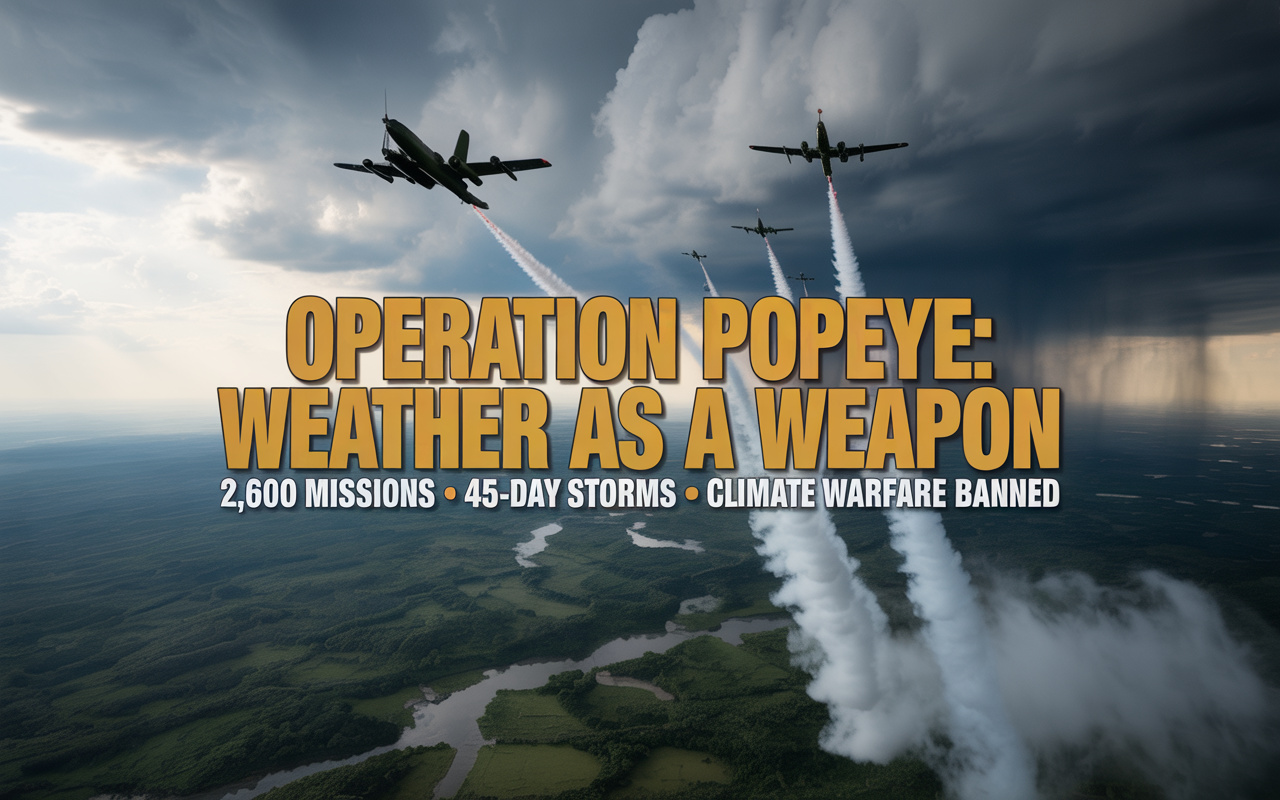

Between 1967 and 1972, the USA altered rains in Vietnam with more than 2,600 air missions. Operation Popeye was the only climate weapon ever used in real war.
For centuries, weather was treated as an unpredictable factor of war. Rain, mud, drought, and cold always influenced military campaigns, but they escaped human control. This quietly changed in the late 1960s, when the United States launched a secret program based on a radical idea: if it was not possible to control the enemy, it would be possible to control the weather around them. Thus, Operation Popeye was born, the only documented case of systematic use of weather modification as a military weapon in a real conflict.
War Beyond Bombs and Missiles
The context of the Vietnam War was one of extreme attrition. Despite air power and technology, the United States faced a central difficulty: the logistics of North Vietnam. A large part of troop, weapon, and equipment supplies flowed through the so-called Ho Chi Minh Trail, a labyrinth of roads, paths, and improvised routes that wound through dense forests, mountains, and neighboring territories such as Laos and Cambodia.
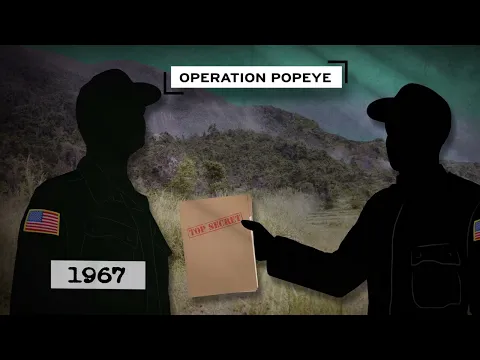

Bombing these routes had limited efficacy. They were quickly rebuilt, camouflaged, and adapted.
-
A Globo actor lives on a farm the size of 300 football fields in Teresópolis, where he produces cheese, honey, and organic chocolate, and has already planted 20,000 native trees.
-
This simple tool eliminates the need for a plumb line with each row, speeds up brick laying by up to 40%, and any laborer can align the wall by themselves, but almost no one in Brazil uses it on construction sites.

-
Won R$ 72 million in the British lottery, but lost it all for not claiming: October ticket in Bexley was forgotten, the 180-day deadline passed, and the fortune will fund local community projects in London.
-
Mixing vinegar with detergent in a blender has become the most talked-about cleaning trick on the internet because it solves a problem that everyone has in the kitchen in seconds and uses only two ingredients that you already have at home.


The solution sought by military strategists was indirect, but clever: turning the terrain itself into a permanent obstacle. Instead of destroying roads, make them unusable. Instead of attacking trucks, prevent them from moving.
The Scientific Principle Behind the Climate Weapon
The scientific basis of Operation Popeye was not fantasy. Since the 1940s, meteorologists had been studying cloud seeding, a technique that involves introducing microscopic particles — usually silver iodide into clouds to stimulate raindrop formation.
The principle is simple: these particles serve as condensation nuclei, accelerating natural precipitation processes.
What Operation Popeye did was militarize this technique, applying it systematically, repetitively, and targeted in strategic regions. The goal was not to create storms from nothing, but to intensify and prolong existing rain systems, especially during the monsoon season.
How the Operation Worked in Practice
Between 1967 and 1972, military aircraft from the United States, primarily C-130 Hercules and adapted fighters, conducted regular cloud seeding missions. These flights took off from bases in Thailand and headed to specific areas of Southeast Asia.
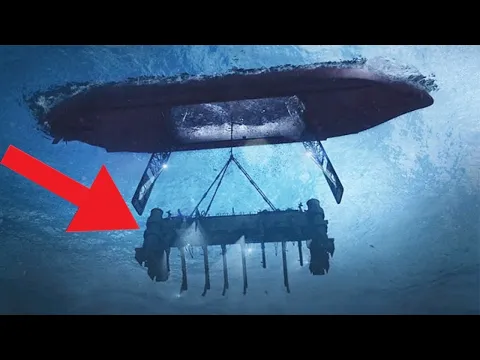
Pilots carried cartridges containing silver iodide and, in some cases, other chemical compounds. Upon identifying suitable cloud formations, they would release the material directly into them. The process was repeated numerous times over the same areas, focusing especially on the logistics routes of North Vietnam.
The informal motto of the operation summarizes its logic with brutal clarity: “Make mud, not war” — make mud, not war.
The Real Scale of Operation Popeye
During its five years of activity, Operation Popeye achieved impressive and rarely mentioned numbers outside specialized circles. It is estimated that more than 2,600 air missions were conducted exclusively for weather modification. This does not include reconnaissance, support, or escort flights.
Military reports and later analyses indicate that, in some target areas, the rainy season was prolonged by up to 30 to 45 days beyond the historical average.
In areas where roads were unpaved, this increase had a direct effect: constant mud, recurring flooding, landslides, and collapse of land mobility.
Did It Really Work?
This is the central question, and the answer is uncomfortable. It worked, but not absolutely. Meteorological data analyzed after the conflict show statistically significant increases in precipitation in some areas subjected to continuous seeding.
Military reports from the time recorded impassable roads for longer periods than normal and actual logistical delays.
On the other hand, the effects were not uniform. Weather is a chaotic system, and the effectiveness of the technique depended on prior conditions. In some missions, results were limited or non-existent. The climate weapon did not offer surgical precision, but operated through saturation, betting on constant repetition.
The Problem of Side Effects
As the operation progressed, internal concerns grew. Altering rainfall patterns does not only affect military targets.
Farmers, villages, and entire ecosystems were impacted without any direct control. Moreover, the effects did not respect political borders, reaching regions outside the intended theater of operations.
From a strategic standpoint, another dilemma arose: if a power could manipulate local weather, what would prevent the use of this technique against cities, crops, or water reservoirs in times of peace or total war?
The Revelation and the International Scandal
For years, Operation Popeye remained classified. This changed in the early 1970s when investigations by the United States Congress revealed the existence of the program. The international reaction was immediate. For the first time, it became clear that the weather had been deliberately used as a weapon of war.
The episode accelerated diplomatic negotiations that culminated in the ENMOD Convention, adopted in 1977 and in force from 1978. The treaty explicitly prohibited the use of environmental modification techniques for military or hostile purposes, including changes in weather, oceans, and geological processes.
The Official End of Climate War
With the entry into force of the ENMOD Convention, projects like Operation Popeye became illegal under international law.
The United States officially ended the program in 1972, even before the signing of the treaty, but the political and ethical impact was already solidified.
Since then, weather modification has been officially treated only in civil and scientific contexts, such as hail mitigation or meteorological studies. The direct military use of weather has been pushed out of the acceptable realm of modern warfare.
Why This Story Almost Disappeared
Operation Popeye is rarely treated as a strategic weapon because it challenges profound moral boundaries. Unlike missiles or bombs, its effects are diffuse, difficult to measure, and potentially permanent.
It showed that it is not necessary to destroy cities to win battles; it is enough to make the environment hostile to survival and movement.
This realization is uncomfortable even today, especially in a world increasingly sensitive to extreme weather events.
The Invisible Legacy of Operation Popeye
Operation Popeye left a lasting warning. It proved that science can be converted into a tool of war in ways that escape traditional logic of weapons.
By turning clouds into targets and rain into a military tool, the program revealed an ethical limit that the international community decided, at least formally, not to cross again.
Yet, in a century marked by climate change, water scarcity, and extreme events, the question remains silently in the strategic backrooms: to what extent will weather continue to be just a natural phenomenon and not a weapon?
Operation Popeye was the only time this line was openly crossed. And perhaps that is why it remains one of the most unsettling chapters in modern military history.





That’s a great article Valdemar, Thank you.
There are pre-Popeye activities in relation to Popeye.
Project GROMET 1 was active in India and Pakistan in relation to solving famine, but it is claimed it was an attempt to understand how weather modification works in an Asian context, by the USA Mil.
GROMET 2 was carried out in the Philippines and is said to be an official pre-Popeye operation to fine tune methods in preparation for deployment over Vietnam.
Best wishes.
Peter