





 Portuguese
  English
  Spanish
  8 min of reading
  1 comment


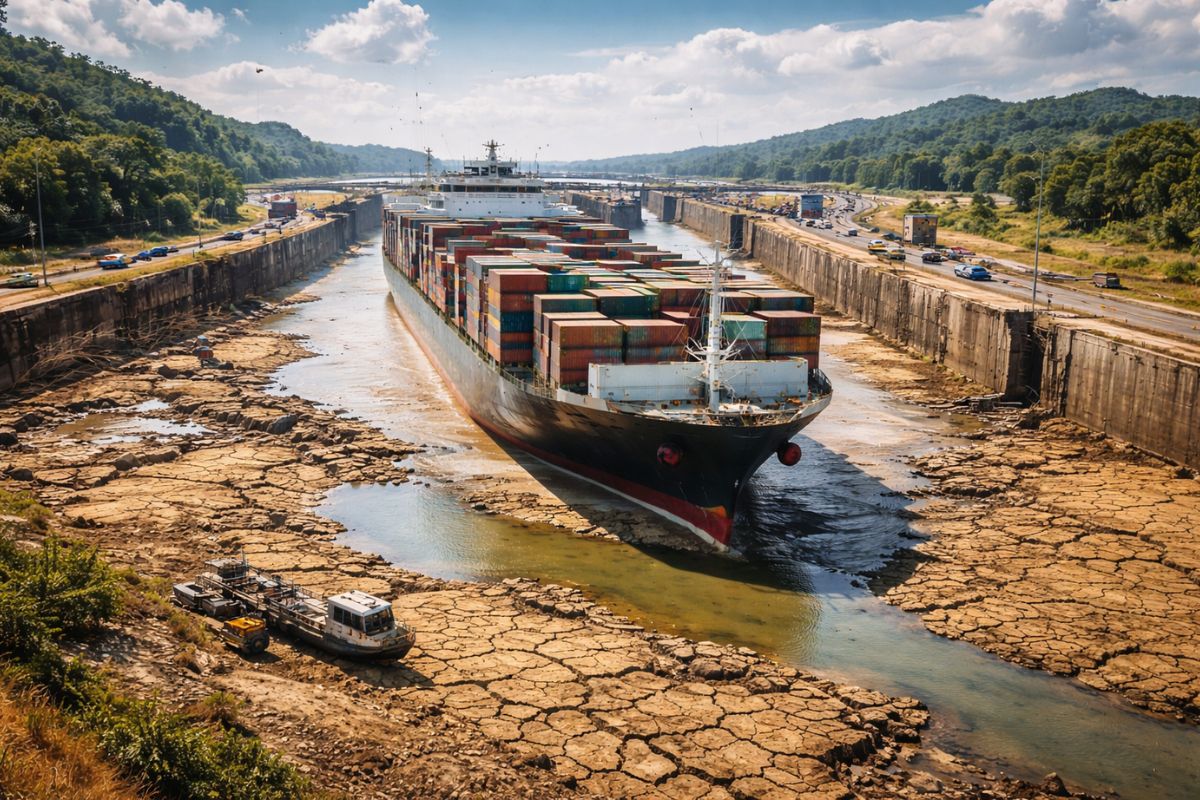


With The Panama Canal Operating At The Limit After Historic Drought, Global Maritime Trade Faces Queues As Interoceanic Corridors, From The Nicaragua Canal To The Dry Canal In Mexico, Come To The Forefront Of Global Debate.
From above, Central America looks almost like it’s about to split. A strip of land separates two giant oceans and, embedded in this isthmus, an artificial cut connects the Atlantic and the Pacific. These 82 kilometers of the Panama Canal have become a global artery of the economy, but today they suffer from the combination of aging infrastructure and climate change. As Gatun Lake shrinks, queues of ships grow, billions are left idle, and the rest of the continent begins to wonder how much longer it can depend on a single bottleneck.
At the same time, alternative corridors are emerging or re-emerging, some only on paper, others with symbolic works. From giant canals in Nicaragua to “dry canals” on tracks in Mexico, the world is testing possibilities to relieve pressure on the Panama Canal without repeating historical mistakes of human cost, environmental impact, and political instability.
The Nightmare Before The Panama Canal

Before the Panama Canal, crossing between the Atlantic and the Pacific was a logistical nightmare. A ship leaving New York for San Francisco had to go down to the southern tip of South America, round Cape Horn, and endure more than 22,000 kilometers of travel through difficult seas, with weeks of delays and constant risk.
-
The government requests the Federal Revenue Service for a new system to automate the income tax declaration, reducing errors, time, and bureaucracy for millions of Brazilians.

-
Pix in installments, international Pix, and contactless payment without internet: the Central Bank revealed the new features coming to the tool that is already used by almost every adult in Brazil.

-
Mercado Livre has just started selling medications with delivery in up to three hours to your door, and this move could completely change the way Brazilians buy medicines on a daily basis.

-
In Dubai, rising tensions from the war in the Middle East are causing super-rich individuals to leave the Gulf and direct their fortunes to a new financial refuge in Asia.


Another option was even more laborious. Goods were unloaded on the coast, crossed the isthmus overland, on mules or makeshift trucks, before being reloaded on the other side.
The map made an obvious bottleneck visible: a narrow point in the Panamanian isthmus that looked like a geographic lock waiting to be opened.
The Green Hell Of The First French Attempt
In 1880, France tried to own the key to that lock. Led by Ferdinand de Lesseps, the same engineer responsible for the Suez Canal, the endeavor towards the Panama Canal was sold as the next great feat of world engineering. In practice, it turned into a financial and human collapse.
The French faced what they called “green hell”: closed jungles, torrential rains, unstable terrain, and tropical diseases like yellow fever and malaria.
More than 22,000 workers died on the job, a gigantic human cost that ultimately buried the project along with the muddy construction sites. Without adequate sanitary solutions and lacking technology to cope with the environment, the initiative was abandoned.
American Dominance, Inauguration And Transformation Of Global Trade
Only in the early 20th century, with American control over the canal zone, did the works return in a structured manner. In 1914, the Panama Canal was finally inaugurated, connecting the oceans with locks and a lake system that changed global trade.
Today, about 4% of all global maritime trade passes through the canal and more than 14,000 ships cross its locks every year, transporting around 270 billion dollars in goods.
For the United States, the Panama Canal is vital: a significant portion of its exports and imports use this route, and about three-quarters of the ships that cross the canal go to or come from American ports.
In geopolitical terms, controlling or influencing the Panama Canal means having power over the flow of grains, fuels, minerals, and manufactured goods, a sort of physical tap of the global economy.
The Achilles’ Heel Of The Panama Canal: Water
All this importance rests on a fragile point. The operation of the Panama Canal depends on fresh water in enormous quantities, especially from Gatun Lake, replenished by rain.
Each crossing consumes millions of liters in a lock system that raises and lowers ships between different levels.
In 2023, a historic drought lowered the lake level by more than 1.5 meters, forcing a limit on daily crossings and reducing the authorized draft of ships. Less water meant fewer ships, more delays, and billions in losses for companies and governments.
At the same time, age takes its toll. Even with expansions, many structures are over a century old.
Minor accidents, such as collisions in the locks and mechanical failures, become more frequent in a scenario where ships are growing in size while the canal copes with physical and climatic limitations.
When the world sees such an important artery of global trade at the mercy of rain, the reaction is almost automatic: to look at the map and seek alternatives to the Panama Canal.
Nicaragua: The Giant Canal That Never Left The Paper

Nicaragua is historically the main candidate to rival the Panama Canal. Since the 19th century, the country has appeared in debates in the United States as a route option between the oceans and almost was chosen before Panama, until the French lobby weighed in on the decision.
More than a century later, the idea returned with force. In 2013, the Nicaraguan government signed an agreement with a Chinese company to build a canal about 270 kilometers long, wider and deeper than the Panama Canal, with an estimated cost between 50 and 60 billion dollars, something over four times the country’s GDP.
The promise was to transform Nicaragua into a new axis of global trade, with a canal capable of receiving ships even larger than those of Panama.
But the project was surrounded by international distrust, intense environmental criticism, and protests from communities that would be displaced. There was a lack of financial transparency and doubts remained about its real feasibility.
The works did not progress beyond a symbolic ditch and, years later, the concession was officially canceled. The “Nicaragua Canal” returned to the drawer, at least for now.
Mexico: The “Dry Canal” That Bets On The Tracks

Mexico chose another strategy. Instead of digging a competing water canal to the Panama Canal, it bets on a “dry canal” in the Isthmus of Tehuantepec. The idea is to modernize railways to carry containers between one port in the Gulf of Mexico and another on the Pacific in a journey of just over 300 kilometers.
In practice, the Mexican interoceanic corridor works like a land bridge: ships unload on one side, cargo crosses the isthmus by rail, and is reloaded on the other side. It’s cheaper and faster to implement than a maritime canal, and it requires less heavy environmental intervention, although it doesn’t have the same continuous flow capacity as a waterway.
The Mexican government talks about integrating this corridor into special economic zones and the railway network of the United States, aiming at trade with Asia. The challenge is turning promise into stable operation, in a country that still faces infrastructure bottlenecks, community resistance, and delays in construction.
Costa Rica, Honduras, Guatemala And Colombia: Plans, Obstacles And The Green Carpet Of Darién
Viewed from above, Costa Rica seems even more promising than Panama itself, with one of the narrowest points between the Atlantic and the Pacific. But there’s no project equivalent to the Panama Canal there. The explanation mixes geography, politics, and strategy.
The country is cut by mountain ranges and active volcanoes, which would make any canal extremely expensive and risky.
Moreover, much of the territory is protected by strict environmental laws, and Costa Rica’s international image is of a green nation, without an army since 1948 and with diplomacy focused on neutrality.
A canal or large corridor would place the country at the center of geopolitical disputes and environmental pressures, contrasting with the brand the country has built.
Honduras and El Salvador have been discussing a dry interoceanic canal connecting the Pacific to the Caribbean for years, with railroads, highways, and logistics areas.
Guatemala has a planned interoceanic corridor that would cut through hundreds of kilometers connecting ports on both oceans and promises, on paper, to be even cheaper and faster than the Panama Canal for certain cargoes.
Further south, Colombia is studying routes to connect the Pacific and Caribbean within its territory. Among the ideas are railway corridors and the use of rivers with auxiliary channels.
All these plans, however, stumble upon the “green carpet” of Darién, one of the densest and ecologically sensitive tropical forests on the planet, as well as a route for irregular migration and illicit activities, which makes any intervention even more complex.
Putting all these projects side by side, the picture is clear: ambition exists, but there is a lack of money, political stability, environmental consensus, and security to bring a direct competitor to the Panama Canal to fruition.
Why The Panama Canal Still Reigns Alone

Despite the drought, age, and all competing plans, the Panama Canal continues to reign almost alone. It already exists, works, has consolidated infrastructure, and is under relatively stable political control.
While other countries struggle with studies, concessions, and protests, the Panama Canal continues to receive ships every day.
Still, the multiplication of proposals is a strong sign: the dependence on a single canal is seen as a risk and, sooner or later, the world will seek redundancies so as not to be held hostage by a single bottleneck between two oceans.
In 2016, Panama completed one of the largest expansions in its history, with new locks that are wider and deeper, capable of accommodating Neopanamax ships with up to 14,000 containers of capacity. This increased competitiveness and attracted routes that previously could not use the canal.
But water remains the Achilles’ heel. The new system included 18 reservoirs to reuse up to 60% of the water used in the locks, an important advancement, but insufficient in scenarios of extreme drought like that of 2023.
Proposals being studied include new dams, such as on the Índio River, and even cloud-seeding techniques to induce rain, an experimental solution that can be a temporary relief or a shot in the dark.
Climate, Geopolitics And Myths Around The Panama Canal
Beyond engineering and water, there’s the political and symbolic dispute. The Panama Canal is central to the geopolitical chessboard. To control or influence it is to have power over entire supply chains.
This relevance fuels exaggerated narratives. In 2020, the rumor circulated that China had “taken” the Panama Canal. In reality, Chinese companies operate port terminals in the country, but canal management remains Panamanian.
The story went viral because it fits into narratives of fear or rivalry between powers, even if it doesn’t match the facts.
Meanwhile, the canal tries to position itself as a reference in sustainability, with programs that encourage ships to reduce emissions and initiatives to preserve natural areas that feed its reservoirs.
The challenge is to balance this agenda with the need to maintain cargo flow amid a more unstable climate and increasing economic pressures.
Ultimately, the Panama Canal remains a monument to human capacity to reshape the economic map of the world, but also a reminder of how large works can become vulnerable to factors as simple as rain.
The future of this route will depend on decisions about infrastructure, the environment, and international cooperation, more than on geopolitical myths or miraculous promises of new canals.
What do you think, will the Panama Canal still be able to bear the weight of global trade alone for a long time or is it just a matter of time before one of these alternative corridors finally gets off the paper?








…vai reinar sozinho durante décadas ainda….