





 Portuguese
  English
  Spanish
  4 min of reading
  0 comments


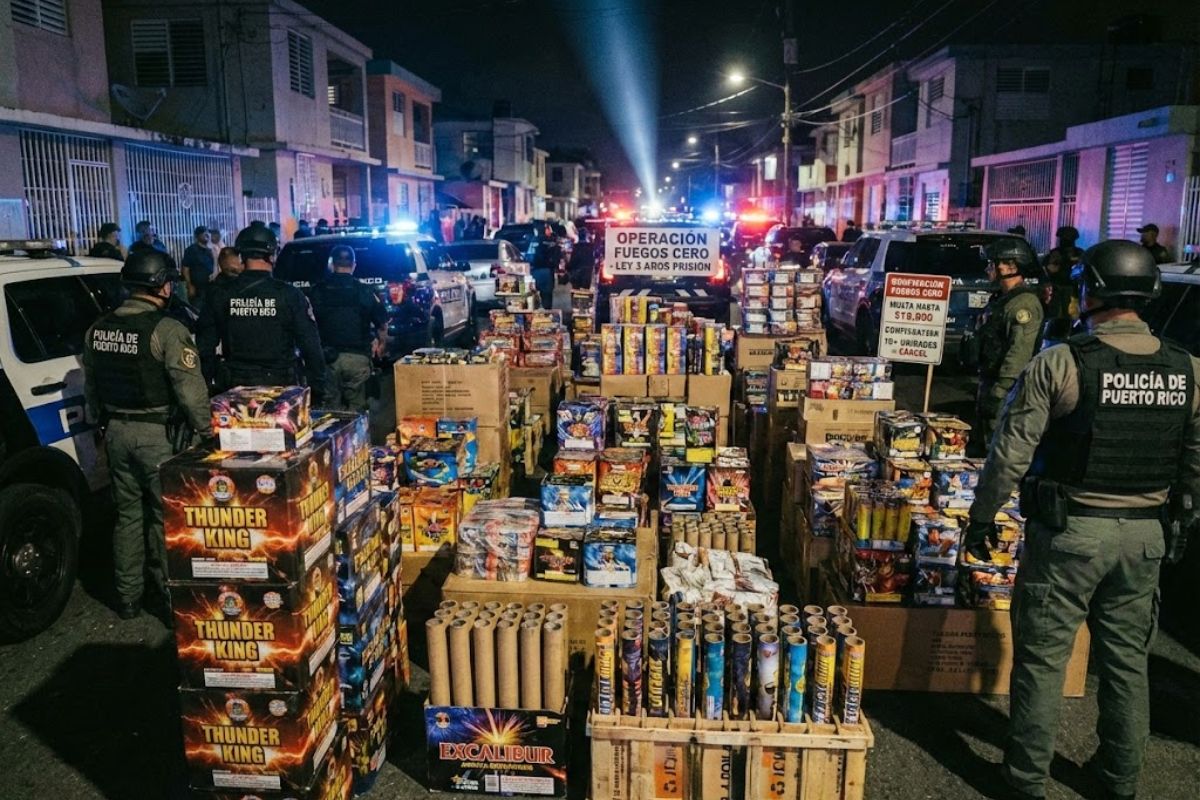
With The New Fireworks Law, Puerto Rico Tightens Control: Up To Ten Units Lead To Detention And Fines, But Those Caught With A Larger Quantity May Face Three Years In Prison And Penalties Of Up To Fifty-Four Thousand Reais, In Cases Considered More Serious By Local Justice.
Puerto Rico has tightened the grip on fireworks by approving Senate Bill 36, which updates the old Fireworks Law of 1963 to align it with the Penal Code of 2012. Governor Jenniffer González Colón recently signed the change, paving the way for much harsher penalties for illegal possession of these items.
With the new wording, possessing up to ten units is now treated as a misdemeanor, subject to up to six months in prison, a fine of up to 5,000 dollars, about 27 thousand reais, or both sanctions. Above this limit, the infraction is considered serious, with a fixed penalty of three years in prison and the possibility of a fine of up to 10,000 dollars, approximately 54 thousand reais.
What Changes With The New Fireworks Law In Puerto Rico
The enacted legislation broadly modifies the so-called Fireworks Law of the country, which was outdated in relation to the Penal Code of 2012.
-
The noise law will no longer be in effect at 10 PM starting in June with a new rule valid during the 2026 World Cup.

-
The Chamber opens a debate on driver’s licenses at 16 years old as part of a reform that includes around 270 proposals to change the Brazilian Traffic Code and may redesign rules for licensing, enforcement, and circulation in the country.

-
The new Civil Code could revolutionize marriages in Brazil with “express divorce” and changes that could exclude spouses from inheritance.
-
Banco do Brasil sues famous influencer for million-dollar debt and intensifies debate on delinquency, risks of seizure, and direct impact on Gkay’s credibility.


The official intention is to facilitate the application of sanctions and provide more clarity on what is considered a misdemeanor or a serious crime regarding the possession of fireworks.
According to the text, the update aims to correct loopholes left by the law created in 1963, which no longer aligned with current parameters of punishment and rehabilitation set in the penal system.
As a result, security and justice authorities now have more objective rules to classify those who circulate with these products.
Up To Ten Units Of Fireworks: Misdemeanor With Fine And Detention
According to the new law, possession of up to ten units of fireworks is classified as a misdemeanor.
In these cases, the judge may impose up to six months in prison, a fine of up to 5,000 dollars, equivalent to about 27 thousand reais, or combine both penalties, depending on the severity of the analyzed case.
The regulation also clarifies what counts as “unit.” Each pyrotechnic device packaged for retail sale, even if it contains multiple items integrated within the same packaging, is treated as a single unit.
This definition seeks to avoid confusion in counting and reduce the argument that the product is merely a fractional set, primarily used during festivities.
Consequently, small purchases of fireworks typical for parties remain possible, but the holder assumes the risk of facing a misdemeanor if caught in a situation deemed dangerous or irregular by authorities.
More Than Ten Units: Serious Crime With A Penalty Of Three Years In Prison
When the quantity of fireworks exceeds ten units, the law treats the case as a serious infraction.
In this condition, possessing more than ten units of fireworks is automatically considered a serious offense, with no room for a more lenient interpretation in classifying the crime.
The penalty is much heavier: the sentence is fixed at three years in prison, which may be added to a fine of up to 10,000 dollars, approximately 54 thousand reais.
The objective is to discourage the accumulation of large quantities of pyrotechnic devices, which may pose a significant risk to public safety if stored or sold without proper control.
In practice, anyone caught with a large stock of fireworks may face not only a more serious criminal process but also a harsh financial penalty, intended to deter irregular activities and illegal trade.
Who Proposed The Change And Why The Law Was Updated
The new regulation on fireworks was proposed by the Senate President, Thomas Rivera Schatz, with co-authorship from senators Brenda Pérez, Jeison Rosa, Wilmer Reyes, and Karen Román.
The group argued that the existing law, from 1963, no longer aligned with the current sanctioning model set in the Penal Code of 2012.
For the legislators, it was necessary to adjust the rules so that the penalties were more consistent and compatible with modern reality, with a greater focus on rehabilitation and social reintegration for those convicted.
Clarity in the limits of fireworks quantities and the prescribed penalties should also facilitate the work of the police, the Public Ministry, and judges in framing and judging cases.
The expectation is that the combination of prison and high fines helps reduce the irregular use of pyrotechnic devices, minimizing the risks of accidents, fires, and disturbances in residential areas.
In your view, do such rigid penalties for the possession of fireworks help or overreach in controlling this type of product?










-

Uma pessoa reagiu a isso.