





 Portuguese
  English
  Spanish
  2 min of reading
  0 comments


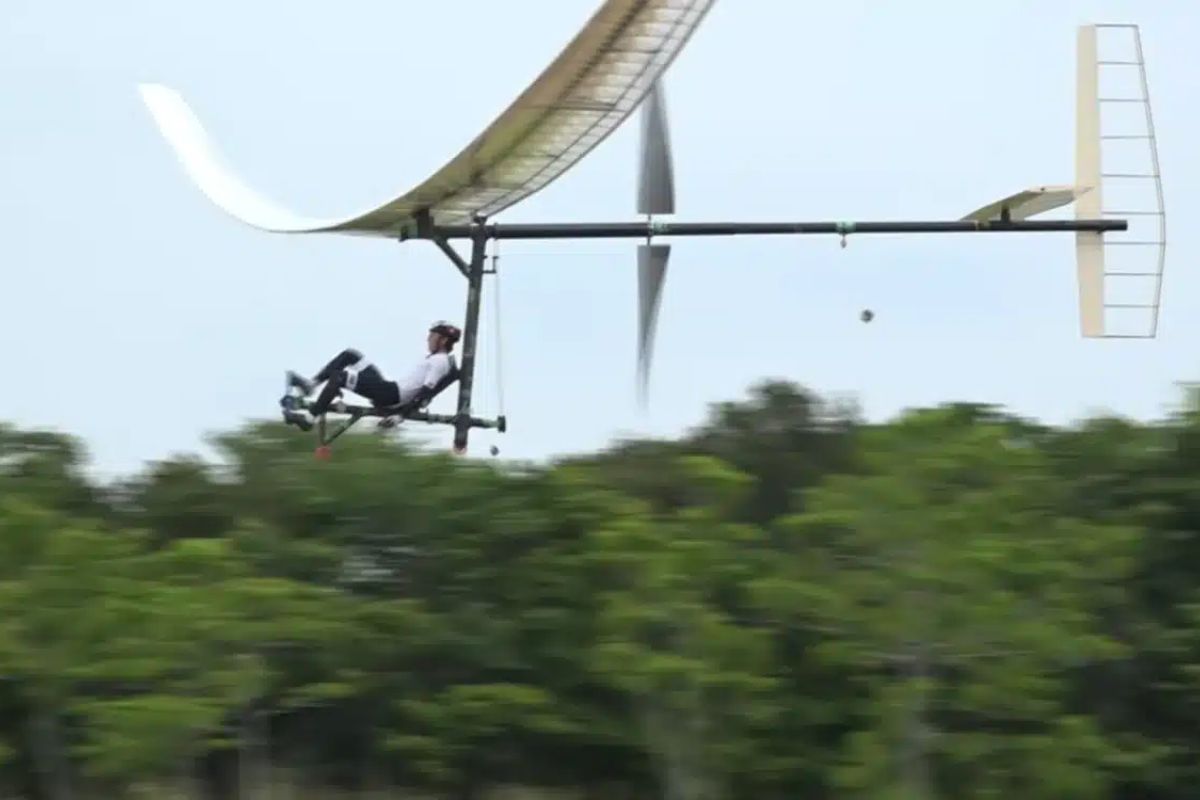
Prototype “Tsurugi” Covered Almost 19 Km Using Only Human Power, Without Engine or Fuel
A team of students from Osaka Public University, in Japan, introduced to the world the flying bicycle “Tsurugi”, powered exclusively by the pilot’s leg strength. The experimental aircraft, built with ultra-lightweight materials and aerodynamic design, made its debut at the traditional Birdman Rally, an event that brings together inventors and engineers to test human-powered vehicles.
In the test, the prototype covered almost 19 kilometers without any type of engine, using only the energy generated by the pedals. The achievement not only surprised the audience and the judges but also reinforced the viability of sustainable projects in the aerospace sector, especially in short-distance personal transport.
What Makes the “Tsurugi” Different from Other Inventions
The “Tsurugi” was designed to combine mechanical efficiency and low structural weight, allowing the force applied by the pilot to be converted into enough energy to maintain flight. The use of carbon fiber and other lightweight composites helped reduce drag and increase the aircraft’s range.
-
Motorola launched the Signature with a gold seal from DxOMark, tying with the iPhone 17 Pro in camera performance, Snapdragon 8 Gen 5 that surpassed 3 million in benchmarks, and a zoom that impresses even at night.

-
Satellites reveal beneath the Sahara a giant river buried for thousands of kilometers: study shows that the largest hot desert on the planet was once traversed by a river system comparable to the largest on Earth.

-
Scientists have captured something never seen in space: newly born stars are creating gigantic rings of light a thousand times larger than the distance between the Earth and the Sun, and this changes everything we knew about stellar birth.

-
Geologists find traces of a continent that disappeared 155 million years ago after separating from Australia and reveal that it did not sink, but broke into fragments scattered across Southeast Asia.

According to the developers, the initial goal was not to create an immediate commercial product, but to explore the limits of human-powered engineering. The performance exceeding expectations indicates that similar technologies could evolve into practical applications, from recreational transport to monitoring missions in hard-to-access areas.
The Importance of the Birdman Rally for Aerial Innovation
The Birdman Rally, held annually in Japan, is considered one of the most important events in the world for the experimentation of human-powered vehicles. It features teams from universities and companies presenting creative solutions to the challenge of keeping aircraft in the air with minimal energy.
It was in this setting that the “Tsurugi” stood out, not only for the distance covered but also for the stability and safety demonstrated during flight. The performance exceeded expectations and placed the Osaka team among the most promising in the development of sustainable aircraft.
The Potential of the Flying Bicycle in the Future

Environmental engineering experts claim that the success of the “Tsurugi” could open doors to a new segment of personal air mobility. Although still impractical for mass urban use, the technology could inspire hybrid or electric motor-assisted solutions, maintaining a low environmental impact.
Furthermore, the simplicity of the concept and the possibility of small-scale production make the project appealing for specific niches, such as adventure tourism, extreme sports, and engineering competitions.
And what do you think, can the pedal-powered flying bicycle become a viable means of transportation in the future? Or will it remain limited to competitions and demonstrations? Share your opinion in the comments.








Seja o primeiro a reagir!